Gov’t slashes cigarette prices after illicit trade nets billions for a few
23 ޖޫން 2026 | އަންގާރަ 12:43The government is slashing cigarette taxes just weeks after a massive hike led to a 90 percent drop in legal imports and a booming black market. Despite initial claims that the price surge was a public health measure, officials are now halving duties to combat rampant smuggling. This sudden policy reversal has sparked public cynicism and accusations that the administration failed to conduct proper research before implementing the failed strategy.

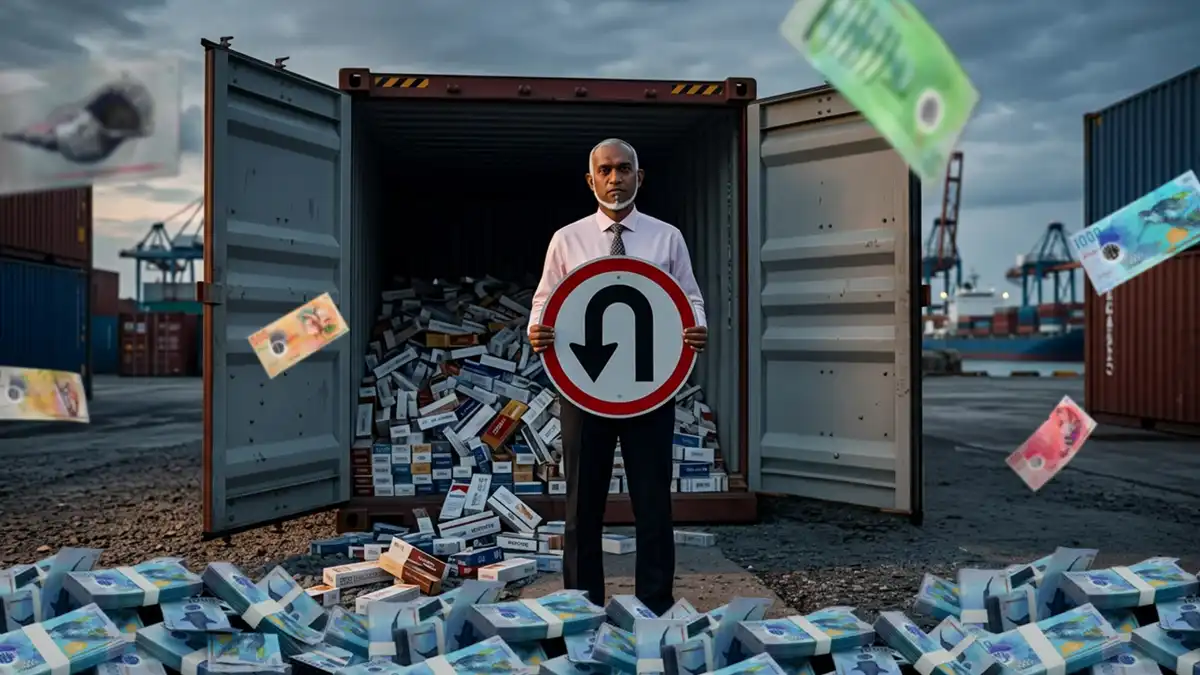
Despite President Muizzu’s recent assertion that there would be no "U-turn" on tobacco duties, the government has decided to significantly reduce cigarette prices. | Raajjemv graphics
It turns out that the grand, heroic crusade against smoking in the Maldives was nothing more than a short-lived illusion.
After imposing a historic, staggering spike in cigarette taxes under the noble guise of saving lives and shrinking the state's medical bills, the administration has abruptly thrown in the towel.
This whiplash-inducing policy reversal follows heavy accusations that the initial tax surge did little more than line the pockets of black-market smugglers with unimaginable wealth.
Naturally, the sudden retreat has left the public deeply cynical about whether the government ever actually cared about anyone's health in the first place.
Math behind the mirage
To understand the sheer scale of this flip-flop, one has to look back at the dramatic legislative shift that started it all.
Following a swift tweak to the Maldives Export-Import Act, the duty slapped on every single cigarette stick skyrocketed from MVR 3.50 to a whopping MVR 8.00, starting 1 November 2024.
If that wasn't aggressive enough, the ad valorem tax rate was simultaneously doubled from 50 percent to 100 percent. Almost overnight, a standard pack of cigarettes that used to cost smokers MVR 100 blasted past the roof to hit nearly MVR 300.
Back then, officials proudly championed this financial squeeze as an essential weapon to protect citizens from deadly cancers and heart disease, while conveniently saving money for the state-funded Aasandha universal healthcare scheme.
Smugglers secure the ultimate windfall
Unsurprisingly to anyone living in the real world, the massive tax spike instantly birthed a booming underground black market.
Smugglers capitalized on the soaring prices immediately, pocketing billions of MVR in illegal profits. Even though Customs officials managed to intercept millions of smuggled sticks, legitimate, tax-paying tobacco imports crashed by a staggering 90 percent.
However, the actual number of smokers on the ground did not seem to budge at all. Instead of quitting, tobacco users simply migrated online, with illegal, untaxed cigarettes being traded entirely out in the open across various social media networks.
Blaming the WHO for government woes
The cracks in the official narrative have become impossible to ignore, especially after some highly questionable commentary from the Minister of Homeland Security, Ali Ihusaan.
The minister recently revealed that the state is now actively scrambling to chop the current stick duty in half, dragging it down from MVR 8.00 back to MVR 4.00.
In an attempt to justify the retreat, the minister insisted that this price drop perfectly aligns with guidelines provided by the World Health Organization (WHO).
The only problem is that the international health body has released absolutely no such recommendation.
Broken promises of the state
This frantic backtracking is particularly embarrassing given that earlier this very month, President Dr. Mohamed Muizzu boldly promised the public that his administration would never execute a U-turn on its aggressive tobacco tax strategy. But reality quickly caught up.
Facing an utter inability to stop black-market smuggling and watching state revenue bleed out, the administration completely discarded its fierce commitment and quietly tossed a new proposal to the People’s Majlis to force prices back down.
Health takes a backseat to profit
Critics and onlookers are calling out these wild, uncalculated price swings, pointing out that they were pushed through without any real research and served as a perfect goldmine for illicit syndicates.
The overwhelming worry now is that these chaotic policy shifts are intentionally designed to maximize the wealth of a privileged few rather than protecting local communities.
The dominant consensus among citizens suggests that the president's initial, sudden price spike was a calculated maneuver specifically designed to hand a lucrative smuggling opportunity to certain connected groups.
For many Maldivians, the fact that the government is now gutting the very prices it repeatedly defended is undeniable proof that the state's supposed war on smoking was never genuine.