Muizzu freezes out very kingmakers who built his throne
12 ޖޫން 2026 | ހުކުރު 08:46The current administration is systematically consolidating power by purging influential political figures and exerting absolute control over the judiciary and legislature. This heavy-handed governance extends to the public sector, where workers face job losses and retaliation for any perceived dissent or opposition ties. Despite this climate of fear and economic instability, growing public defiance suggests an inevitable backlash against these restrictive measures.

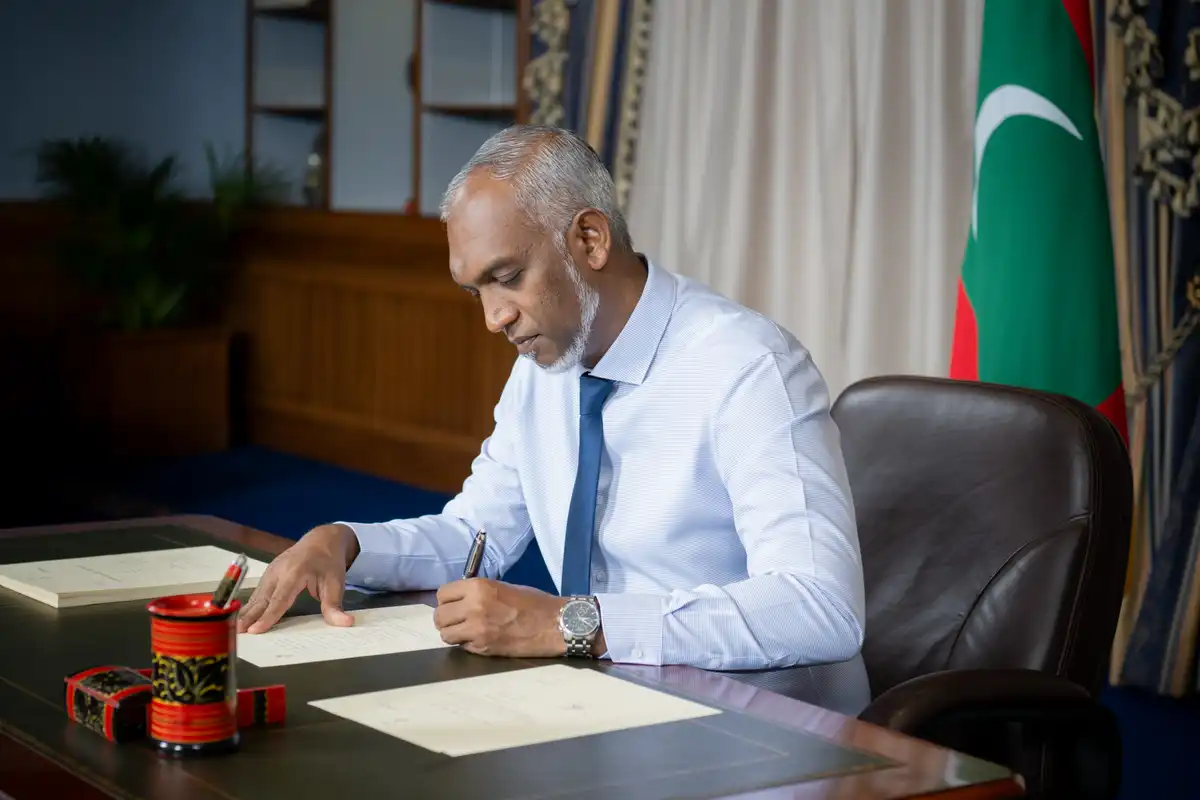
President Dr. Mohamed Muizzu ratifying an amendment to a law. | President's Office
The systematic dismantling of independence started at the very top of the ruling party's hierarchy, orchestrated by the precise individuals who engineered the political arrangements that elevated the leader to power.
The initial target of this marginalization was an influential political heavyweight, Abdul Raheem Abdulla, the exact man who guaranteed the leader’s ticket and personally managed the submission of his official candidacy documents to the Elections Commission of Maldives.
In a sudden, overnight maneuver lacking any conventional ceremony, Abdul Raheem's son was stripped of his ministerial position. Following that, Abdul Raheem’s own political leverage was deliberately squeezed, isolating him to a heavily restricted capacity where his perspective is no longer permitted to carry any real weight.
Major policy shifts and official duties were stripped from his purview without a single moment of prior discussion.
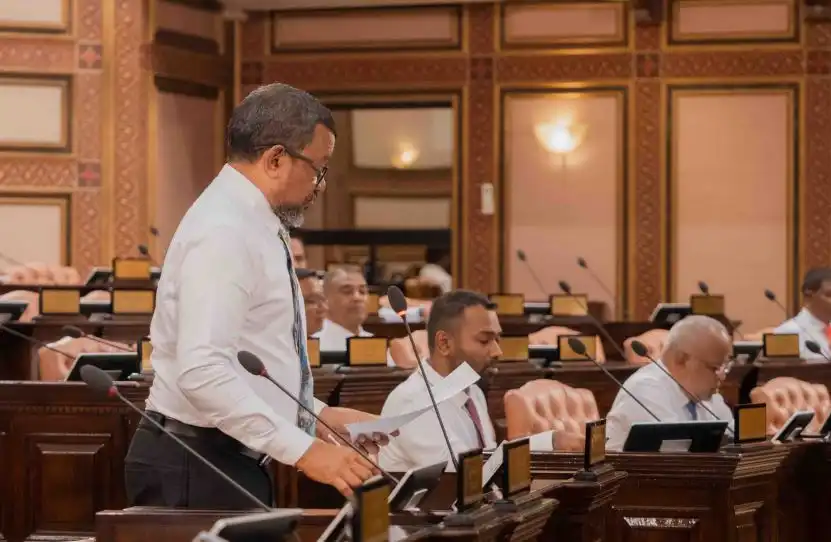
No representative is safe from the parliamentary purge
The pattern of retaliation quickly trickled down to other key figures, resulting in the dismissal of parliamentarian Asma's children from their respective government posts. Along with losing her family's positions, she was stripped of her legislative committee chairmanships and pushed so far to the political margins that even her hold on her parliamentary seat appeared highly vulnerable.
Similarly, lawmaker Azaan found himself squarely in the crosshairs after offering minor critiques and formally introducing a matter for parliamentary review. For this brief display of autonomous thinking, he was stripped of his access to the party's primary communication groups and aggressively minimized until he fell back into compliance.
The former Deputy Speaker of the People’s Majlis experienced a similar fate, finding himself completely removed from his leadership post. While the general populace remains entirely in the dark regarding any actual misconduct on his part, an unexpected accusation materialized overnight, and he was cast out of his role with zero hesitation.
Bureaucracy and state enterprises reduced to a game of musical chairs
The list of these high-handed actions stretches incredibly far. As the current governing term moves forward, virtually no single ministry has been spared from these intrusive, three-tiered administrative meddlings.
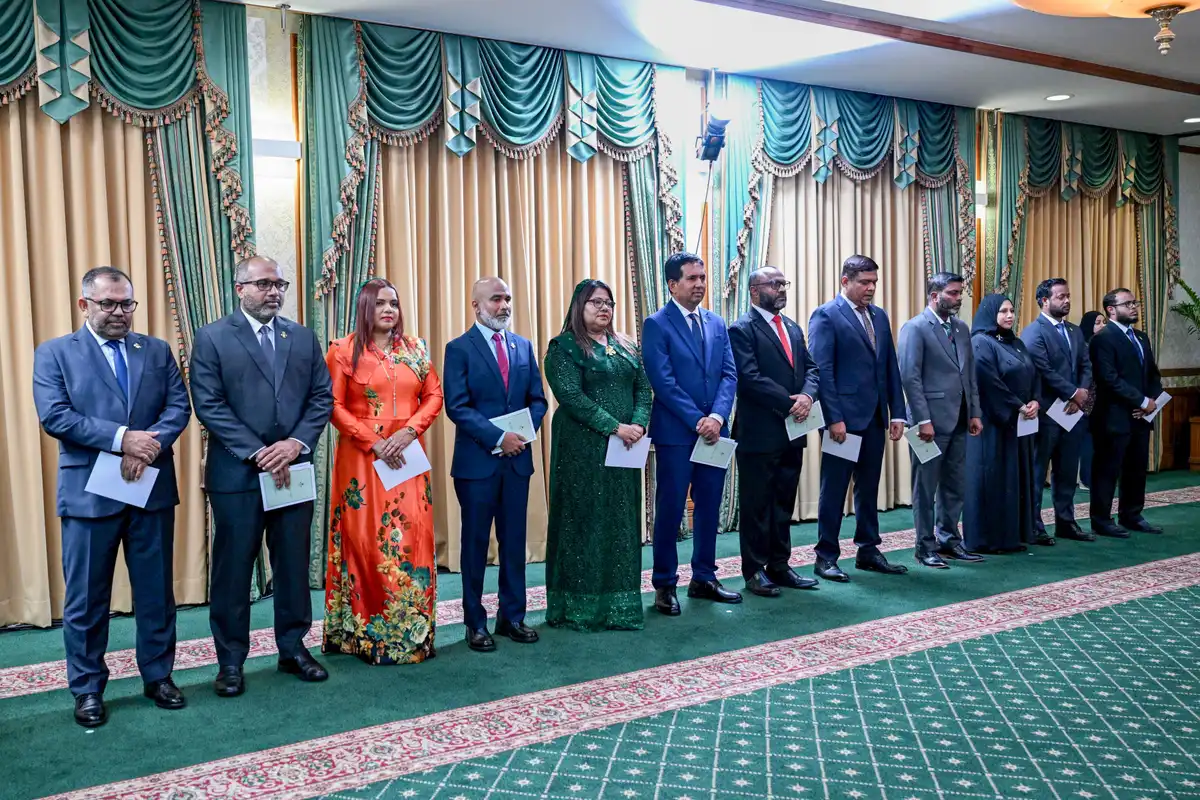
Cabinet ministers are being shifted around like mere tokens on a game board, pressured into hand-delivering their resignations or facing instantaneous termination.
The situation is significantly more chaotic for the Managing Directors and Deputy Managing Directors tasked with running state-owned enterprises, where leadership overhauls occur with the relentless frequency of daily medical prescriptions.
Professionals are hired and thrown away with such velocity that they are effectively treated as single-use items.
Rigging the game and seizing the leash of power
This heavy-handed interference corrupted the democratic process itself during the election cycle.
The application forms of specific candidates were arbitrarily tossed out, while other individuals who had legitimately triumphed in their party primaries saw their hard-won endorsement tickets stripped away.
In electoral districts where a favored personal ally of the leadership chose to run as an independent, the officially endorsed party candidate was coerced into withdrawing from the race to clear a path for them.
Beyond these internal party machinations, the constant turnover within the top ranks of the police force, combined with calculated tactical maneuvers inside the Judicial Service Commission, offer further evidence of a total consolidation of authority.
This entire framework of absolute control began by dominating the very lawmakers who were voted in by the citizens.
By gaining complete mastery over these legislators, the incumbent firmly holds the leash of a political trap that these very representatives helped construct for themselves, providing him with a specialized mechanism to intensify the pressure on any individual whenever he chooses.
Hardworking citizens and desperate youth trapped in an economic mirage
This suffocating atmosphere has officially expanded beyond political circles to crush the general public.
Pervasive delays are now plaguing the hard-earned wage payments of the frontline laborers at WAMCO, who represent some of the most industrious citizens in the country.
Adding to this financial injury, their mandated pension contributions have allegedly been withheld from the Pension Office for a span of nearly two years.
Any worker who has possessed the courage to speak up or sign formal petitions protesting this flagrant injustice has been hit with immediate disciplinary measures, official warnings, temporary suspensions and outright firings.
Simultaneously, the individuals brought on board during the heat of the political campaign, alongside the local youth who were enticed with promises of secure employment, are trapped in a state of unceasing vulnerability.
While a portion of these workers face immediate layoffs, others are kept cataloged on specialized rosters that strip away their liberty to move freely or speak their minds.
The young people who were seduced by the grand illusion of stable jobs find themselves entirely stranded inside a political mirage.
The new era of total retaliation and the certainty of backlash
An even more aggressive, punitive phase of governance has now materialized, characterized by the systematic targeting of anyone even remotely linked to opposition politics.
A public worker was reportedly fired from his job for the simple offense of snapping a photograph alongside Abdulla Sodiq during the recent electoral period.
Government personnel who traveled to the airport to participate in the welcome reception for former president Mohamed Nasheed were met with immediate job suspensions.
Even the husband of a woman who merely sang a song for Nasheed’s political campaign was subjected to equivalent professional retaliation.
In plain terms, the space required to live a free life has been totally blocked for any citizen residing within the operational grasp of the current administration.
A deep and calculated fear has been injected into society, sending a message that any form of disagreement will trigger the immediate destruction of one's livelihood and the forced uprooting of one's entire family.
While the population may not be locked away in physical cells, they are thoroughly bound by sophisticated and contemporary shackles.
However, if historical precedents teach us anything, it is that this brand of absolute subjugation cannot be sustained forever.
The citizenry will inevitably rise up to discard these heavy restraints. They will smash the locking mechanisms of these contemporary bonds and render them entirely useless, a brewing public defiance that is already reflecting clearly in the voting outcomes of recent elections.