Awarding Thilafushi Port to China a Matter of Concern for India: Report
6 ސެޕްޓެމްބަރު 2026 | އާދީއްތަ 11:33India's concerns regarding China's expanding economic and logistical influence in the Indian Ocean have intensified following the awarding of the Thilafushi Port development's first phase to China Harbour Engineering Company (CHEC). As this project was previously intended to be undertaken with Indian cooperation, the shift highlights a growing regional rivalry manifesting through strategic infrastructure development.
Work is underway on the first phase of the Thilafushi port development project. | Economic Ministry
Indian media reports indicate that the Maldivian government's decision to award the first phase of the Thilafushi Port project to a Chinese company is a matter of concern for India.
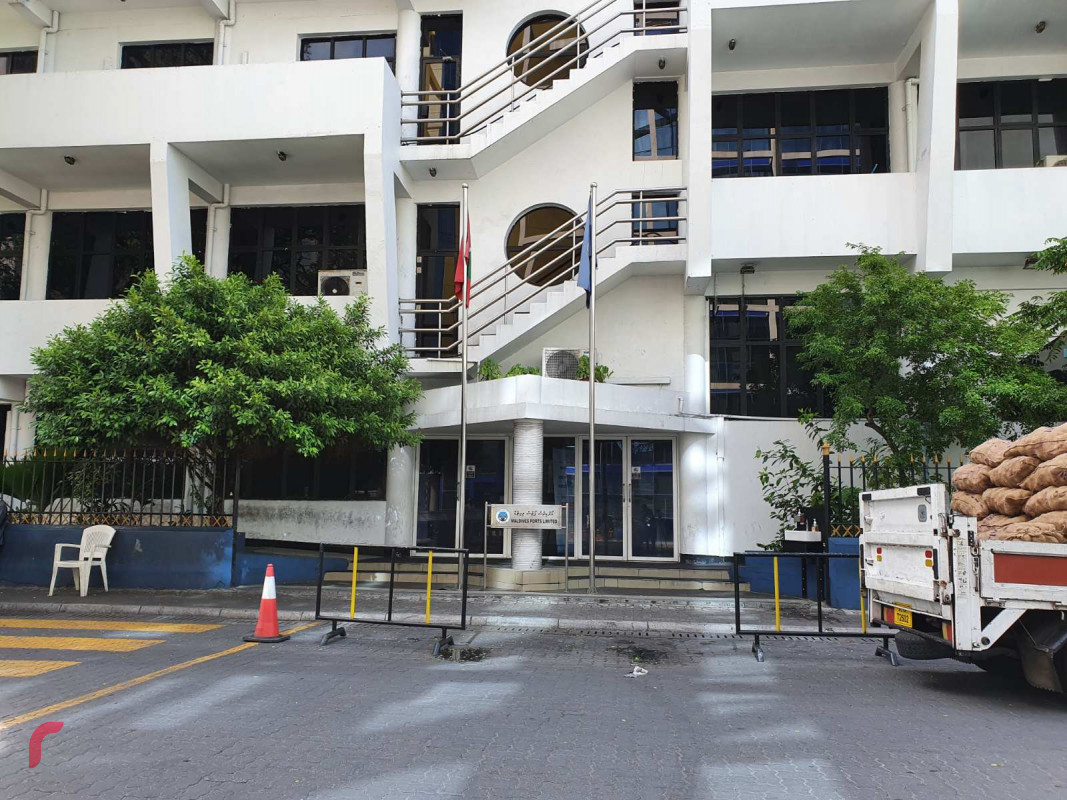
Maldives Ports Limited (MPL) has signed an agreement with China Harbour Engineering Company (CHEC) for the first phase of the project to relocate the Male' Commercial Port to Thilafushi. It was noted that this decision follows the abandonment of a previous agreement with India to jointly develop this port.
Under the agreement signed at a ceremony held at the MPL Head Office by the company's Chief Executive Officer Mohamed Rishwan and CHEC Country Manager Mao Bao, the design and quay wall construction of the port have been entrusted to China's CHEC. However, certain components of the project, including a 100-meter quay wall and paving works on a three-hectare area, have been awarded to the Maldives Transport and Contracting Company (MTCC) under a separate agreement.
A report published in "Outlook India" stated that this port is not merely a commercial infrastructure. Thilafushi is being developed as the Maldives' primary international maritime hub. It mentioned that this includes container and bulk cargo facilities, domestic cargo handling, warehousing, logistics, and an export processing zone for small industries.
Upon completion, the port's size will expand from five hectares to 20 hectares. Furthermore, a 650-meter quay wall, a 125-meter jetty, a bonded warehouse, and an X-ray facility will be established. This is expected to reduce the current goods clearance time from five to six days down to 48 hours.
The newspaper stated that India's strategic concerns are linked to Thilafushi's location. Situated in the central Indian Ocean, it is near Male' and intersects major international maritime routes.
The report further noted that while Chinese involvement does not directly imply the site will become a military base, China's control over a strategically significant commercial port would strengthen Beijing's economic and logistical influence in India’s maritime neighborhood.
It added that this is not the first time China has established a footprint in the Maldives. CHEC constructed the Sinamale' Bridge connecting Male' and Hulhumale'. Additionally, in 2023, the company commenced reclamation of 150 hectares of land for Thilafushi Phase II under the Housing Development Corporation (HDC).
The publication emphasized that the timing of these works heightens concerns, particularly as India has made significant investments in the Maldives. Most notable among these is the Greater Male' Connectivity Project (GMCP), which connects Male' with the industrial island of Thilafushi.
It was noted as a surprise for India that after assisting in the establishment of the transport network required to make Thilafushi a key hub, the port works were awarded to a Chinese contractor.
The Thilafushi project is designed to bring port services, logistics, warehousing, re-export, and small industries under one roof. This implies that with Chinese involvement, Chinese companies will gain a logistical and commercial hub near Indian waters, facilitating the distribution of Chinese goods and equipment to Indian Ocean nations.
The report suggested that India’s response should be to view this project not solely through a military lens but as a prompt to further expand regional supply chains. Indian manufacturers seeking markets in Africa, West Asia, and island nations will require their own networks for cost-effective shipping, logistics, and warehousing.
The report concluded that the decision regarding Thilafushi serves as a geopolitical signal. While it may not pose an immediate threat to Indian manufacturing or defense exports, its primary significance is that the rivalry with China is shifting from arms and diplomacy to ports, logistics, supply chains, and industrial infrastructure.