Supreme Court rules High Court was correct to exclude state's new evidence in Aarah case
1 ޖުލައި 2026 | ބުދަ 09:53The state has appealed to the Supreme Court following the High Court's decision to reject new evidence submitted in the V. Aarash case, arguing that these materials are crucial to proving falsehoods in defense testimony and that their exclusion would obstruct justice. While the defense has objected, maintaining that introducing new evidence at this stage violates established legal procedures, the criminal trial remains suspended pending a final ruling from the Supreme Court.

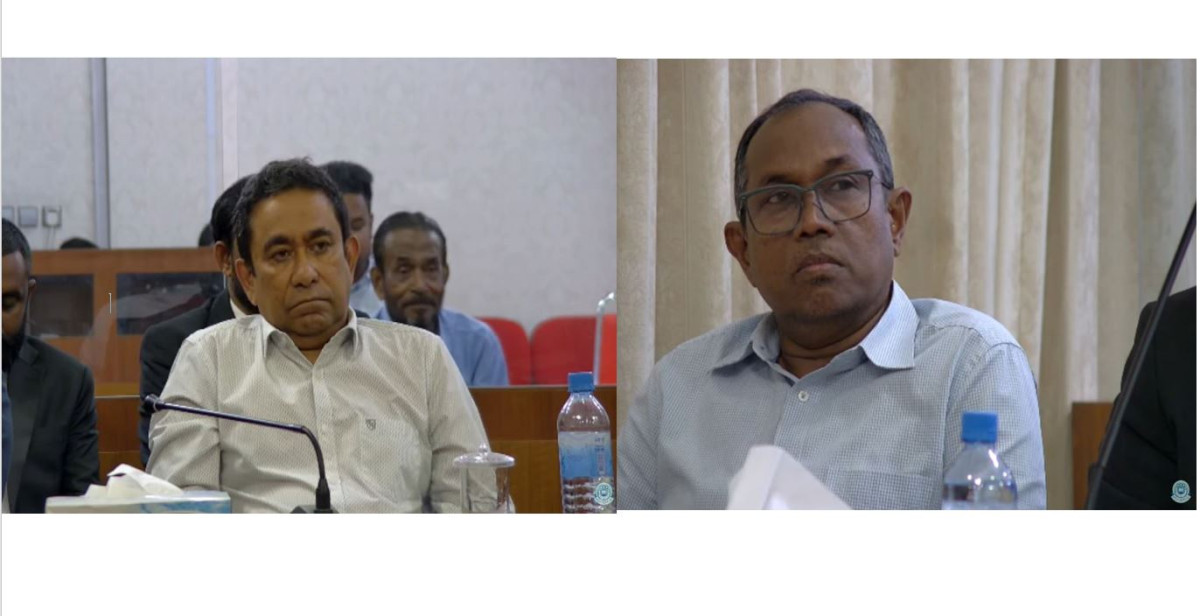
From a hearing regarding the V. Aarah case. | RaajjeMV
The Supreme Court of the Maldives has ruled that the High Court was correct in its decision to set aside certain evidence in the ongoing appeal concerning the Vaavu Atoll Aarah case.
The proceedings at the Criminal Court have been stayed pending a final decision by the Supreme Court. The Criminal Court is currently rehearing the case following a High Court ruling that overturned the 11-year prison sentence issued against former President Abdulla Yameen in 2022, ordering a retrial.
The High Court's ruling on the Aarah corruption case outlines three primary directives. These include granting a fresh opportunity to deliberate and decide on pre-trial motions, excluding the new evidence presented by the state, and setting aside the interpretation detailed in point 68 of the lower court's report for a retrial at the Criminal Court.
Among these, the State has appealed to the Supreme Court regarding the order to exclude its newly submitted evidence.
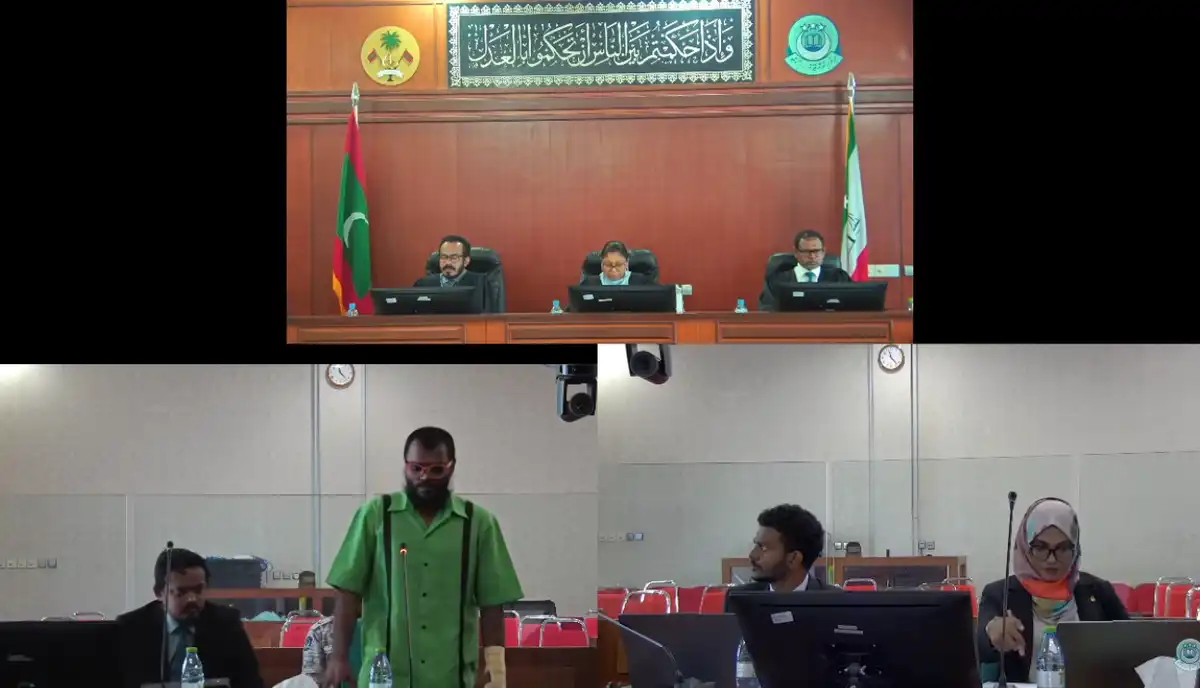
The case is being presided over by a Supreme Court bench consisting of Justice Aisha Shujune Muhammad, Justice Dr. Mohamed Ibrahim, and Justice Abdulla Hameed.
Justice Shujune’s Opinion:
The Supreme Court delivered its verdict on the matter during a hearing held on Wednesday. Justice Aisha Shujune Muhammad was the first to deliver her legal opinion.
Justice Shujune has delivered a ruling on a procedural point raised by Yameen and Yusuf Naeem, who argued that the State’s reliance on the Supreme Court’s precedent in the "Ali Zubair case" introduced an entirely new legal argument. The defense contended that this approach violates established judicial principles and fails to meet the fundamental criteria for a valid appeal.
Justice Shujune stated that the court could not support the State's argument that the High Court should have applied the principles of the Ali Zubair case on its own initiative. She further noted that previous judicial precedents establish that superior courts should not accept or rule on new arguments not presented at the lower court, except under highly exceptional circumstances. Justice Shujune emphasized that this legal principle exists for specific, substantive reasons.
Furthermore, Justice Shujune stated that even in instances where a new point is introduced for consideration, there are specific criteria that must be met. However, she noted that the State had failed to present sufficient grounds to justify such a consideration.
Justice Shujune stated that the State had the opportunity to cite the Ali Zubair case during the High Court proceedings; however, the prosecution failed to make even a minimal reference to that argument at that stage.
Consequently, Justice Shujune concluded that this appeal does not meet the necessary threshold for appellate review. Furthermore, she ruled that there are no grounds to overturn the High Court's decision.
The other two presiding judges also concurred with that opinion.
Background of the case:
Although the Supreme Court concluded hearings for this case in September last year, a significant amount of time has passed without a verdict being issued.
The evidence ordered to be excluded by the High Court in this case consists of new evidence submitted by the prosecution to rebut the testimonies provided by defense witnesses. These pieces of evidence specifically pertain to challenging the credibility of the defense witnesses.
Considering the arguments presented by both sides in this case, the State contended that the Criminal Procedure Act allows for the submission of new evidence even after the commencement of the trial. However, defense counsel raised objections to this assertion.
The High Court set aside the evidence in the case, citing that President Yameen and Yusuf Naeem were not granted the opportunity to submit their arguments or engage in debate regarding the evidence presented against them.
However, the State maintains that the opportunity to complete that stage of the process remains open. The State further noted that excluding new evidence in this case, in accordance with the High Court's ruling, results in an unjust outcome. In this regard, the prosecutor stated that the submission of new evidence was necessary specifically to rebut the evidence presented by the defense.
According to the prosecution, these are crucial documents submitted to verify the credibility of defense witnesses and to potentially refute their testimonies. For instance, while defense witnesses claimed that no E-Voting Committee (EVC) minutes remained unsigned, the state has submitted several minutes to disprove this assertion.
The state's evidence also includes an attendance report for Ahmed Nareesh.
Furthermore, the State argued before the Supreme Court that the submission of new evidence while a case is ongoing is a procedure recognized by law. State prosecutors further asserted that the introduction of new evidence became necessary because defense witnesses had provided false testimony.
State prosecutors informed the Supreme Court that suspicions were raised after President Yameen and Yoosuf Naeem exercised their right to remain silent during the investigation regarding the USD one million in question, only to later present evidence in court claiming it was a currency exchange transaction. The prosecution further noted that the testimony provided by the witnesses contained numerous factual inconsistencies. The state's legal team added that these circumstances necessitated the submission of new evidence to the court.
Consequently, the State has requested that the lower court be given the opportunity to reconsider the admissibility of its new evidence, while ensuring that President Yameen and Yoosuf Naeem are granted the chance to address, debate, and challenge the credibility of said witnesses. In its primary submissions to the Supreme Court, the State argued that this approach would safeguard the rights of both parties, whereas excluding the new evidence entirely would result in a prejudice against the State's rights.
The Prosecutor General’s Office maintains that the High Court’s decision to exclude evidence presented by the State contradicts established principles for rectifying procedural defects. The State further contends that the procedural issues encountered in this case are of a nature that can be corrected.
The state submitted this new evidence to the court on October 4, 2022, the same day it was obtained. According to the prosecution, the evidence was uncovered during a police investigation conducted in response to testimonies provided by defense witnesses.
The state prosecutor further noted that the disclosure and submission of evidence while a trial is ongoing is permitted under the Criminal Procedure Act. Consequently, the prosecutor argued that the defense's assertion that this is an unprecedented or "new" occurrence is incorrect.
However, defense counsel argued that the state had initially submitted an unsigned draft as the Economic Youth Council (EYC) minutes. They contended that this draft was submitted in error, despite the state having already received the relevant documentation from the President's Office during the investigation. The lawyer further noted that the state subsequently submitted the signed version as new evidence.
Furthermore, the defense counsel stated that the new evidence submitted by the State was intended merely to "bolster their case," adding that the proceedings in the lower court had unfolded in an irregular manner.
Furthermore, the defense lawyers noted that the state is currently presenting an entirely new argument before the Supreme Court by incorporating elements from the "Ali Zubair case," a previous Supreme Court ruling. The lawyer further asserted that this appeal contradicts established judicial principles and fails to meet the fundamental requirements for an admissible appeal.
Furthermore, the lawyer stated that the points raised by the State were merely an attempt to fit the appeal within a legal provision, emphasizing that the Supreme Court is not an institution established to provide legal counsel or guidance to the State.