Traditional satire triggers gov’t snowflakes
30 މެއި 2026 | ހޮނިހިރު 11:05The annual Mashi Maali Parade in Kulhudhuffushi used creative costumes and floats to deliver sharp, non-partisan critiques of current political issues during Eid al-Adha. While the public celebrated the event on social media, government officials and state-aligned religious scholars condemned the displays as offensive and un-Islamic. Critics argue the administration is weaponizing religion to suppress traditional satire and shield itself from public mockery.


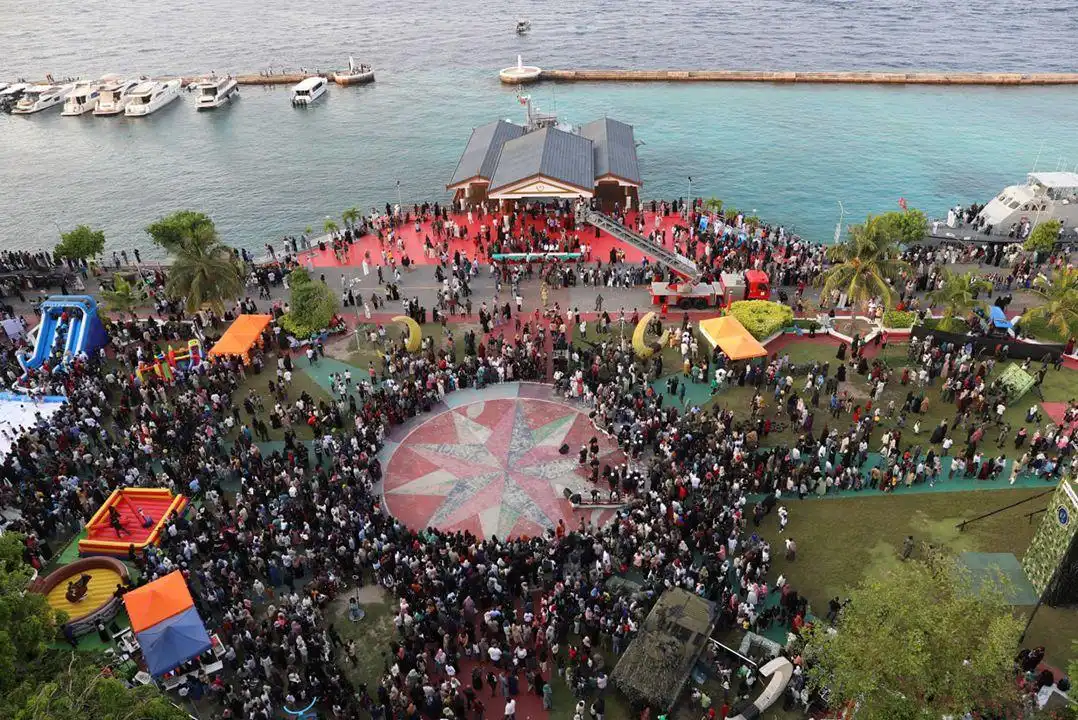
A photograph captured during the Kulhudhuffushi Maali Parade held as part of this year's Eid-al-Adha festivities. | Kulhudhuffushi city council
The annual Mashi Maali Parade in Kulhudhuffushi, a staple of the Eid al-Adha festivities, is hardly a fresh concept. This event has been a enduring tradition for a long sequence of years. Pulling in massive crowds, this spectacle is anything but mundane. Its distinctive flair comes from the way it mirrors the current political atmosphere using various traditional Maali figures.
Looking back, the procession has consistently functioned as an arena for shining a spotlight on the empty vows made by administrations and the behavior of government bureaucrats. Because it just as readily lampoons the shenanigans of the opposition party, the event proves its even-handed and unbiased nature.
Unbiased mockery and costumed critique
People from every imaginable political faction in Kulhudhuffushi participate in this march together, leaving their party prejudices behind. Their collective goal is to deliver sharp social and political commentary wrapped in comedy and amusement, thereby nudging politicians about their broken commitments and ridiculing ongoing political affairs. They pull this off by utilizing an array of outfits, imaginative parade floats, and underlying commentary packed with double subtexts.
Massive catalog of political burners
The eagerly awaited procession for this specific year showcased some truly remarkable Maali characters designed to mock the most urgent problems of the day. A wide assortment of political personalities and topics were brought to life, including "the U.S. dollar that refuses to rise", "the referendum", "the U-turn", "the traditional Joali", and "the lady’s call" log.
The ridicule extended to "the midnight caller", "the tall black object", "fish cans tasting of electricity", "the inflated electricity bill", and "the campaign foundation stone".
The lineup did not stop there, as it also featured "the magical foundation boat that deceived the people", "three prayer mats", "the journalist’s airport meeting", "the advance team", "the air-conditioned classrooms", "the poverty of development", "the degree graph", "the pointless white shirt", "the great Kulhudhuffushi terminal", "the 58L project", and "the fallen fruit" alongside a plethora of other targets.
The internet loves it, the regime cringes
Footage documenting these exhibits spread like wildfire across various social media platforms, winning immense praise from the general populace.
Conversely, the reaction was completely inverted among those who back the current administration.
The most prominent pushback came from a digital post by Azima Shakoor, a former Attorney General who also serves as the legal advisor to the family of President Dr. Mohamed Muizzu. She asserted that the Kulhudhuffushi spectacle had completely spoiled the spirit of the entire Eid holiday, a comment that immediately ignited a fierce wave of public anger.
Coordinated attack of ministers
The administrative backlash did not conclude with Azima. In what bore all the hallmarks of a synchronized campaign, religious scholars aligned with the state began churning out online posts to denounce the procession.
They framed the festival as something entirely forbidden by faith, arguing that these types of exhibitions clash directly with Islamic values.
Taking an indirect swipe at the festivities, Sheikh Ali Zaid labeled the presentations as devilish behavior. In a statement published on the social media network 'X', previously recognized as Twitter, he argued that vulgar actions rooted in intimidation, ridicule, and the breach of societal morals do not qualify as genuine amusement, but are instead repulsive, satanic actions. He went on to insinuate that this sort of conduct serves as a direct reflection of the personal integrity of the people taking part.
In a very similar fashion, the Minister of Islamic Affairs, Dr. Mohamed Shaheem Ali Saeed, took an indirect jab at the festival. Writing on the platform 'X', he prompted Muslims to remember that Eid festivities have to be managed in a way that never conflicts with Islamic heritage, injecting the opinion that the holiness of Islamic Eids needs to be preserved by sticking to Islamic morals and honorable standards while celebrating.
Weaponizing the divine to protect political egos
Even with the heavy condemnation pouring in from the state apparatus and its loyalists, the Kulhudhuffushi Maali Parade walked away as a triumph of popular culture that struck a profound chord with ordinary citizens.
Though state-sponsored clerics have abruptly decided to broadcast religious viewpoints on the event, it remains a undeniable fact that these processions represent an ancient custom.
The historic quietness of these very same clerics on the matter implies that this sudden spiritual outrage is merely a calculated holy card being dealt by the administration, which is using its pocket scholars to shield itself from uncomfortable political mockery.