Total land reclaimed in Maldives exceeds combined reclamation of Africa and Europe over same period: Study
2 ޖޫން 2026 | އަންގާރަ 12:03A recent study reveals that over 4,000 hectares of land have been reclaimed across 189 Maldivian islands since 2000. The findings indicate that while reclamation projects have surged since 2008, they have been carried out in a disorganized manner without a robust national plan. Consequently, the report emphasizes the urgent need to review land reclamation policies to address the potential adverse environmental and social impacts.
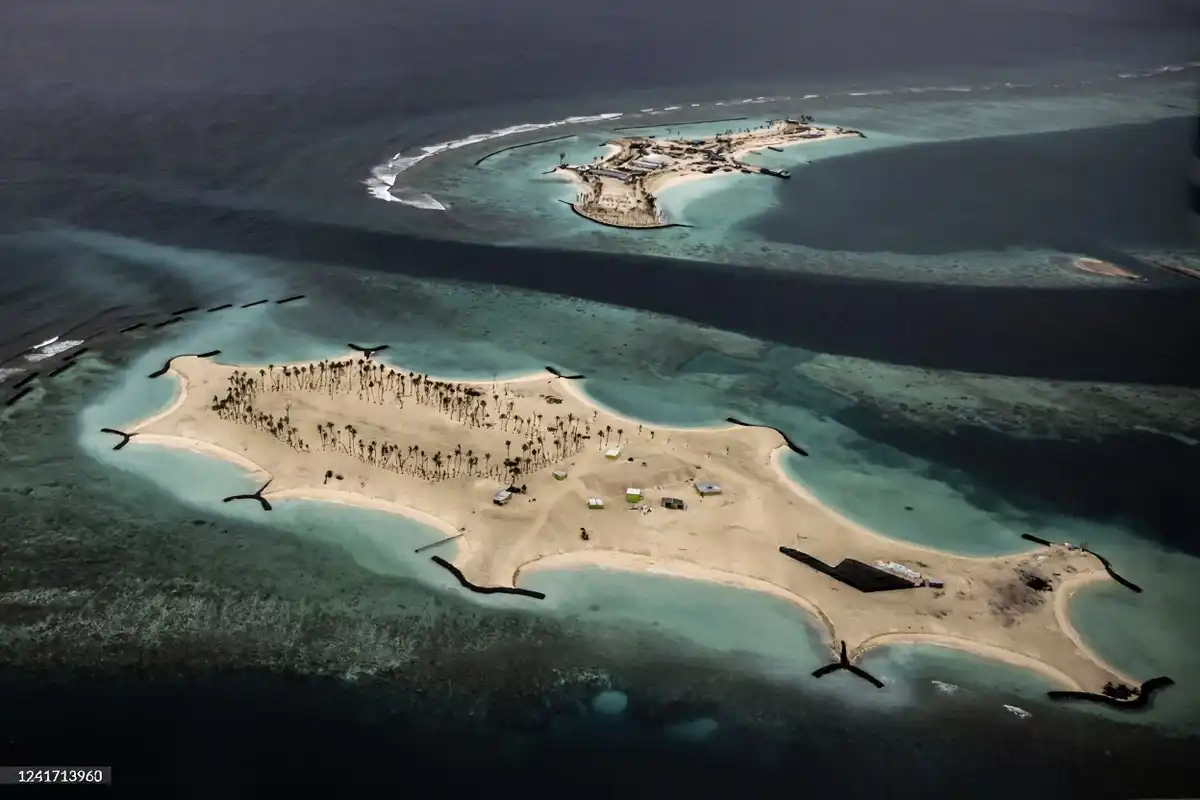
An aerial view of two islands developed through land reclamation in the Maldives. | getty images
A recent study has revealed that the total land area reclaimed by the Maldives exceeds the combined total of all land reclamation projects carried out across Africa and Europe during the same period.
A study titled "Land Reclamation in the Maldives: Trends and Impacts from 2000 to 2024" reveals that the total area of land reclaimed in the Maldives over the past 24 years exceeds the combined total of land reclaimed across the entire continents of Africa and Europe during the same period.
A study published in the Maldives Journal of Engineering and Technology highlights that while land reclamation has become a central pillar of the Maldives' development policy, there has been a lack of comprehensive national data documenting the extent and methodologies of reclamation projects across inhabited islands.
This study analyzes land reclamation projects carried out for public use across 189 inhabited islands between 2000 and 2024. Utilizing a multi-method approach to data collection, the research compiled a detailed database of 109 projects by integrating satellite imagery, Environmental Impact Assessment (EIA) reports, and government records with Geographic Information System (GIS) mapping.
The findings reveal that over 4,000 hectares of land were reclaimed during the study period. In a striking comparison to global statistics, the extent of land reclaimed in the Maldives since 2000 exceeds the combined reclamation totals of Africa and Europe.
Geographic analysis indicates that these projects have been predominantly concentrated in the central region of the country.
Furthermore, the study highlights a pattern of redundant infrastructure development across atolls and a lack of systematic planning in development practices. Notably, the research points to a significant surge in land reclamation projects following the transition to a multi-party system in 2008.
The study also uncovers discrepancies between reclamation policies, population growth rates, and national decentralization strategies. These findings raise critical questions regarding the adequacy of existing regulations, the absence of a robust national master plan, and the long-term environmental and social consequences of standardized reclamation practices.
The study concludes by calling for an urgent review of land reclamation policies to better align development goals with demographic realities, environmental preservation, and community well-being.