Muizzu administration’s weapon of choice and Nazim’s sidelining
31 މެއި 2026 | އާދީއްތަ 11:15The current administration is accused of using theatrical allegations and manufactured crises to sideline internal political rivals and institutional leaders. High-profile targets, including BML and Deputy Speaker Ahmed Nazim, have faced claims of coups and misconduct that often dissolve without legal proof once the individuals are removed. This pattern suggests a strategy of using the state apparatus to consolidate power through calculated purges and intimidation.


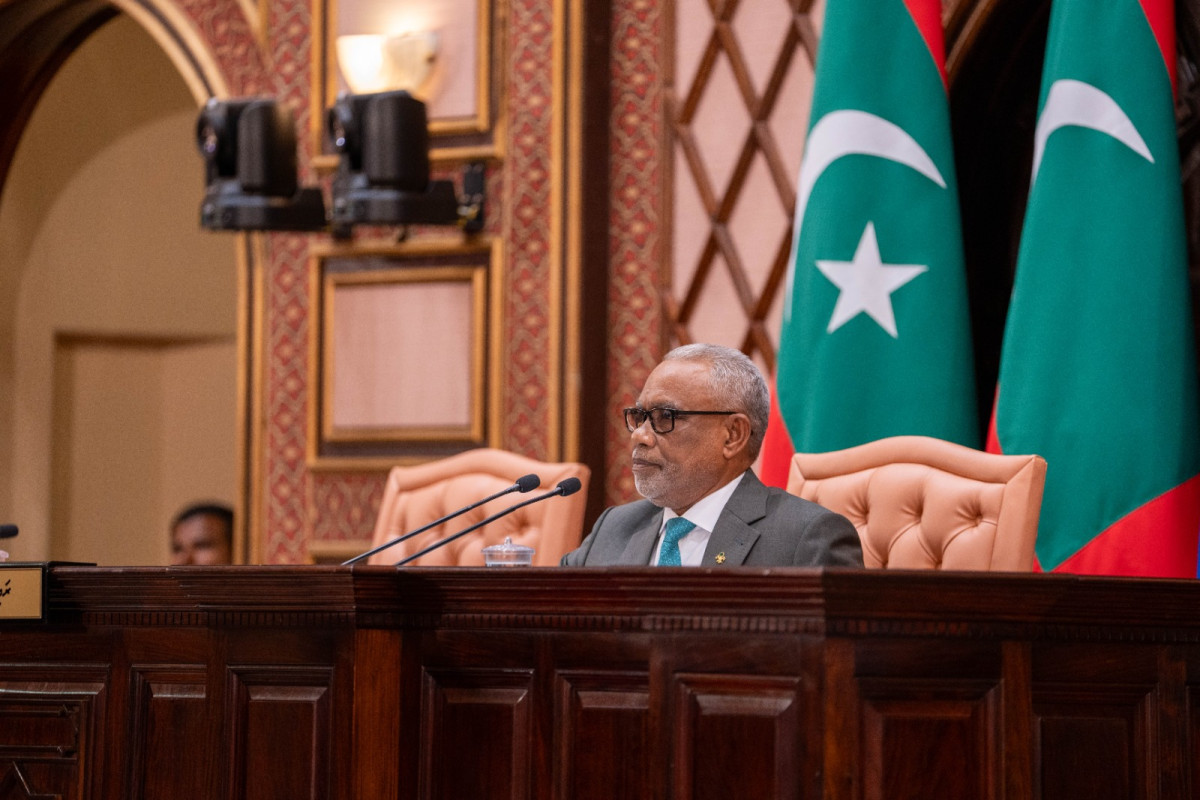
Former Deputy Speaker Nazim (R) and President Muizzu (L). | President's Office
The government machine recently operated with its signature theatricality, painting a specific individual as the absolute greatest threat to national security.
Under the dramatic pretense of analyzing heavy accusations, she was swiftly locked away behind bars. The state's grand claim was that she had allegedly dabbled in black magic or Sihr, for the sole purpose of worming her way closer to the president.
Authorities went so far as to ransack her entire home, while her two siblings were instantly stripped of their political positions for no other reason than their biological ties to the supposed sorceress. The administration apparently viewed her as such an existential hazard that they even barred her from nursing her 18-month-old toddler.
This nightmare belonged to Fathimath Shamnaz Ali, the former State Minister who happens to be the ex-wife of Adam Rameez, the very man who functioned as Muizzu’s most trusted confidant and secured his path to the presidency.
Eventually, after being kept in a cell away from her dependent infant under these shadowy claims, she was unceremoniously let go. Nearly two years have slipped by since she walked free and yet the state has still not produced a single official charge against her.
The true status of that supposedly massive, perilous threat is still wrapped in complete mystery.
Capitalizing on imaginary coups
Next in line for the administration's extraordinary wrath was the Bank of Maldives (BML). The state alleged that the country's national bank had teamed up with the main opposition Maldivian Democratic Party (MDP) to mastermind an unlawful coup to topple the current government.
This was not whispered gossip, as Muizzu himself stood before the world and boldly declared the existence of this criminal uprising. In the wake of the Head of State's announcement, the police department kickstarted a high-stakes investigation, claiming to possess robust intelligence and a mountain of varying evidence.
While handcuffs were never actually used on anyone, multiple veteran officials found themselves forced out of their jobs and the Chief Executive Officer was decisively dethroned and packed off to his home country.
However, when the theatrical dust finally settled, not a shred of proof connecting the bank to a government overthrow materialized.
To this day, not a single person has faced prosecution for the alleged rebellion, leaving the grand accusation to simply dissolve into thin air.
Limbo of the inner circle
These types of convenient accusations seem to pop up like clockwork under the current regime. A rotating door of various allegations, born out of deep internal friction within the incumbent's tight inner circle, are left hanging in a perpetual state of limbo.
The playbook is consistent, with targeted individuals being systematically sidelined, isolated or completely muted. Even Speaker of the People's Majlis Abdul Raheem Abdulla, who has only just recently found his voice and stepped back into the political spotlight, appears to have emerged only after spending a significant stretch of time trapped and silenced within these exact tribal dynamics.
Sudden undoing of a deputy speaker
The latest target of this political machinery is Ahmed Nazim, the Deputy Speaker of the People's Majlis and MP for Dhiggaru Constituency, who is now facing heavy scrutiny.
The plot against Nazim is anything but ordinary, fracturing a prolonged period of quiet with sudden and sharp hostility. Without a single warning or an inkling of prior discussion, members of the main ruling People's National Congress (PNC) abruptly signed and delivered an official motion to strip Nazim of his leadership title.
According to the specific wording of the no-confidence motion brought forward by the ruling party, the removal was deemed necessary because the Deputy Speaker repeatedly abused his state influence for personal advancement, stirred up internal discord and acted with a prejudice that directly harmed the public interest.
The document further alleged that he brought political bias into legislative proceedings, actively cheered on the destruction of parliamentary harmony and completely abandoned his official duties.
The resignation ritual
Naturally, the fine details of these claims remain entirely obscure, as no concrete actions or public remarks have emerged to actually back up the party's narrative.
Up until the moment the paperwork was filed, no such rumors had been floating around the general public, the political opposition or even the corridors of the government itself.
Even so, almost immediately after this severe indictment hit the floor and the reality of a dismissal vote loomed large, Nazim made the choice to voluntarily step down.
For his part, Nazim has firmly maintained that the state's case against him is hollow fiction and that he is entirely innocent of the behavior described, noting that there is zero evidence to validate any of it.
However, while he chose to resign rather than endure the public execution of a hostile parliamentary vote, Nazim observed that because every single member of the ruling party’s legislative group had signed their names to his ouster, stepping aside was simply the civilized, democratic response when the overwhelming majority of his electors demand it, completely separate from whether the accusations hold any water.
Moving on to the next target
With that, the curtain drops on this particular chapter, leaving Nazim successfully pushed out while the core allegations remain entirely unresolved.
The big question left dangling is what will actually happen to these unresolved charges.
The word on the street is that while the official paperwork listed a very specific set of grievances, the real motives driving this hit job are entirely separate, concealing a deeper hidden secret behind his sudden fall from grace.
The reality is that the rank-and-file members didn't initiate this purge on their own whim; they acted under the direct orders of the incumbent.
Once again, the knife-fighting has played out deep inside the private halls of power.
It remains to be seen what the future holds for Nazim, how the broader political chess board will shift and what brand-new allegations might be manufactured against him next.
We are left with no choice but to sit back and watch.