Revolving doors and sinking trust drags Muizzu administration into deeper chaos
9 ޖޫން 2026 | އަންގާރަ 13:49The abrupt departure of Finance Minister Moosa Zameer highlights growing instability within a government facing severe foreign currency shortages and credit rating downgrades. Critics point to a disconnect between official austerity measures and the continued creation of political roles, fueling public distrust. This administrative turmoil, coupled with repeated electoral defeats, suggests a significant decay in confidence regarding the leadership's ability to manage the national economy.

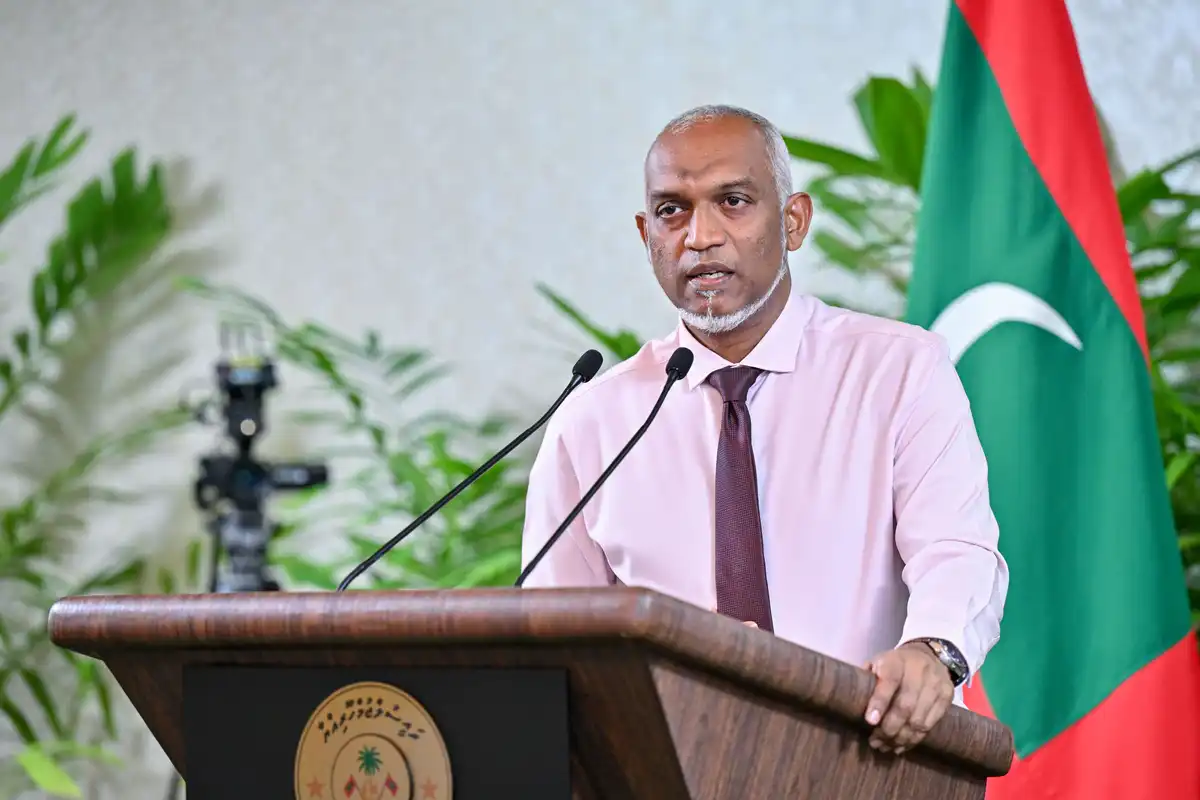
President Dr. Mohamed Muizzu speaking at a presser. | Presidents office
The completely unexpected departure of Minister of Finance and Public Enterprises Moosa Zameer unfolds right in the middle of a continuous cycle of cabinet restructurings, high-level exits and relentless modifications to senior positions throughout the state apparatus since the current leadership first took the reins of power.
When looking at the situation objectively, the sheer frequency with which these cabinet adjustments occur triggers incredibly heavy skepticism regarding the actual capacity of this governance team to sustain a reliable and steady inner circle.
Such unending and predictable reshuffling acts as a massive roadblock to the steady execution of long-term state programs, fosters deep-seated friction inside various public institutions and severely threatens to dismantle whatever remaining public faith exists in the ultimate strategic roadmap of the state leadership.
A fiscal ship without a captain
Zameer’s abrupt exit demands particular attention because it is playing out against a very grim backdrop of severe foreign currency scarcity and a rapidly accelerating wave of public anxiety over the actual solvency of the national treasury.
Well-known global credit assessment organizations, with entities like Fitch Ratings leading the charge, have previously gone on the record to broadcast their deep apprehensions regarding the precarious financial health of the island nation.
These international observers have explicitly drawn attention to the volatile external financing vulnerabilities and the immense, unyielding pressures weighing on the foreign exchange reserves of the archipelago.
Hypocrisy in the state balance sheet
Adding fuel to the fire, the current governance team has found itself trapped under a microscope of intense public condemnation concerning how it handles the national budget.
Even though the finance ministry publicly trumpeted a series of strict cost-cutting guidelines and frugality programs, representatives from the political opposition have continuously pointed out and challenged the unyielding establishment of new political positions and taxpayer-funded roles.
Detractors of the regime argue that these administrative choices stand in absolute, direct opposition to the loud rhetorical demands of the government for fiscal discipline and systemic expenditure reductions.
Rejection at the ballot box
Simultaneously, the administration is struggling to stay afloat under a mountain of intensifying political backlash sparked by a continuous sequence of crushing electoral defeats.
The definitive outcomes of recent voting cycles, which have been defined by repetitive failures for the active ruling party, strongly indicate a massive and growing wave of frustration among the general citizenry.
These back-to-back political embarrassments draw a clear line under the fact that there has been a drastic and rapid decay in overall public confidence toward the ruling elite.
An exhausted excuse of inherited problems
While desperate defenders of the regime try to argue that the prevailing economic nightmares are simply a bad hand inherited from previous governments and that deep structural fixes require a long time before they show any positive signs of life, the critics see right through the spin.
Given the reality that the current administration has been calling the shots for a period exceeding two full years, a vast portion of the public believes that these repetitive justifications can no longer hide what is widely viewed as total administrative helplessness.
As a direct consequence of this environment, the sudden departure of the finance minister operates as a perfect emblem for the much larger anxieties choking the country when it comes to the general stability of the administration, its chaotic economic steering, its reckless public cash distribution and its miserable performance at the voting booths.
These cumulative disasters paint a clear picture of an administration trapped in a permanent state of emergency, continuously flailing to execute its basic governance mandates.
As things stand today, ordinary citizens are entirely fed up with the non-stop chaos and the unpredictable disruptions rattling the government, a collective anger that keeps manifesting itself in consecutive election losses.
The ultimate question that remains unanswered is whether the current leadership possesses the humility to look this undeniable truth in the eye.