
Death sentence of Mahmood’s killer, Sha Alom, appealed to Supreme Court
26 މެއި 2026 | އަންގާރަ 22:06The High Court has upheld the death sentence of Bangladeshi national Sha Alom Mia for the murder of Dhangethi businessman Mahmood Abu Bakur, following a majority ruling by the presiding judges. Despite procedural disagreements among some members of the bench, the court determined that the evidence and the defendant's repeated confessions—made on four separate occasions—sufficiently proved a charge of intentional homicide. The ruling further noted that Mia’s own statements confirmed the murder was a premeditated act driven by financial greed.

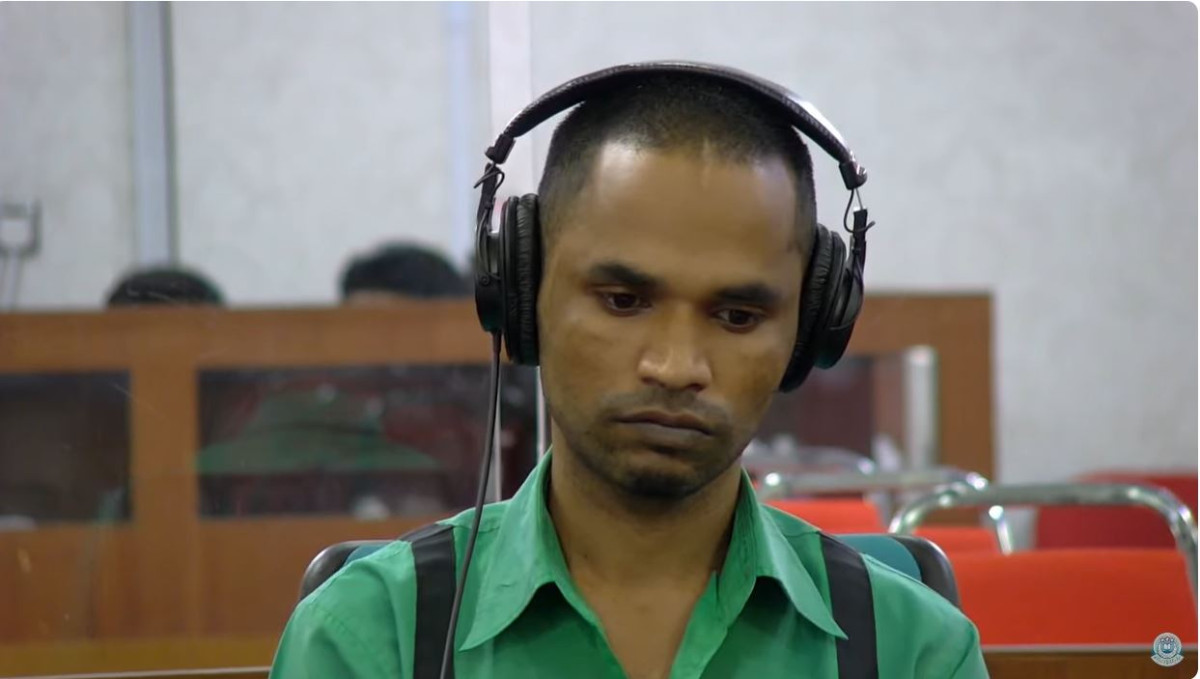
The murder case of Dhangethi businessman Mahmood Abu Bakuru. | RaajjeMV
The state has petitioned the Supreme Court to verify the validity of the death sentence upheld by the High Court against Bangladeshi national Sha Alom Mia, who was convicted of the murder of Dhangethi businessman Mahmood Abu Bakuru.
In cases involving the death penalty, the verdict must be submitted to the higher courts to ensure it is a final judgment. Accordingly, the state has now filed the matter with the Supreme Court for final confirmation.
During the High Court proceedings, a majority of the bench voted to uphold his conviction. In delivering the verdict, Judge Hassan Shafeeu noted that there was no evidence to confirm the defendant, Shah Alom, had been informed of his legal rights. The judge further highlighted that he had not signed the mandatory statement acknowledging that these rights had been guaranteed to him.
Consequently, the judge stated that given these circumstances, the validity of Shah Alom's confession is also called into question. The judge further noted that it is mandatory to ensure an individual's constitutional rights are fully guaranteed before obtaining a confession.
Judge Shafeeu stated that he is in favor of remanding the case to the lower court for a new ruling once all legal procedures have been properly completed.
Justice Mohamed Niyaz delivered the next opinion. Justice Niyaz stated that confirmation of whether the defendant understood the charges could be established through their legal counsel, and that it was not mandatory to question Shah Alom directly.
In this regard, Judge Niyaz stated that the original charges and the corresponding penalties had been clearly explained, and that the defendant was convicted of those specific offenses. The judge further noted that the defendant's rights had been duly communicated through an interpreter.
Furthermore, the judge stated that there was no evidence of injustice against Shah Alom resulting from any procedural irregularities or deviations.
Judge Niyaz stated that Sha Alom had detailed the manner in which he murdered Mahmood, noting that the elements of intentional homicide were clearly evident from the facts. Consequently, Judge Niyaz ruled that the lower court's death sentence against Sha Alom must be upheld. Judge Fatimath Farheeza concurred with this opinion.
In his confession, Sha Alom detailed the brutal assault, stating that he first struck Mahmood in the forehead with his hand, causing him to collapse, before hitting him with an iron bar. To ensure the victim was dead, Alom admitted to stabbing him multiple times with a knife. He further recounted driving a sharpened iron rod into Mahmood’s body; when the rod became lodged, he reportedly climbed on top of the body to exert enough force to pull it out.
While describing the details of the murder, he also recounted how he placed the body in a pit to conceal it. Sha Alom explained that the subsequent injuries were inflicted to ensure the victim was dead and to prevent any possibility of recovery.
Judge Niyaz stated that the confession was valid, noting that the defendant had been informed that the offense carried the death penalty at the time he confessed. Furthermore, two women who were passing by the scene at the time of the incident witnessed Sha Alom dragging an individual by their legs.
Furthermore, the injuries observed on Mahmood's body were consistent with the details provided in the suspect's confession.
Furthermore, he stated that he killed Mahmood after witnessing someone hand him a large sum of money while he himself was facing financial difficulties. He admitted that he formed the intent to take that money from Mahmood on that very day.
He has confessed to the crime on four separate occasions.