87 percent of budget spent on recurrent expenditure; PSIP spending drops by 16 percent as budget deficit hits 1.5 billion
24 ޖުލައި 2026 | ހުކުރު 18:03Spending on development projects as of July 16 this year has declined by 16 percent compared to the same period last year, while expenditure on salaries and pensions reached MVR 8,008.4 million. Despite the state generating MVR 22.9 billion in revenue by mid-July, rising expenditures have resulted in a deficit of MVR 1.5 billion, with the total value of outstanding government securities now climbing to MVR 97.3 billion.
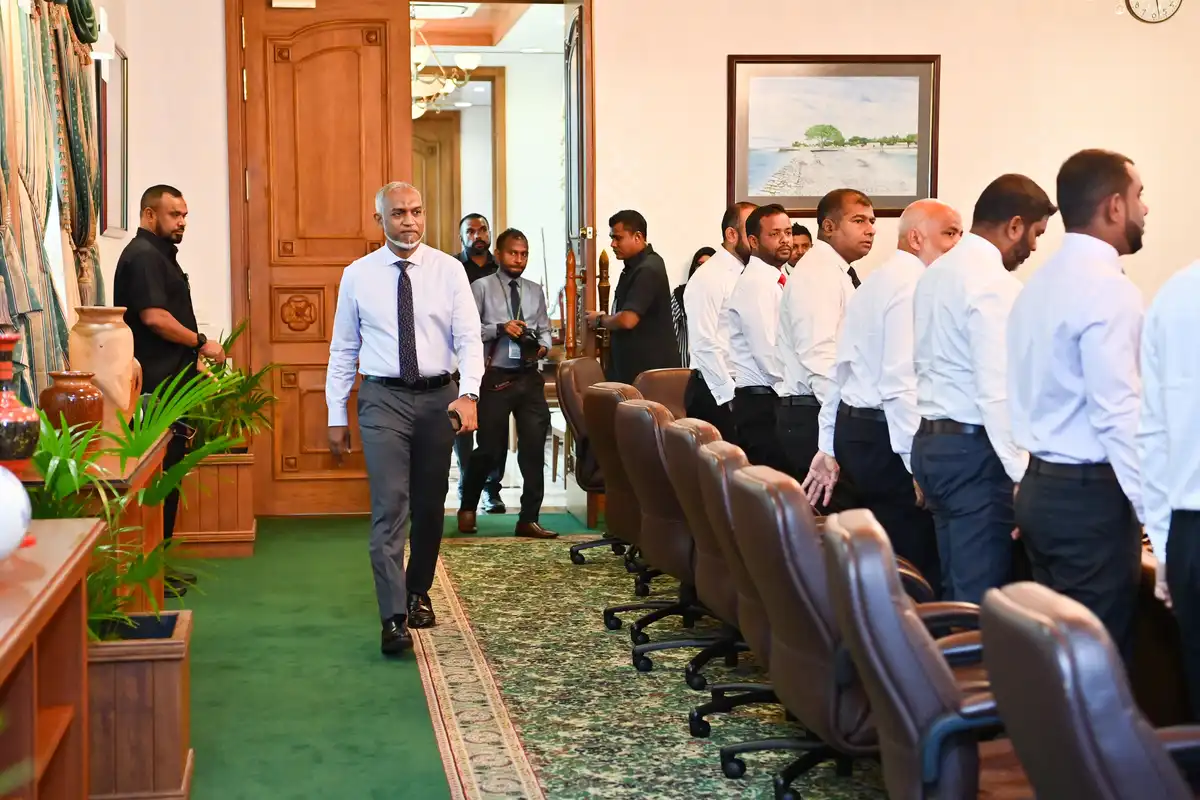
Ministers stand in honor as President Muizzu arrives for Cabinet meeting. | President's Office
Operating expenses, or recurrent expenditure, accounted for 87 percent of total state spending as of July 16 this year, according to data released by the Ministry of Finance. Out of the MVR 21,362.7 million spent on recurrent costs, the largest portion was allocated to employee salaries and benefits. Specifically, MVR 8,008.4 million was spent on salaries and pensions, while administrative costs amounted to MVR 13,283.7 million. This includes MVR 3,129.9 million for subsidies and MVR 1,183.2 million for the national health insurance scheme, Aasandha.
Capital expenditure has reached MVR 3,152.4 million, with the largest portion allocated to infrastructure projects. Specifically, MVR 1,030.0 million was spent on land and building projects, while MVR 1,752.0 million was utilized for other infrastructure developments. Although total spending under the Public Sector Investment Program (PSIP) has reached MVR 3,161.5 million to date, this represents a 16 percent decrease compared to the same period last year.
Based on the budget utilization of state offices, the Ministry of Education, Higher Education, and Skills Development recorded the highest expenditure. The ministry spent MVR 2,715.9 million, while the Ministry of Infrastructure, Housing, and Urban Development utilized MVR 2,212.6 million. Additionally, the National Social Protection Agency (NSPA) spent MVR 1,825.5 million, and the Maldives Police Service utilized MVR 1,393.5 million from the budget.
Regarding the state of national debt, the total value of government securities issued as of July 13, 2026, stands at MVR 97,346.3 million. The largest portion of this figure consists of MVR 95,804.3 million owed to domestic financial institutions. This includes MVR 44,852.4 million in Treasury bills and MVR 28,614.9 million in Treasury bonds. Additionally, the value of bonds owed to foreign parties amounts to MVR 1,542.0 million.
The state received a total of MVR 22,979.7 million in revenue and grants as of July 16 this year, according to the weekly fiscal statistics released by the Ministry of Finance and Public Enterprises. During this period, total government expenditure stood at MVR 24,515.0 million. Consequently, the state budget has recorded a deficit of MVR 1,535.3 million so far this year. While revenue has increased compared to the same period last year, the data indicates that expenditures have risen at a proportionately higher rate.
An analysis of government revenue reveals that tax receipts account for the largest share of total income. Tax revenue reached MVR 17,621.9 million, with the Goods and Services Tax (GST) emerging as the primary contributor. Of the MVR 9,674.4 million collected in GST, MVR 6,680.0 million was generated from the tourism sector (TGST). Meanwhile, non-tax revenue stood at MVR 4,917.7 million, marking a 2.9 percent decline compared to the same period last year. Additionally, the state received MVR 438.8 million in foreign aid and grants.