
Supreme Court dismisses case seeking to annul Muizzu administration's Ras Male' agreement with Eagles Hills
13 އޮކްޓޯބަރު 2026 | އަންގާރަ 08:00The Supreme Court has dismissed a constitutional challenge filed by lawyer Ali Hussain seeking to nullify the Ras Malé development agreement with Eagle Hills, ruling that the case does not meet the criteria for direct submission to the apex court as a court of first instance. The petition argued that the agreement is unconstitutional and should be declared void because it grants land ownership interests and 99-year leasehold rights to a foreign entity.

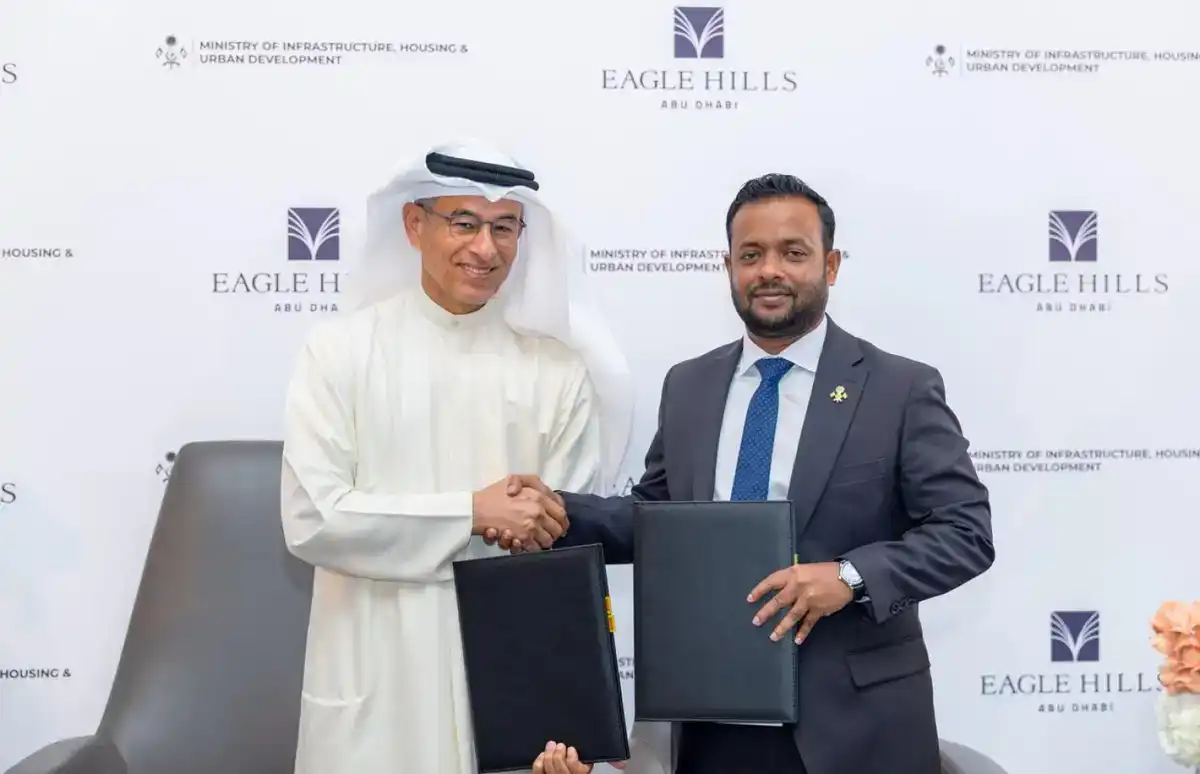
Minister Muththalib shakes hands with Mohamed Alabbar after signing the agreement to hand over the Ras Male' land development project to Eagle Hills. | Raajje MV
The Supreme Court of the Maldives has dismissed a constitutional case filed in the public interest, which challenged the validity of the "Commercial Terms Agreement" signed between the Maldivian government and Eagle Hills company for the development of Ras Malé.
Legal practitioner Ali Hussain has filed a constitutional case with the Supreme Court, challenging the validity of an agreement signed on September 21, 2026, between the Ministry of Infrastructure, Housing and Urban Development and Eagle Hills, a company based in the United Arab Emirates (UAE).
The Maldivian government has refused to disclose the full text and specific details of this agreement. However, legal counsel Ali Hussain, who filed the case, noted that statements released by the government and Eagle Hills properties indicate the agreement encompasses the following components.
The case was dismissed on the grounds that it could not be accepted, as it does not fall under the category of matters required to be filed directly with the Supreme Court as a court of first instance, pursuant to Section 11 of the Judicature Act of the Maldives.
Background of the case:
Article 250 of the Constitution of the Republic of Maldives stipulates that any disposal, sale, lease, or transfer of ownership of state-owned property or assets must be conducted strictly in accordance with the law.
The case filed with the Supreme Court contends that the Maldives lacks a legal framework empowering the state to lease public property to foreign entities for a continuous period of 99 years. The petition further asserts that any agreement to lease land to foreign parties for such an extended duration without explicit legal authority constitutes a direct violation of Article 250 of the Constitution.
Furthermore, the lawsuit challenges the legal validity of clauses within the agreement that grant Eagle Hills the authority to create permanent third-party rights over the land. The case highlights that while Article 251 of the Constitution mandates a maximum duration of 99 years for foreign ownership or leasing of Maldivian land, this agreement effectively facilitates a mechanism through which foreign entities could acquire perpetual ownership interests in the country's territory.
Consequently, as this agreement directly contravenes Articles 250 and 251 of the Constitution, the Supreme Court has been petitioned to declare the agreement null and void.
However, the court has now dismissed the case.