Recurrent costs consume 87 percent of state budget as PSIP spending plunges, deficit hits MVR 1.5bn
26 ޖުލައި 2026 | އާދީއްތަ 08:08Government spending reached MVR 24.5 billion by July, resulting in a MVR 1.5 billion deficit despite rising tax revenues. Capital investment fell 16 percent as the education and infrastructure sectors led budget usage. Meanwhile, state debt climbed to MVR 97.3 billion, primarily driven by domestic securities and treasury bills.

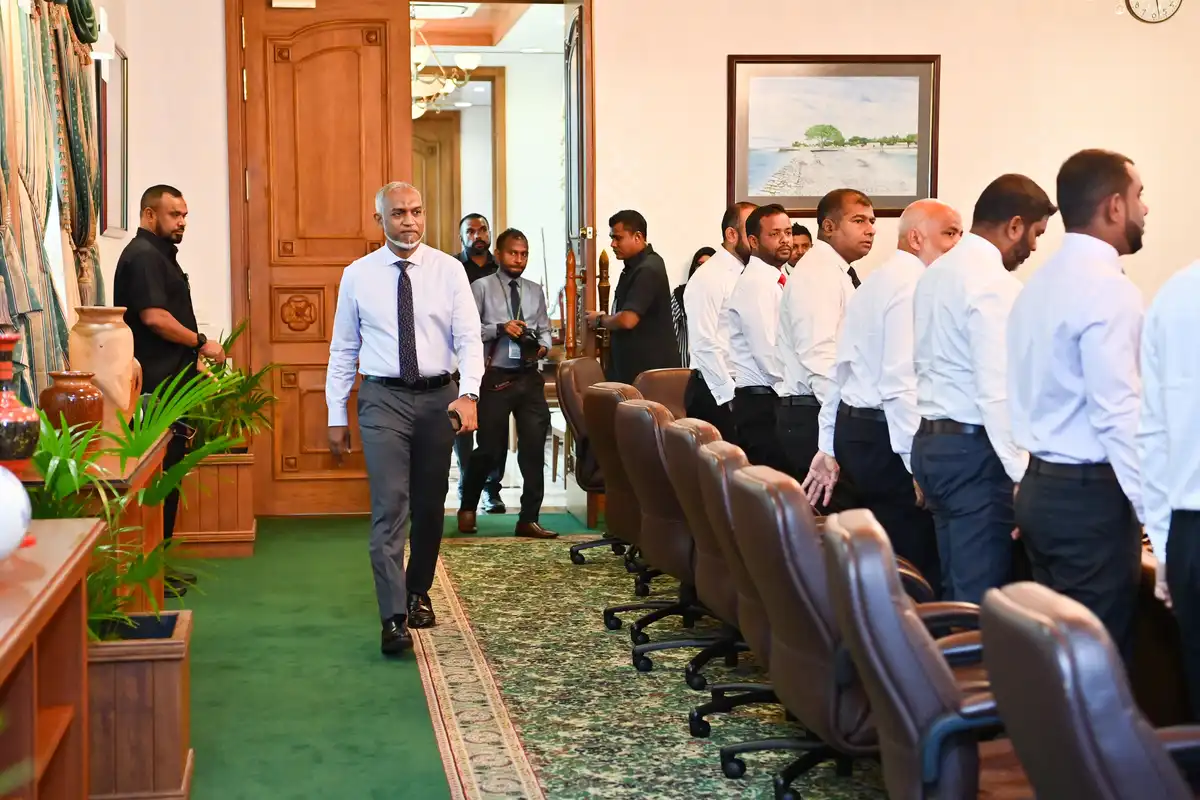
All cabinet ministers stand to receive President Muizzu as he arrives for a cabinet meeting. | President's Office
Figures published by the Ministry of Finance and Public Enterprises reveal that 87 percent of all government spending was funneled into recurrent administrative and operational costs up to July 16 of this year.
Out of the MVR 21,362.7 million expended on running costs, staff compensation claimed the biggest chunk. Specifically, MVR 8,008.4 million was disbursed for wages and retirement pensions, whereas general administrative expenses swallowed MVR 13,283.7 million. Within those operational outlays, MVR 3,129.9 million went toward subsidies, and MVR 1,183.2 million was channeled into the Aasandha healthcare coverage plan.
Capital spending over the identical timeframe totaled MVR 3,152.4 million, concentrating predominantly on physical infrastructure developments. Among these investments, MVR 1,030.0 million was used for property and structure projects, while MVR 1,752.0 million went toward other public infrastructure facilities. Even though overall spending under the Public Sector Investment Program reached MVR 3,161.5 million to date, this marks a 16% drop when compared against the matching timeframe from the prior year.
Examining budget usage across public authorities, the Ministry of Education, Higher Education, and Skills Development registered the single largest disbursement at MVR 2,715.9 million. The Ministry of Infrastructure, Housing and Urban Development ranked second with outlays of MVR 2,212.6 million. Further, the National Social Protection Agency (NSPA) drew MVR 1,825.5 million, while the Maldives Police Service expended MVR 1,393.5 million from state coffers.
Turning to national debt obligations, the cumulative value of state-backed financial securities reached MVR 97,346.3 million by July 13, 2026. The vast bulk of this balance is held by local financial entities, amounting to MVR 95,804.3 million. This includes MVR 44,852.4 million issued in short-term Treasury Bills and MVR 28,614.9 million in long-term Treasury Bonds. Meanwhile, state bonds held by international creditors amounted to MVR 1,542.0 million.
Weekly fiscal reports published by the Ministry of Finance and Public Enterprises detail that total public income and grant funding reached MVR 22,979.7 million by July 16 of this year. Over the same timeline, aggregate state spending climbed to MVR 24,515.0 million. As a result, the national balance sheet has run up a deficit of MVR 1,535.3 million so far in the current year. The report notes that although income grew relative to the corresponding timeline last year, overall spending expanded at a comparatively faster pace.
A breakdown of government revenues indicates that tax collections provided the overwhelming majority of income, bringing in MVR 17,621.9 million. The Goods and Services Tax served as the primary financial driver by producing MVR 9,674.4 million, with Tourism GST contributing MVR 6,680.0 million of that total. In addition to this, non-tax revenues generated MVR 4,917.7 million, a 2.9 percent dip compared to the year before, while foreign grants brought in MVR 438.8 million.