Voters said no and the bulldozers packed up
28 މެއި 2026 | ބުރާސްފަތި 11:32The incumbent is accused of using grand development projects as temporary tools to secure votes during elections. Despite his claims of avoiding symbolic initiatives, major works in Addu City and Thinadhoo often stall or vanish once polling concludes. This recurring cycle of rapid pre-election activity followed by post-election stagnation suggests that these promises are primarily designed for political gain rather than genuine progress.

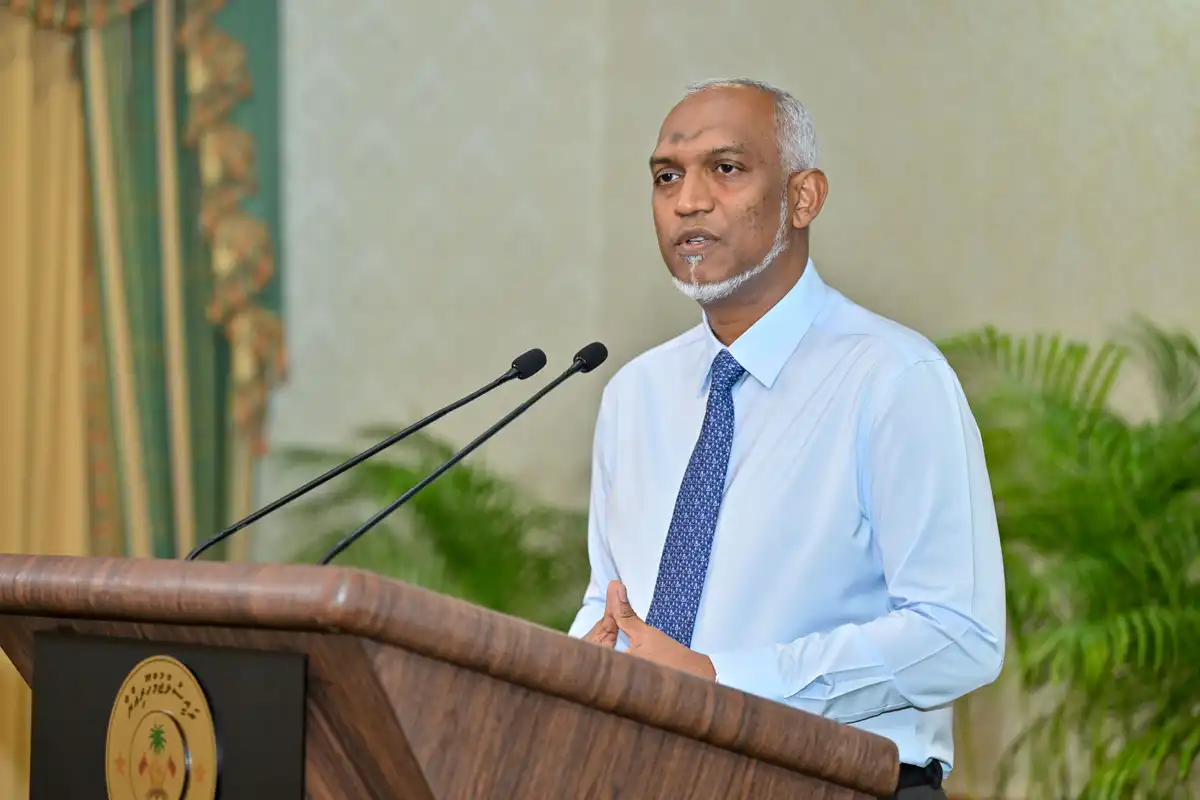
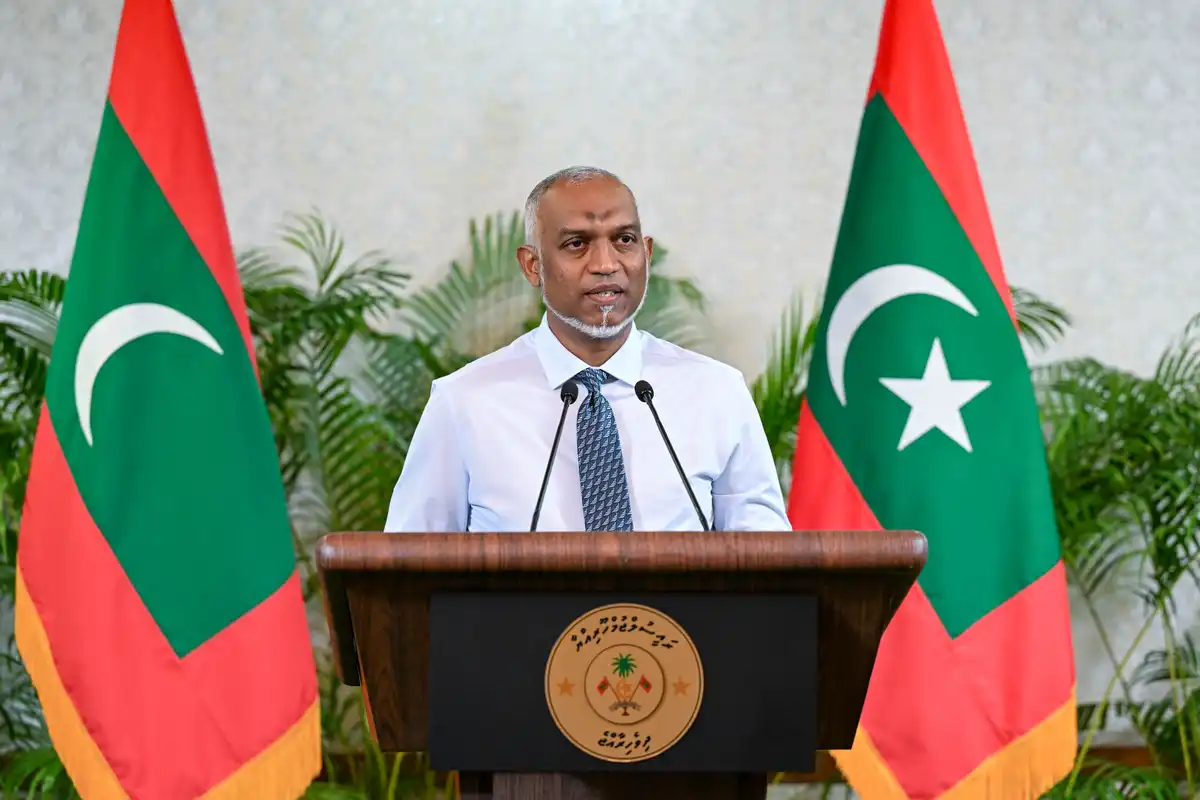
The President of the Republic Dr. Mohamed Muizzu's remarks at a press conference, questions posed by journalists to the President, and the President's answers to those questions. | Presidents Office
President Dr. Mohamed Muizzu frequently declares that he never utters a promise without a steadfast commitment to seeing it through.
According to his public narrative, a project is only ever pledged when there is absolute certainty in its execution, with all the essential resources and financial backing firmly locked in place.
He consistently asserts that any initiative bearing his name will advance at breakneck speed, completely free from delays.
This precise messaging has formed the bedrock of his political platform, stretching from his initial presidential bid through every subsequent voting cycle.
Art of the campaign mirage
Woven tightly into this political rhetoric is his regular guarantee that he refuses to launch superficial, symbolic initiatives, solely to manipulate the behavior of voters at the ballot box. He made this point a central pillar of his speeches following his presidential victory and throughout the race for parliamentary seats.
Mirroring his words, a flurry of activity spread across various islands as new public works were kicked off and dormant operations suddenly crackled back to life. The spectacles were especially grand in major regional centers like Addu City and Thinadhoo City, where high-profile contracts for massive developments were officially inked.
The state made sure the public witnessed the formal beginnings of these endeavors, which included extensive road networks and major airport expansions.
Super-majorities and sudden stagnation
The reality shifted dramatically the moment the polling stations closed and the ruling administration locked down a super-majority inside the People’s Majlis. Almost instantly, a vast number of these newly minted developments ground to a dead halt, and they remain frozen in limbo.
The tiny handful of operations that managed to survive are crawling forward at a miserably slow rate. Further, some of those grandly celebrated contracts have been completely nullified and the construction companies that were originally brought in to do the heavy lifting have vanished from the map. It seems the magnificent displays orchestrated in the heat of political campaigns were wiped from the executive memory as soon as the ballots were securely counted, with all operational momentum evaporating the second the primary political goal was achieved.
Shift in tactics but the same old game
This exact behavioral blueprint repeated itself during the recent local council races, as well as amid the administration's maneuvers to drum up public support for an upcoming referendum. On this occasion, the head of state explicitly vocalized that he would never inaugurate development works just to score points for a vote.
However, while the message remained the same, the strategy received a minor face-lift. The leader publicly announced he would refrain from traveling directly to the islands for physical campaign trail stops. Instead, he stayed behind in the capital, Malé City and used his platform to drop a continuous stream of major announcements.
As the date of the vote crept closer, the frequency of these inaugurations escalated until new initiatives were seemingly unveiled a couple of times every single day. The administration staged lavish events to formally hand over housing flat developments, which were quickly followed by equally dramatic foundation-stone ceremonies.
The government even sent machinery out onto the highway to begin carving out a dedicated racing track aimed at the younger demographic, padding out a massive inventory of newly minted public works.
Post-election ghost towns
Now, the political dust has fully settled and the final results delivered a crushing blow to the ruling party, with the public delivering a resounding rejection. True to form, the established cycle is playing out right on cue.
The various works that were so loudly initiated have dissolved into nothingness. Any lingering belief that these projects would actually proceed at a rapid velocity has been exposed as a complete fantasy. Just like before, the conclusion of the election signaled the immediate death of the labor.
The youth racing track stands as a perfect monument to this pattern. While the votes were being courted, construction was moving along at an impressive clip. In the days right after the loss, a smattering of construction vehicles lingered lazily on the property.
Little by little, that machinery faded away until the entire site was stripped bare. For the foreseeable future, construction on the track has officially died, likely waiting in the wings to be dusted off and paraded out yet again when the next voting season rolls around.
Endless cycle of ballot box bait
At the end of the day, regardless of the commander-in-chief's repeated persistence that he would never degrade public works into cheap electioneering tools, he continues to flood the country with fresh projects right before citizens head to the polls.
The only real mystery left is what actually happens to these grand plans once the votes are tallied. This latest political chapter has shown that absolutely nothing has changed.