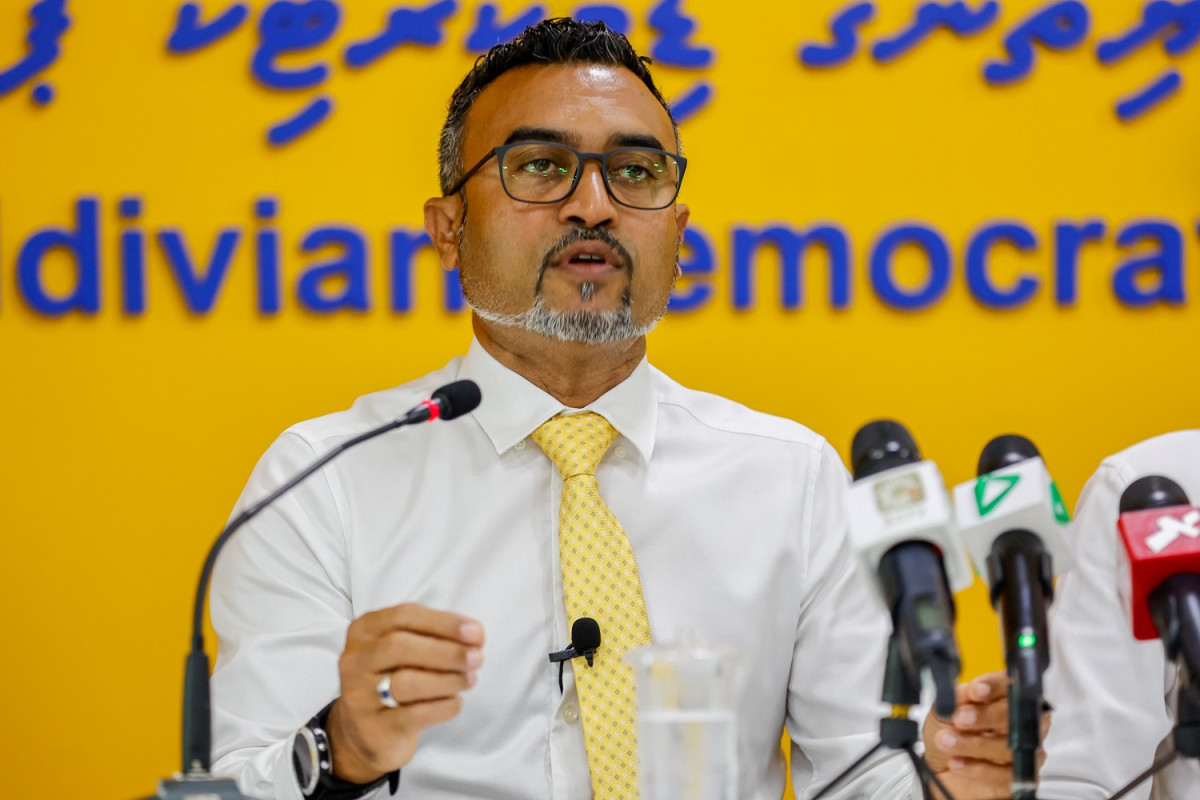
Supreme Court rules unanimously that MP Sinan has lost his seat!
12 އެޕްރީލު 2026 | އާދީއްތަ 09:26A private individual has filed a constitutional case with the Supreme Court seeking to disqualify North Hithadhoo MP Mohamed Sinan, alleging that he has lost his seat due to an outstanding judgment debt resulting from his failure to comply with a court order regarding unpaid bank loans.


Mohamed Sinan, the Member of Parliament for the North Hithadhoo constituency, speaks in Parliament. | People's Majlis | Majilis
The Supreme Court has issued a ruling in the constitutional case seeking to vacate the seat of Mohamed Sinan, the Member of Parliament for the North Hithadhoo constituency, declaring that he has officially lost his seat.
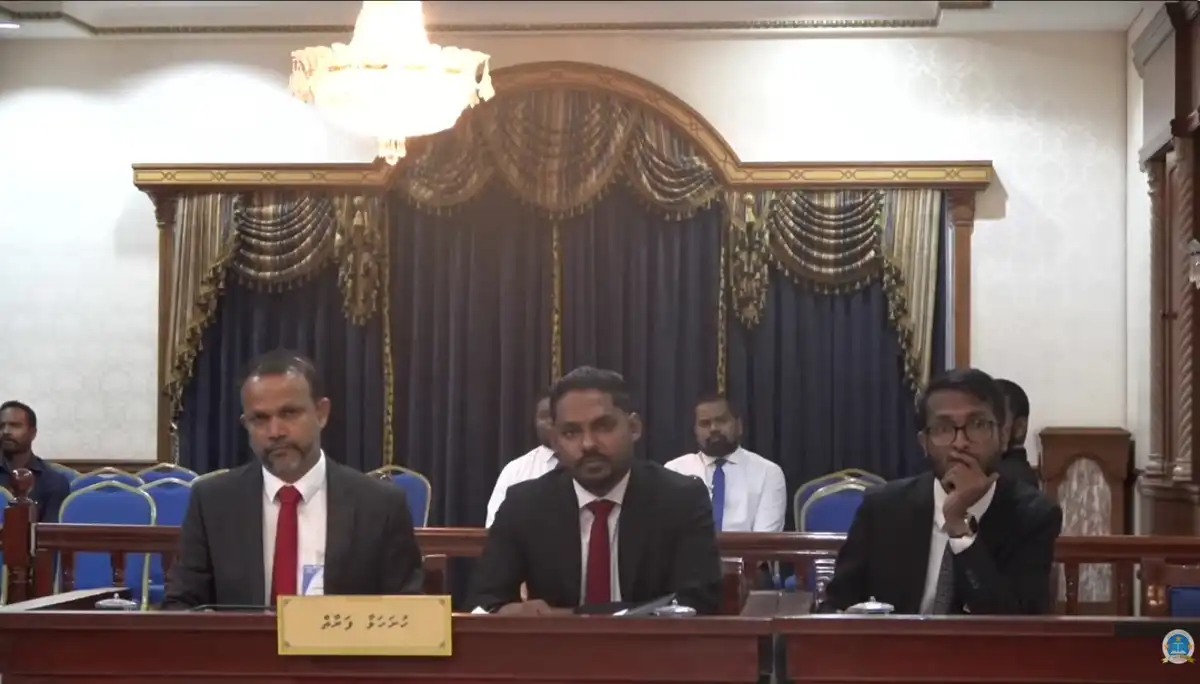
The bench presiding over this case consists of Justice Aisha Shujoon Mohamed, Justice Ali Rasheed Hussain, Justice Hussain Shaheed, Justice Mohamed Saleem, and Justice Dr. Mohamed Ibrahim.
This is a case submitted by Ghalib Saleem of Gaafu Alifu Dhaandhoo.
A case was filed with the Supreme Court seeking to strip PNC Member of Parliament Sinan from his seat over an outstanding bank loan. The petition alleges that he failed to settle a debt owed to the Maldives Islamic Bank in accordance with a prior court judgment.
According to the Constitution, a Member of Parliament shall lose their seat if they fail to settle a proven debt in accordance with a court judgment. Specifically, Article 73(c)(1) of the Constitution stipulates that a person shall be disqualified from holding a seat in Parliament if they have an outstanding proven debt and are not making payments as mandated by the ruling.
This case involves a 3.8 million MVR loan taken from the Maldives Islamic Bank (MIB) by Sinan in collaboration with several other parties. On October 14, 2024, the Hithadhoo Magistrate Court ruled that an outstanding balance of 2.5 million MVR must be settled within six months. The court order mandates that the total amount be cleared through monthly installments over the six-month period, with a minimum required payment to be submitted to the court each month.
However, according to the case proceedings, an enforcement motion was subsequently filed due to the failure to make payments as ordered. Following this legal action, the individual settled the outstanding arrears equivalent to four months, along with the remaining balance.
Based on the arguments presented in the Supreme Court, the central question focused on whether Sinan had settled the debt in accordance with the court's ruling. Sinan's legal counsel argued that the court had granted a six-month grace period to settle the outstanding amount. The lawyer further asserted that the debt was fully cleared before this deadline expired, noting that the payment was made as soon as the member became aware of the judgment.
According to Sinan's lawyer, he only became aware of the judgment on January 22, 2025. From that date, he worked toward settling the debt, paying 1.7 million Rufiyaa on February 13 as soon as the funds were secured. The lawyer further stated that the remaining balance was cleared before the expiration of the six-month period stipulated in the court order.
However, the legal counsel for Ghalib Saleem, who filed the case, stated that the Magistrate Court had sent the verdict to Sinan via Viber the previous day. The court further confirmed that they had messaged and called him to ensure receipt of the document. In response to the message, Sinan had even replied with "Got it," acknowledging that he had received the text. Nevertheless, Sinan maintains that despite sending that reply, he had not actually read the verdict.
Delivering the verdict, Justice Aisha Shujoon stated that the procedures for issuing a default judgment are clearly outlined in the Civil Procedure Act. She noted that despite Sinan receiving the necessary legal documents, he failed to submit a defense within the prescribed period. The Justice further observed that Sinan’s legal counsel withdrew from the case only after the deadline for filing a defense had already expired.
Regarding the question of whether an outstanding debt existed, Justice Shuujoon ruled that the evidence clearly established the individual's liability for a proven debt.
Consequently, the remaining point for determination is whether he has made the payments in accordance with the judgment.
Justice Shujune noted that the Hithadhoo Court's ruling explicitly grants MIB the authority to foreclose on collateral in the event of a default on proven debt. She further highlighted that Sinan had not sought to overturn or appeal that specific judgment.
Furthermore, Justice Shujune noted that despite Sinan’s claims of being unaware of the judgment, there are Viber messages confirming he was informed of the ruling. She also highlighted that the Maldives Islamic Bank (MIB) had sent formal correspondence via email reminding him to settle the payments in accordance with the court's decision.
Justice Shujoon stated that claiming ignorance of the law is not a valid defense, and that no weight can be given to the argument that the verdict had not been read.
Shujoon stated that if a judgment requires a specific amount to be paid in a particular manner within a set timeframe, the ruling would explicitly state those terms. In this instance, she clarified that the wording of the judgment mandated the total sum be divided over a six-month period starting from October 14, 2024, with the resulting monthly installment being the minimum amount required to be paid to the court each month. She further noted that the court has already registered an enforcement case due to non-compliance, which she argued clearly demonstrates the court's original intent and the binding nature of the ruling.
Consequently, Shujoon ruled that the debt-related eligibility criteria for membership had not been met, and that the seat had therefore been vacated.
Justice Shujoon’s opinion was also supported by the remaining judges on the bench.