Legal challenge to halt referendum: Verdict to be delivered if no further clarifications are required!
26 މާރިޗު 2026 | ބުރާސްފަތި 10:51The state maintains that the legal question was formulated in accordance with the law, asserting that the petitioner has misinterpreted constitutional provisions. Unless the presiding judges require further clarification, the court is expected to deliver its verdict in the next hearing.

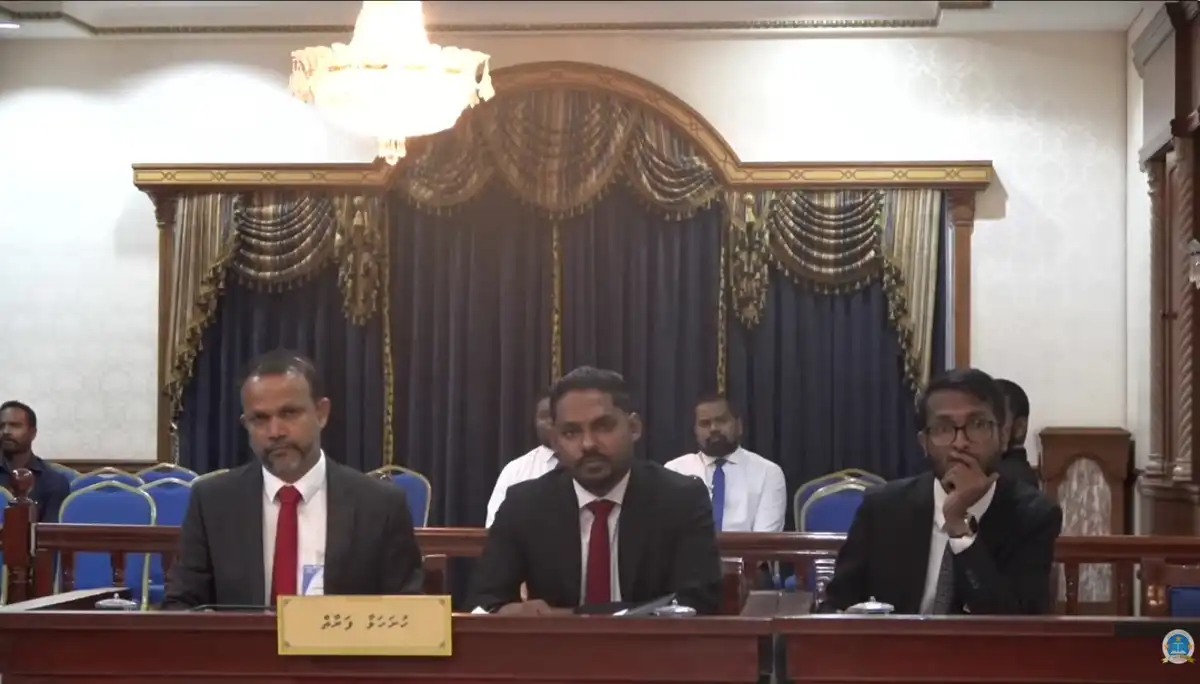
A scene from the first hearing of the case seeking to block the referendum. | RaajjeMV | Raajje MV
The Supreme Court has conducted the first hearing in a case seeking to declare the phrasing of the referendum question unconstitutional.
The case was filed in the Supreme Court by legal counsels Ibrahim Shiyam and Aik Ahmed Easa. The petition names the President's Office, the Attorney General's Office, and the Elections Commission as respondents.
The initial hearing for this case was held on Thursday morning.
Speaking at the hearing, the Chief Justice noted that the Maldivian Democratic Party (MDP) had requested permission to intervene in the case as a petitioner. However, he stated that no decision had been made on the matter yet due to time constraints. Following this, the Chief Justice opened the floor for the legal counsel to present the case.
Presenting the case, attorney Shiyam stated that this is a matter of significant public interest. He argued that the core issue lies in the fact that the question posed was framed in a manner that obscures the true nature of the constitutional amendments being proposed.
The phrasing of this question highlights two specific changes introduced by the bill to the public: first, the synchronization of presidential and parliamentary elections, and second, the established procedure for determining the parliamentary term. After presenting these details, the question asks whether the President should ratify the bill. However, the question is framed in a manner that obscures the true implications of the legislation and stands in violation of Article 262 of the Constitution.Attorney Ibrahim Shiyam
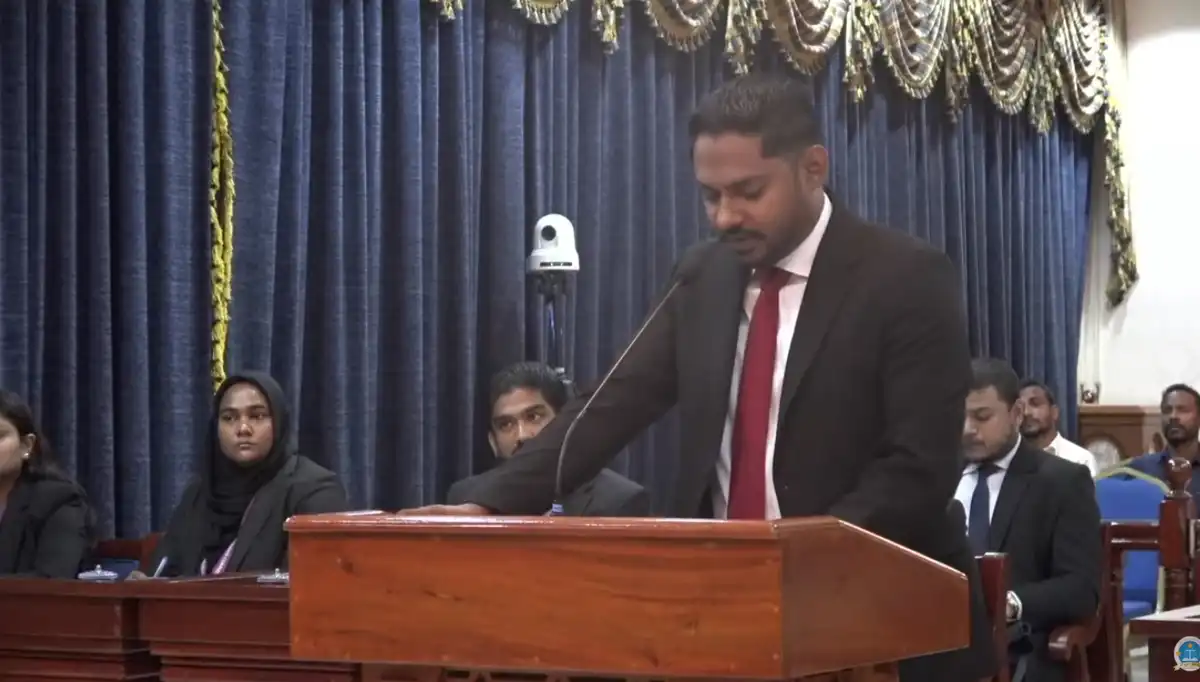
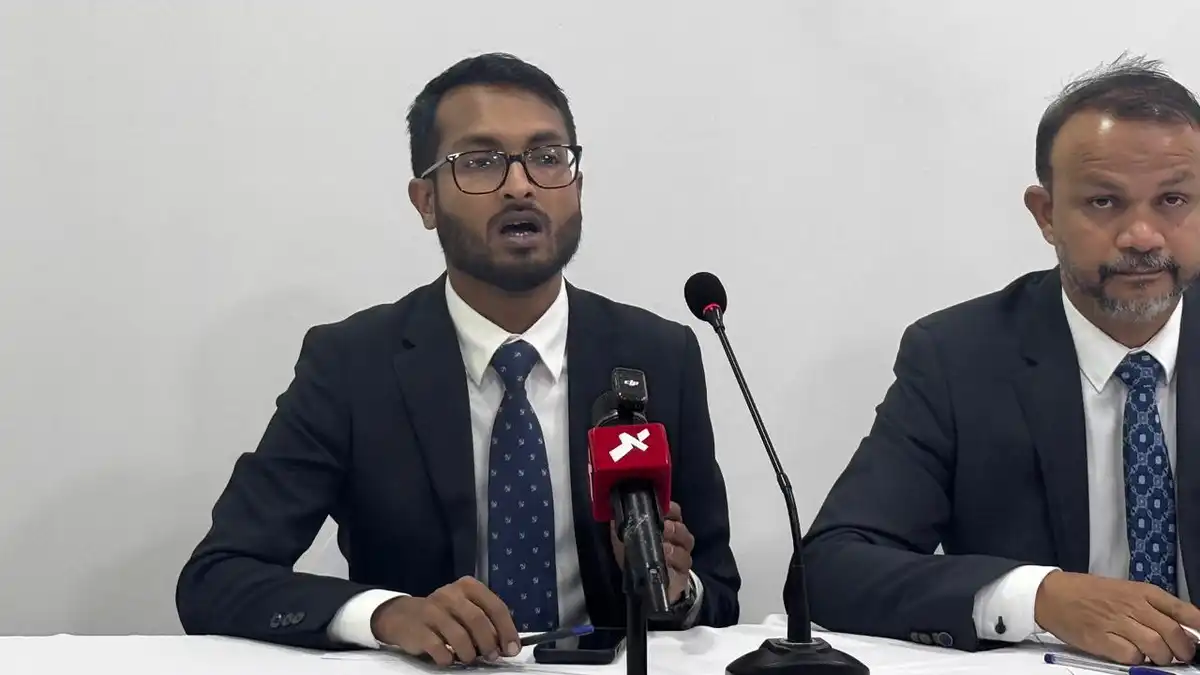
Legal counsel Ibrahim Shiyam delivers his arguments during the hearing of the petition seeking to halt the referendum.
Shiyam stated that the phrasing of the question in the Presidential Decree and the Elections Commission's announcement contravenes Article 262 of the Constitution. He further noted that the referendum should instead focus on whether the public consents to shortening the current parliamentary term.
Consequently, the petitioner in this case seeks a ruling to halt the public referendum scheduled for April 4, 2026. The request is based on the argument that the proposed referendum question has not been framed in accordance with the mandatory principles stipulated under Article 262(b) of the Constitution.
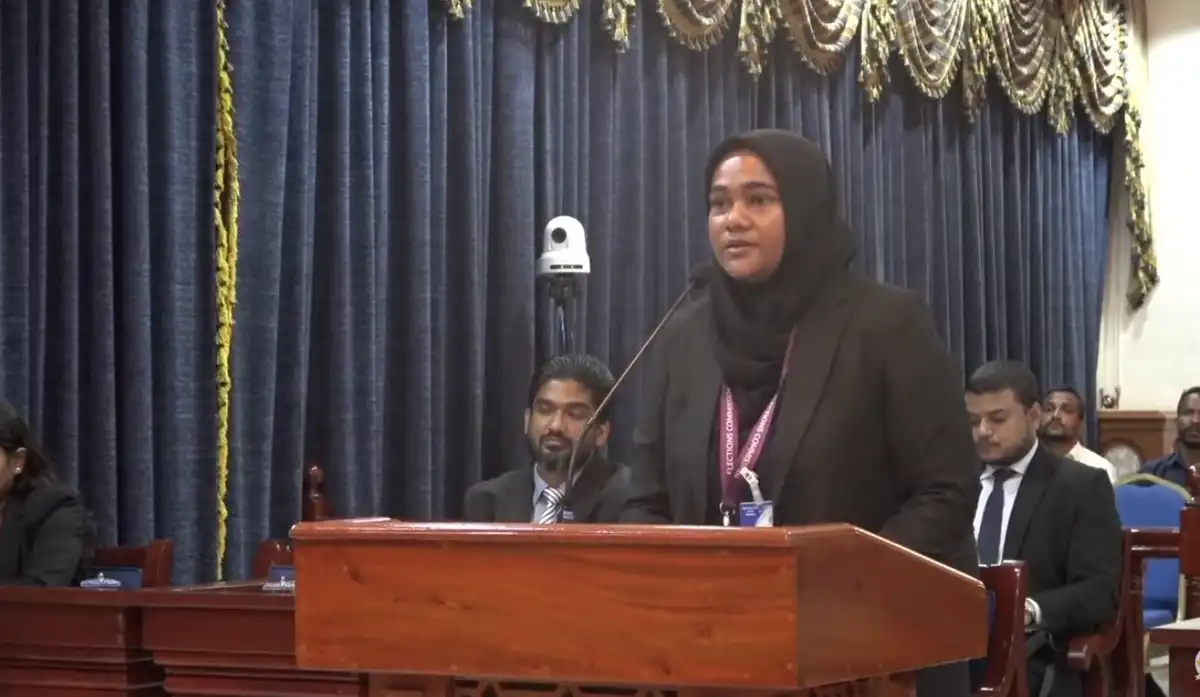
Assistant Chief Counsel Hawwa Sana represented the state and provided the official response in this case.
The counsel stated that the state does not believe the question formulated in the President's decree contravenes the Constitution. In this regard, the counsel noted that a violation of Article 262(b) would only occur if the President were to ratify a bill without conducting a referendum, or if the President proceeded with ratification despite failing to secure a majority in such a vote.
The lawyer further stated that the claim asserting the phrasing in question violates Article 262(b) is entirely without legal merit. He added that the petitioner is misinterpreting the provision in their submission.
The lawyer further stated that Article 262 stipulates "a bill passed by the People’s Majlis to amend the Constitution shall become law only when the President assents to such **bill**." He argued that this implies the entire bill must be put to a public referendum. Furthermore, he noted that the bill for the 8th Amendment to the Constitution consists of legal principles that are inherently interconnected.
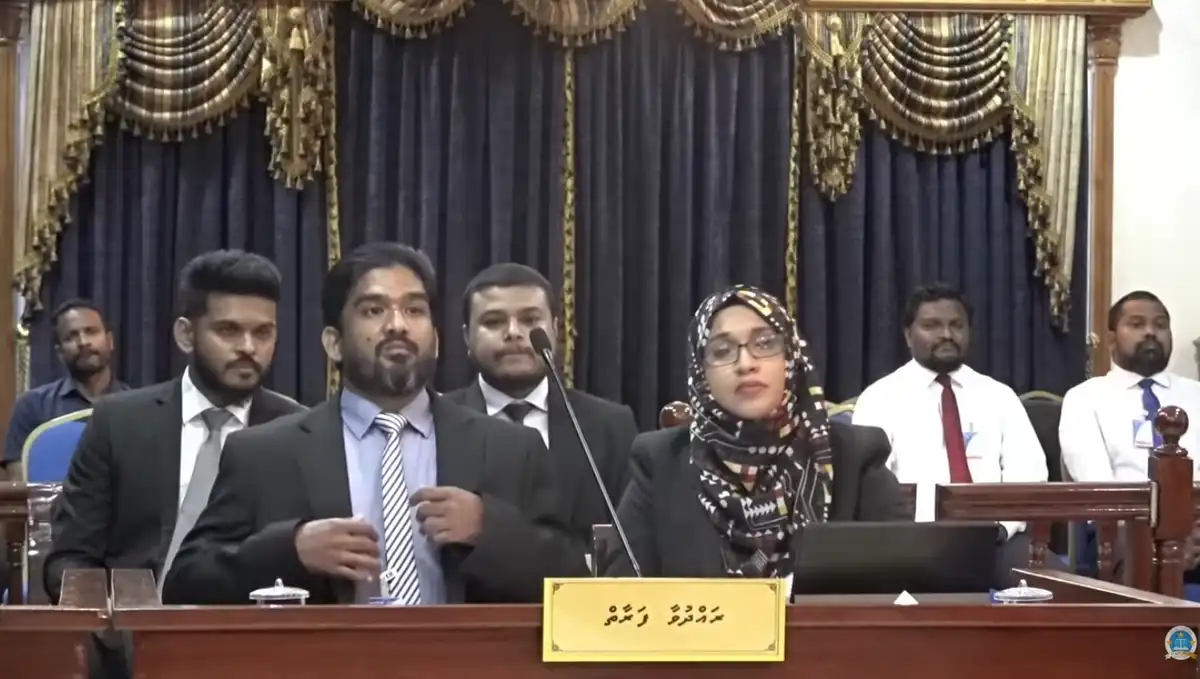
Referendum Case: State Attorneys
The legal counsel argued that Article 262(b) of the Constitution does not outline the procedures for phrasing or designing the referendum question, despite the petitioner's reliance on that specific provision. He further clarified that the requirements and procedures for formulating the question are instead stipulated in the Referendum Act.
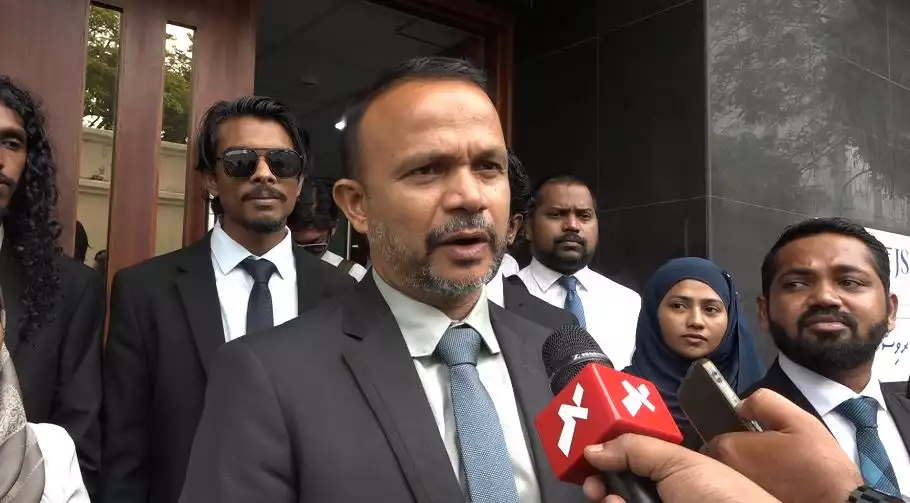
Speaking at the hearing, Senior State Attorney Jude Mohamed Waheed stated that the scope of this case is based on the claim that the matter in question contravenes Article 262(b) of the Constitution. However, the counsel argued that the language of that article clearly indicates it pertains to the procedures to be followed regarding constitutional amendments concerning specific sensitive matters. Furthermore, the State Attorney contended that asserting a contradiction with the intent of that article does not constitute a valid constitutional issue.
The lawyer stated that since the question posed in the President's decree was deemed flawed, the petitioner must clarify how their proposed alternative question rectifies those issues.
During the opportunity to respond to the state's arguments, attorney Ali Hussain stated that the proposed amendment would only result in a six-month reduction within the term of the 20th Parliament. He further clarified that despite this change, the statutory five-year term for members of Parliament remains intact under the law.
Ali Hussain stated that the details must be clearly presented to the public within the referendum question. He further noted that the question has been formulated in a manner that contradicts the underlying purpose of Article 262 of the Constitution.
Following this, the judges sought clarification on several points regarding the case. The Supreme Court bench presiding over the matter consists of Chief Justice Ahmed Muthasim Adnan, Justice Ali Rasheed Hussain, Justice Dr. Mohamed Ibrahim, Justice Husnu Al Suood, and Justice Mohamed Mughnee.
Judge Shaheed, a recent appointee to the court, questioned why the referendum query was being characterized as concealing the issue of the parliament's term, noting that the bill itself is not a secret document.
In response to the question, attorney Ali Hussain stated that the public remains unaware that this proposal would effectively reduce the current parliamentary term by six months. He emphasized that under existing laws, the parliamentary term is still defined as five years. Furthermore, he warned that holding this vote concurrently with the local council elections could lead to unfavorable outcomes.
The local council election is a political contest, whereas what is being integrated with it is a constitutional matter. These are two fundamentally different types of elections. By its very nature, a referendum is not a political election. This is an unnecessary step and an inappropriate question to be posing at this juncture.Attorney Ali Hussain
Unless the judges require further clarification on any matter, the next stage of the proceedings will be the delivery of the final verdict.