Naushad’s Death: Prosecution Relies Solely on Circumstantial Evidence, Fails to Refute Doubts Raised by Defense
7 އެޕްރީލު 2026 | އަންގާރަ 13:01The Criminal Court has acquitted two individuals charged in the fatal stabbing of Mohamed Ahmed Didi (Naushad) inside the "Class" shop in Maafannu, ruling that the prosecution failed to provide sufficient evidence. The court determined that the state’s evidence, including DNA and fingerprint reports, did not meet the required threshold for a conviction and failed to overcome the reasonable doubts raised by the defense.


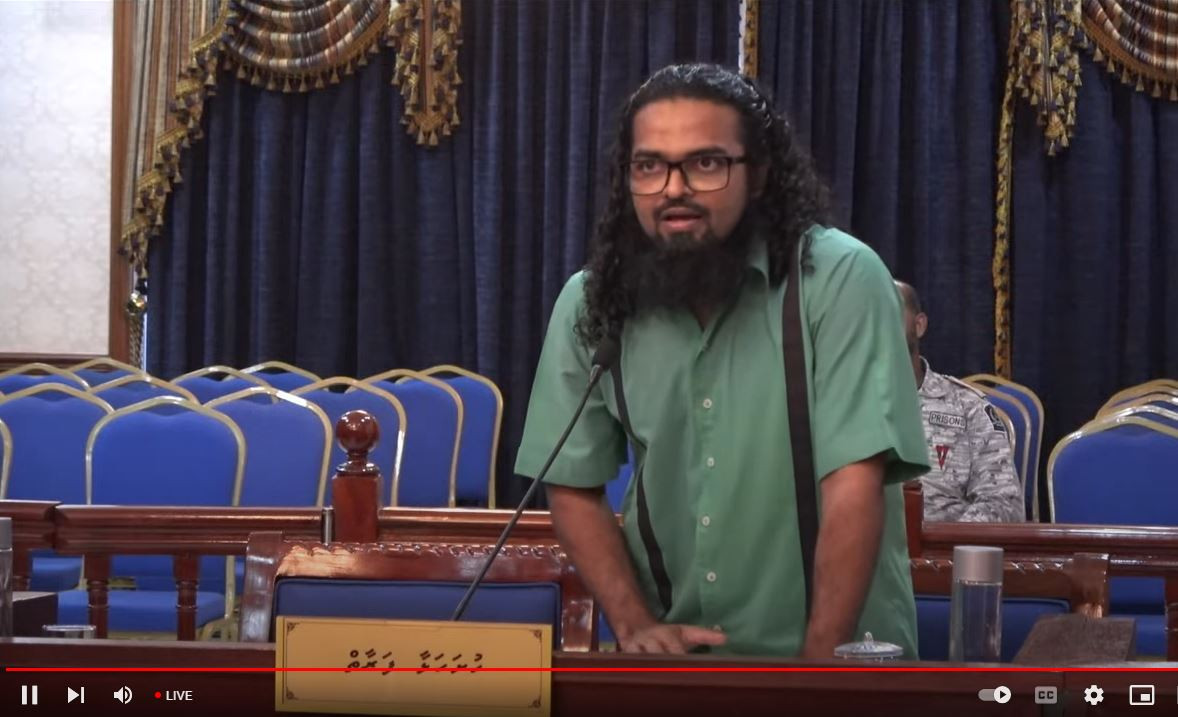
Investigation into the fatal stabbing of a man inside a shop in Maafannu ward. | Social Media | social media
The court has released the final judgment report regarding the fatal stabbing of Mohamed Ahmed Didi (Naushad) of Izmir, S. Hithadhoo.
The incident related to this case occurred on February 24, 2023, at approximately 21:30. Naushad was attacked while inside the "Class" shop located on Muranga Magu in Maafannu. While inside the shop, he sustained deep stab wounds to his head, neck, chest, and abdomen, as well as both knees.
The state has filed charges in this case against Ibrahim Faih Nizam, of Rathdebhaige, S. Maradhoo-Feydhoo, and Siruhan Ali, of Gulhenoorammaage, Th. Gaadhiffushi. The defendants are charged with intentional murder using a sharp object. The indictment was brought under the Act on Prohibition of Threatening and Possession of Dangerous Weapons and Sharp Objects.
The Criminal Court noted that this case was submitted based solely on circumstantial evidence.
The court noted that the defendants can only be found guilty if the entirety of the facts and surrounding circumstances of the case are fundamentally inconsistent with their innocence.
Furthermore, the judge stated that the chain of custody for evidence must remain unbroken and emphasized that there should be no facts or circumstances suggesting the innocence of the defendants.
However, noting that the circumstances of this case were not so straightforward, the judge ruled that the prosecution had failed to prove the charges beyond a reasonable doubt or sufficiently refute the arguments raised by the defense.
In this regard, the judge noted that Faih and Sirhan had presented an alibi defense along with supporting evidence. This further strengthened the doubts raised by the defense, with the judge emphasizing that cases involving Qisas (retaliatory punishment) must be proven beyond any shadow of a doubt.
The presiding judge stated that the chain of custody for the evidence submitted by the state in this case was incomplete. Furthermore, the judge noted that the video and image analysis reports provided very little corroboration to prove that the two defendants were the individuals who committed the crime.
Furthermore, the court noted that according to the fingerprint analysis report, the fingerprints of seven unidentified individuals, in addition to those of the defendant, Siruhan Ali, were found at the scene. The court further highlighted that the identities of these individuals remain unknown.
Furthermore, the court noted that the prosecution's case was weakened by the fact that investigators failed to determine the specific type of DNA sample recovered from the defendant, Faih Nizam. The court also highlighted that an unidentified individual's DNA was found within the same sample, yet the identity of that person remains unknown. Consequently, the court found that these factors lend weight to the defense's argument, which suggests that Faih's DNA could have been transferred to the scene by other means, given that the shop is a public space frequently accessed by various individuals.
Furthermore, the judge noted that while a prosecution witness testified that the incident was an act of retaliation stemming from a series of clashes between two rival groups, the case fails to clarify the evidentiary basis for this claim, and no such supporting evidence was presented. The judge further observed that no evidence was submitted to prove that the police had even conducted an investigation into a string of violent confrontations between the two groups during that period to substantiate the claim. The witness in question was an expert presented by the state to establish the motive behind the crime.
In delivering the verdict, Criminal Court Judge Ibrahim Ihsan ruled that the charge of intentional murder using a sharp object had not been proven to the required legal standard. The judge noted that the prosecution failed to establish the case beyond any doubt—the standard required for Qisas (retaliation) cases—nor had it met the standard of proof beyond a reasonable doubt as mandated under Article 51(h) of the Constitution.