Anantara Maldives Resorts to develop 3D-printed artificial reef
25 ޖޫން 2026 | ބުރާސްފަތި 08:43In a groundbreaking collaboration to restore coral reefs, Swiss company "rrreefs" and Anantara Dhigu Maldives Resort have launched an innovative project utilizing 3D-printed terracotta clay. Named "Theyra Maa," these artificial reef structures are specifically engineered to facilitate coral larval settlement and provide a protected habitat for diverse marine life. This joint initiative between the tourism industry and environmental experts represents a significant step forward in using cutting-edge technology to revitalize the Maldives' coral ecosystems and ensure their preservation for future generations.
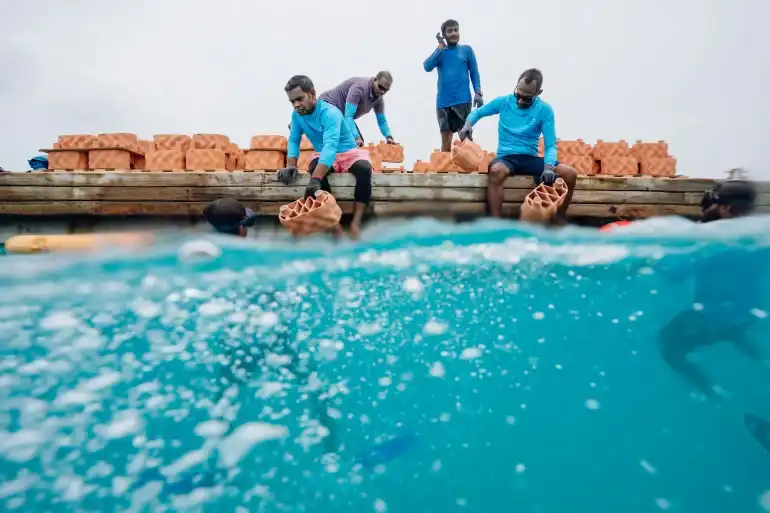
Preparations are underway to deploy hundreds of clay reef modules within the lagoon to initiate a large-scale artificial reef restoration project. | Minor Hotels
Anantara Maldives Resort, located in South Malé Atoll, has installed 13 3D-printed artificial reef structures within its lagoon. This project, conducted in collaboration with the Swiss reef restoration company "rrreefs," aims to regenerate and breathe new life into degrading coral systems.
Named "Theyra Maa" which translated means "13 Flowers", these artificial reefs are constructed using 3D-printed terracotta clay. The structures were designed following microscopic research to facilitate the attachment of coral larvae, promote biodiversity, and encourage the growth of beneficial biofilms.
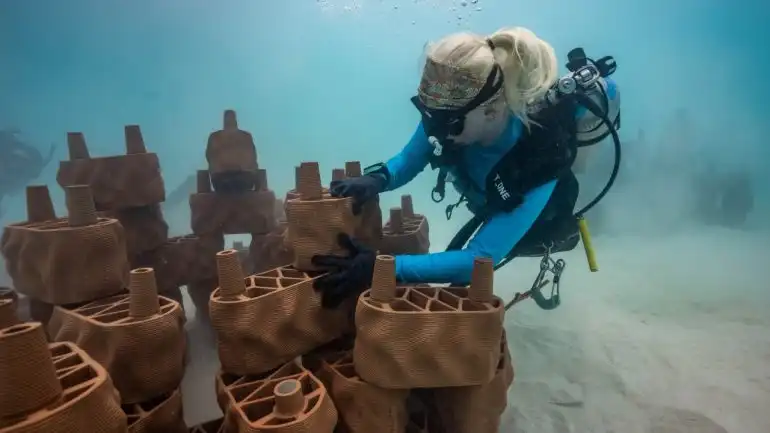
Anantara Dhigu Maldives Resort, located in South Male' Atoll, is currently installing artificial reef structures within its lagoon.
While these artificial reefs utilize a combination of steel and concrete for structural reinforcement, their biological functionality is derived from the specific geometry and intricate pore structures of their ceramic components.
"Every element of this design has been meticulously engineered to facilitate coral growth. The structures are designed to slow down the surrounding currents, making it easier for coral larvae to attach themselves. Furthermore, the small crevices between the 3D-printed clay layers provide a sanctuary for juvenile corals, protecting them from predators and allowing them the opportunity to flourish," said Mauro Bischoff, Head of Production at REEFS.
The project was carried out by a multidisciplinary team of experts. The group included Josephine Graf, co-founder of REEFS; marine ecologist Dr. Julia Spaet; and Dr. Gerrit Nanninga, a research fellow at the Ludwig Maximilian University of Munich.
The "Theyra Maa" project is more than just a scientific endeavor. It marks the first time Reefscapers has collaborated with a commercial resort to undertake such an initiative. The project is reportedly funded through the support of Edelweiss Air, a member of the Lufthansa Group, in partnership with "help alliance."
Oriana Migliaccio, the Resident Marine Biologist at Anantara Dhigu Resort, noted that such collaborations remain a rarity within the industry. "Opportunities like these are still few and far between. We are proud to work alongside 'Reefscapers' and our other partners to restore coral reefs and strengthen our coastal ecosystems for future generations," she said.
The "additive manufacturing" or 3D printing technology utilized in this project is an increasingly popular global solution for marine conservation. This innovation allows for the creation of intricate designs that mimic natural structures, which are often impossible to achieve through traditional manufacturing methods.
Similar initiatives are expanding across other regions of the globe. For instance, the Environment Agency – Abu Dhabi has signed an agreement with the company "Archireef" to deploy 3D-printed reefs constructed from natural materials. In Jordan, the Aqaba Development Corporation, in collaboration with other partners, has also installed 3D-printed concrete reefs. This project was showcased at the United Nations Ocean Conference held in Nice, France, in 2025.
The "Theyra Maa" project stands out not only for the advanced technology it employs but also for its unique operational model. Rather than being a purely academic research initiative, it functions as a commercial venture within a resort setting. This approach offers tourists a firsthand experience of the project, while simultaneously opening new avenues for fundraising and raising environmental awareness.