Former Chief Justice: Supreme Court ruling is undoubtedly flawed and lacks valid constitutional grounds
1 އެޕްރީލު 2026 | ބުދަ 10:26Former Chief Justice Dr. Ahmed Abdulla Didi has characterized the Supreme Court's recent ruling as a "flawed" decision lacking constitutional basis, asserting that any referendum question must be clearly formulated to ensure voters understand the specific articles being amended and their implications.


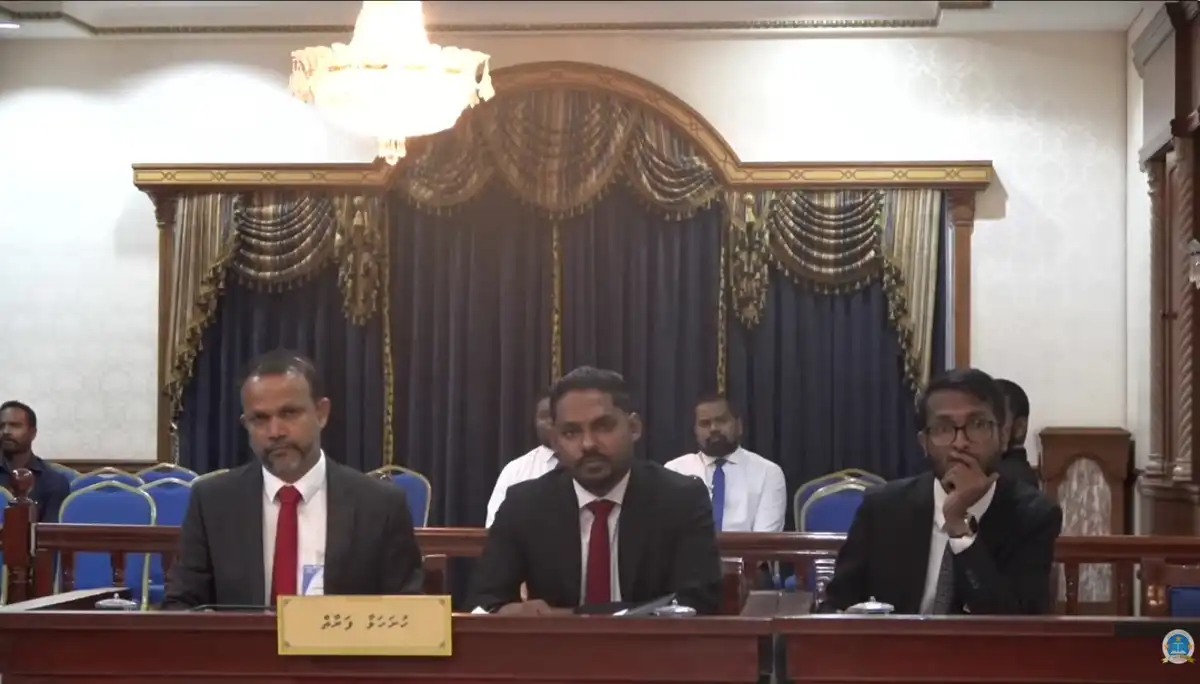
Former Chief Justice of the Maldives, Dr. Ahmed Abdulla Didi, speaking during RaajjeTV’s "Noonekey" campaign program. | RaajjeMV | Raajje MV
Former Chief Justice Dr. Ahmed Abdulla Didi has stated that the Supreme Court's ruling, which declared that the referendum cannot be halted, is not based on valid constitutional or legal principles.
In a post shared on X, Dr. Didi stated that a review of the relevant constitutional provisions and the general principles of constitutional interpretation clearly demonstrates that the Supreme Court's ruling lacks a valid constitutional or legal basis.
Dr. Didi stated that when a constitutional provision is articulated in clear, unambiguous language, it must be applied exactly as prescribed within that text. He emphasized that such matters should be determined strictly by the constitutional mandate rather than through individual interpretation.
In this regard, Dr. Didi noted that Article 162(b) of the Constitution explicitly stipulates that any bill passed by the People’s Majlis to amend specific provisions of the Constitution shall only be ratified by the President if a majority of those voting in a public referendum approve the amendment. He emphasized that this clearly demonstrates that any question posed to the public in a referendum under this constitutional provision must specifically ask whether or not the citizens consent to the proposed constitutional amendment.
He further stated that including any additional language in the question, such as asking whether the President should ratify the constitutional amendment, would constitute a clear violation of the boundaries set forth in Article 162(b) of the Constitution.
Furthermore, Dr. Didi stated that the question proposed in the Presidential Decree for the public referendum on the 8th Amendment to the Constitution is clearly constitutionally invalid. He noted that the question fails to specify the particular amendment or the relevant article under Section 162(b) of the Constitution, which mandates a public referendum for certain constitutional changes. Specifically, he highlighted that the question does not clarify how the amendment to Article 79(a) of the Constitution would alter the term of the People’s Majlis.
Dr. Didi emphasized that in referendums mandated prior to the ratification of constitutional amendments, it is a constitutional requirement that the ballot question be formulated clearly. He noted that voters must be informed of the specific article or articles being amended, and provided with a concise summary of the proposed changes.
For the aforementioned reasons, there is no doubt that today’s Supreme Court ruling is defective, having been issued without any sound constitutional basis or justification.Former Chief Justice Dr. Ahmed Abdulla Didi
Therefore, in light of these reasons, he stated that the Supreme Court's ruling was issued without being based on valid constitutional grounds or principles. In this regard, he characterized the judgment as being, without a doubt, fundamentally defective.