Under the thumb: the slow collapse of independent power in the Maldives
30 މާރިޗު 2026 | ހޯމަ 03:23The Maldivian democratic system is facing a crisis as the executive branch increasingly dominates the legislature and judiciary. The People’s Majlis has become a subservient body that fails to oversee government actions, while the courts struggle to maintain independence amid political pressure. This erosion of the separation of powers undermines constitutional principles and prevents institutions from holding the presidency accountable. Restoring balance is essential to protect the rule of law.


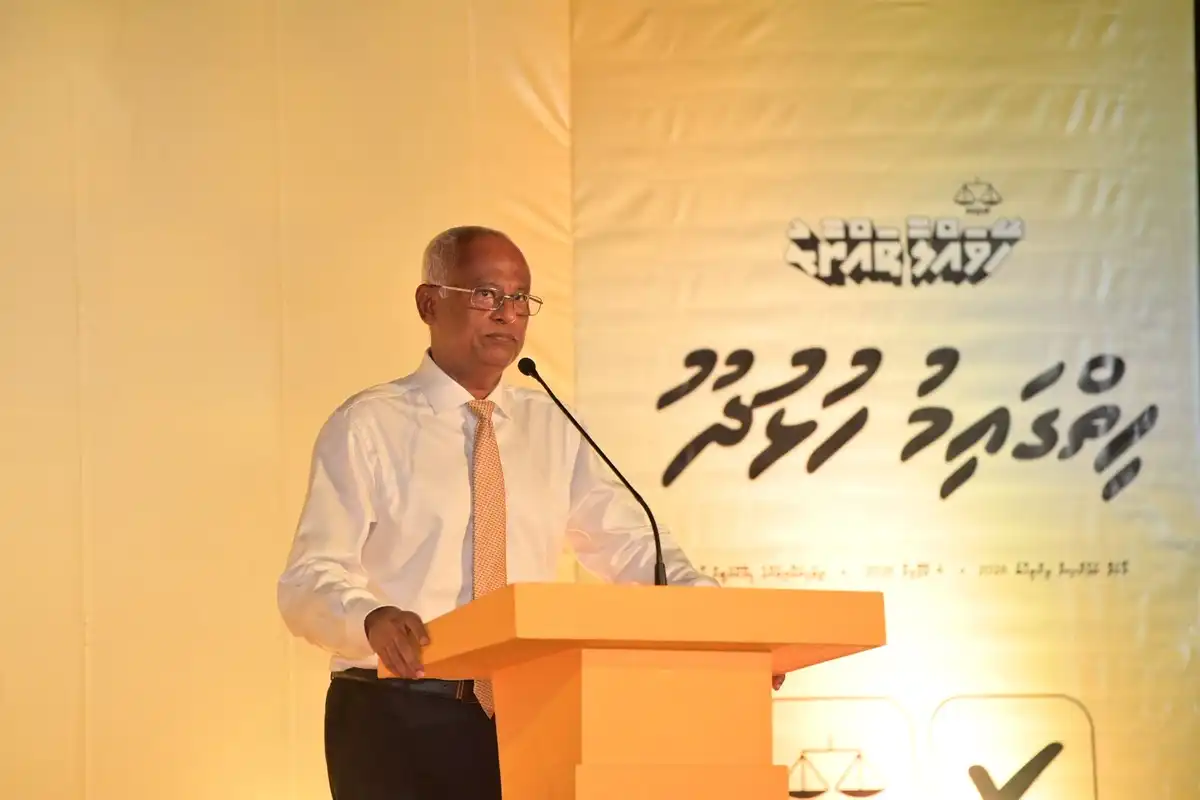
President Dr. Mohamed Muizzu. | President's Office | getty images
The separation of powers is not some decorative flourish for the Constitution; it is supposed to be the backbone of a functioning democracy. Like any modern republic, the Maldives pays lip service to this principle, theoretically dividing authority between the Executive, the Legislature and the Judiciary. Each branch is meant to operate in its own lane, independent and untouched, maintaining a system of checks and balances. Yet, in practice, that equilibrium has vanished. There is a profound public realization that instead of sharing power, every ounce of authority is being vacuumed into the hands of the president himself.
The illusion of accountability
The Maldivian legal framework is built on a pledge of accountability that now feels like a fairy tale. While the Executive governs, the People’s Majlis is tasked with overseeing those actions, and the Judiciary is meant to interpret the law. In an ideal state, these branches would actually disagree, providing the friction necessary to prevent the abuse of power. However, when this vigilance dies and institutions start marching in a single direction rather than monitoring one another, the system’s inherent defenses are effectively eroded.
According to the Constitution of the Republic, the presidency is already a formidable office, granted the power to set national policy, command the security services and handpick key officials. However, these powers were never intended to be exercised without restraint. The People’s Majlis should be the arena where government decisions are debated and challenged. Instead, when parliamentary independence is sacrificed at the altar of political influence and party loyalty, the Majlis transforms into nothing more than a subservient branch of the government. A legislature incapable of questioning authority is a legislature incapable of protecting its citizens.
A judiciary in the shadows
The state of the Judiciary appears equally grim. The courts are supposed to be the final recourse, upholding the law without fear or favor. Judicial independence is not a luxury; it is the foundation. Without it, the rule of law is just a commodity to be traded. While concerns over judicial independence in the Maldives are nothing new, the current climate has reached a fever pitch. When the courts hesitate to challenge the government, or when rulings consistently mirror the interests of the ruling power, one has to wonder if it’s a coincidence or a calculation.
If the Executive branch exerts this much influence over both the People’s Majlis and the courts, "separation of powers" becomes a phrase that exists only on paper. Democracy, in this scenario, is merely a facade.
Constitutional stagnation
A glaring example of this decay is a constitutional amendment that results in parliamentarians losing their seats, which has been conveniently stalled in the Supreme Court for an entire year. The matter remains unresolved and prolonged with no end in sight. While this case sat in limbo, several judges were suspended and lost their positions, only to be replaced by new appointments to the nation's highest court.
The speed at which the government-aligned majority in the People’s Majlis forced this bill through was alarming. Work began in the morning, and by the afternoon, the amendment was passed exactly as the committee decided. This efficient bulldozing of legislation, followed by a year of judicial silence, illustrates the true state of the nation.
The erosion of Article 4
Article 4 of the Constitution explicitly states that all power originates from and remains with the people. Yet, there is a blatant disregard for this principle. When a case was filed to invalidate an amendment that strips away the people’s right to choose their representatives, it became clear that there is currently no institution in the country actually capable of hearing such a matter.
It is no exaggeration to conclude that both the People’s Majlis and the judicial system are now functioning under the long shadow of the Executive. Lawmakers have been reduced to a position where they are compelled to act solely according to the president’s instructions. Overcoming these challenges requires more than just criticism; it requires institutions to actually do their jobs.
The parliament must find its voice, the courts must reclaim their independence and the Executive, must accept that true power lies in balance, not total control.