What were the circumstances surrounding the two Supreme Court precedents cited in court order regarding Adhadhu documentary case?
11 މެއި 2026 | ހޯމަ 08:24The Criminal Court has issued a gag order prohibiting any discussion regarding Adhadhu’s "Aisha" documentary and has mandated that the trial proceedings be held behind closed doors. While the court cited Article 42 of the Constitution and various Supreme Court precedents as the basis for its ruling, critics argue the move stifles public freedom of expression; consequently, the order strictly forbids the disclosure of any information related to the case, whether directly or indirectly.

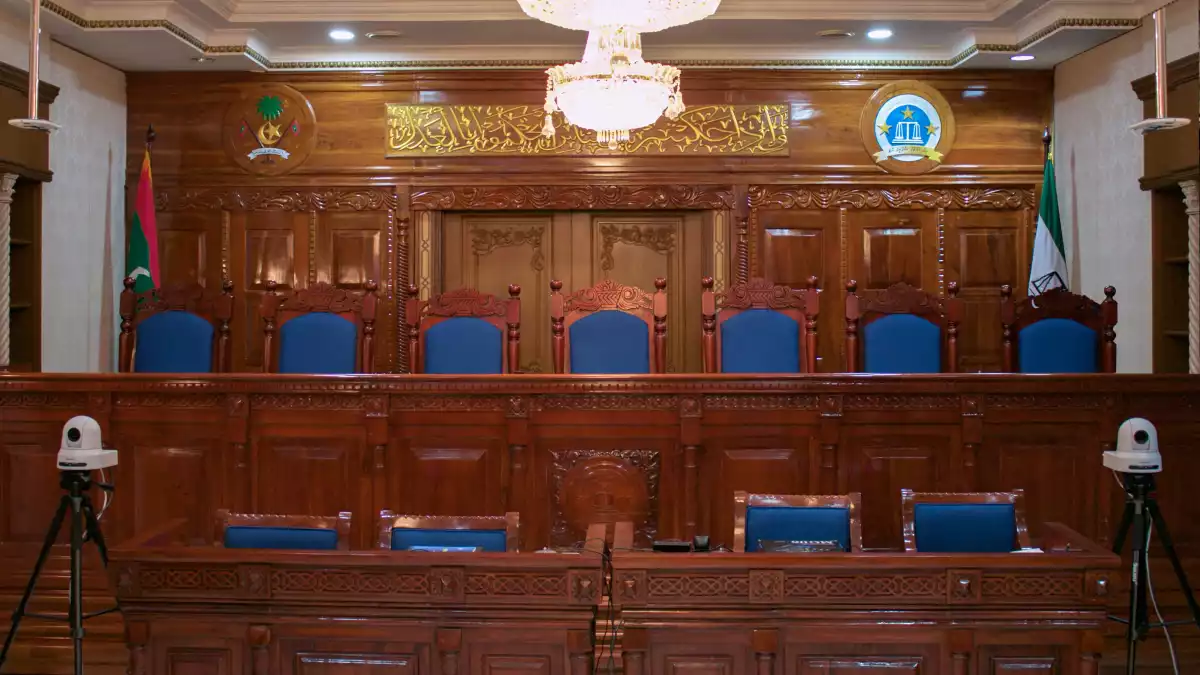
Inside the Supreme Court. | Twitter
The state has pressed charges against the leadership of Adhadhu following the publication of its documentary, "Aisha." Defamation charges have been filed against the news outlet’s CEO, Hussain Fiyaz Moosa, and its Editor, Hassan Mohamed. These legal proceedings were initiated less than 20 days after the investigation into the matter was first made public.
The court order outlines three primary directives. First, it prohibits the broadcasting of any documentary related to the case and bans any discussion of the matter, whether directly or indirectly. Second, it mandates that the trial proceedings be held in camera, closed to the general public. Third, the order stipulates that any violation of these directives will be treated as contempt of court.
The legal basis cited for issuing such an order includes Article 42(c) of the Constitution, as well as precedents established by court orders previously issued in two Supreme Court cases.
Constitution of the Republic of Maldives Article 42:
The order cites Article 42(c) of the Constitution. Article 42 stipulates that: *"While trials must generally be conducted in public, a presiding judge has the discretion to conduct an entire trial, or a portion thereof, behind closed doors for any of the following reasons, provided it is consistent with democratic principles."*
Therefore, an examination of this article reveals that while it allows for court proceedings to be conducted in camera, it emphasizes that such actions must be carried out in a manner consistent with democratic principles. Consequently, it is necessary to deliberate on what constitutes these democratic principles as stipulated in this article, the specific rights and freedoms guaranteed under them, and the extent to which those rights may be restricted.
Cases cited by the Supreme Court:
The Criminal Court order states that the proceedings and reporting on this case are being restricted because hearings involving sexual offenses and other matters of moral turpitude must be conducted behind closed doors. However, in previous cases of this nature that were held in camera, journalists have maintained the right to report on proceedings to a certain extent. This precedent includes cases involving sexual offenses and other sensitive matters of public morality.
The order references mandates previously issued by the court in relation to two separate cases.
One of these orders was issued by the Supreme Court during the appeal proceedings of Mohamed Ameen, who has been charged in a terrorism case. The order states that every individual has the right to be presumed innocent until proven guilty. It further prohibits the dissemination of any opinions or news that could prejudice this constitutional right before a final verdict is reached, noting that any such actions would be considered contempt of court.
The referenced order pertains to the Supreme Court ruling in the case of Ahmed Moosa Mohamed (Ammaty), regarding the charges filed against him in the SeaLife scandal. That order established a similar precedent. Specifically, it stated that until a final court verdict is reached, expressing any opinion that undermines his right to the presumption of innocence shall be considered contempt of court.
Overall, both orders indicate that reporting on the case has not been subject to an absolute ban. Instead, it is noted that both the Supreme Court ruling and the Criminal Court order to which it refers maintain the path for news dissemination within the established legal frameworks.
However, under the order issued by the Criminal Court on May 10, all news media in the Maldives are prohibited from reporting, broadcasting, or discussing any news related to this case, whether directly or indirectly, in any format or program. Furthermore, this restriction extends to political parties and the general public, effectively "taping the mouths" of all Maldivian citizens and silencing any discourse on the matter.