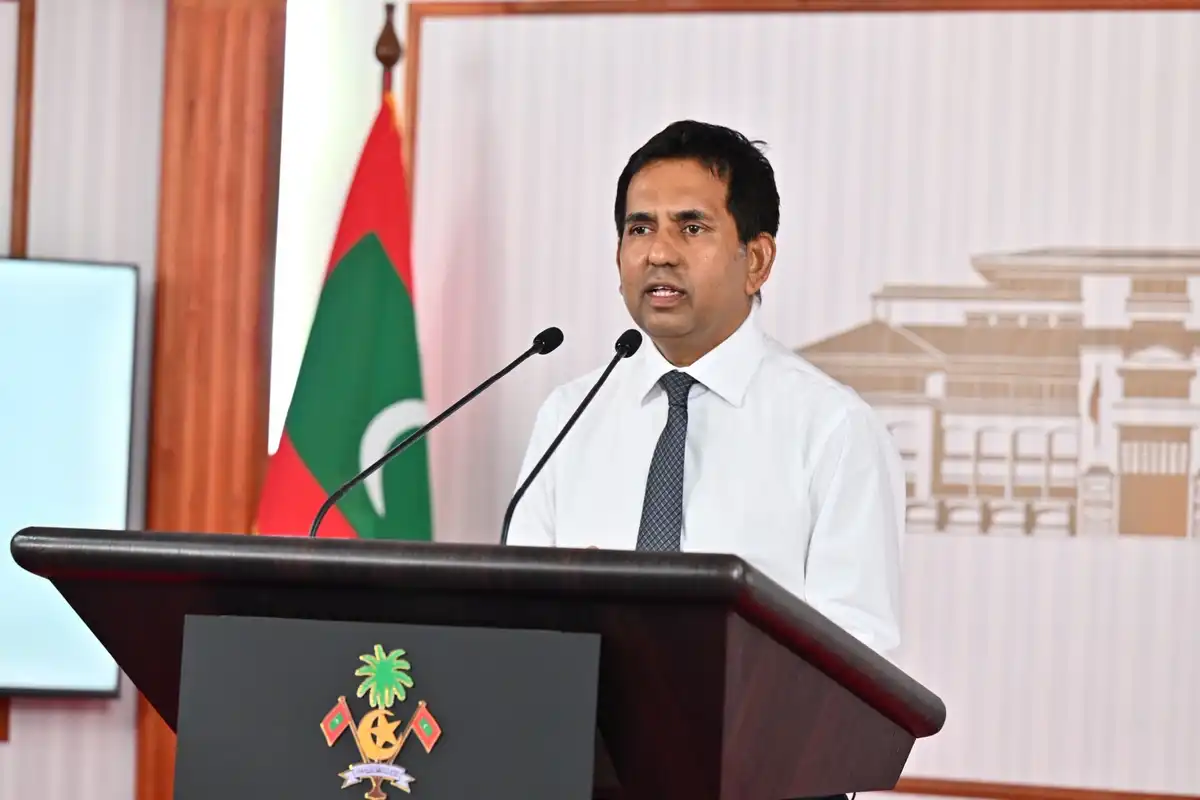
It is "natural" for BML to require additional dollars: Minister Saeed
8 މެއި 2026 | ހުކުރު 09:03Minister Saeed stated that the Bank of Maldives’ increasing demand for foreign currency is a natural consequence of business growth, emphasizing the necessity of facilitating these requirements. He noted that the volume of dollars issued by the bank for business telegraphic transfers and card transactions has doubled this year compared to the last; however, public outcry has intensified following the bank's recent adjustments to card limits, while black market exchange rates have surged past 20 Rufiyaa per dollar.

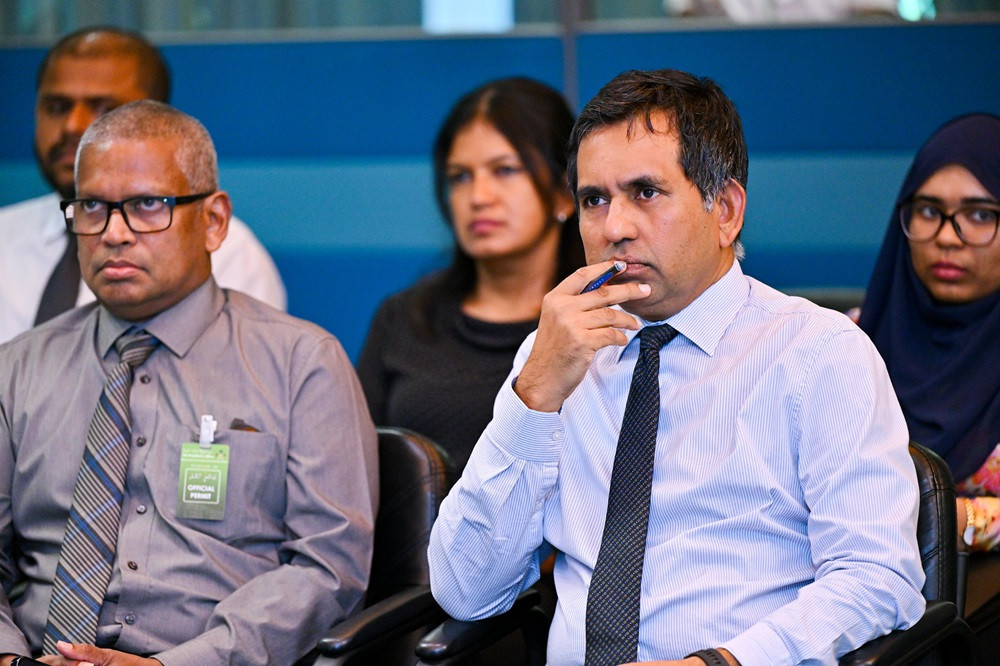
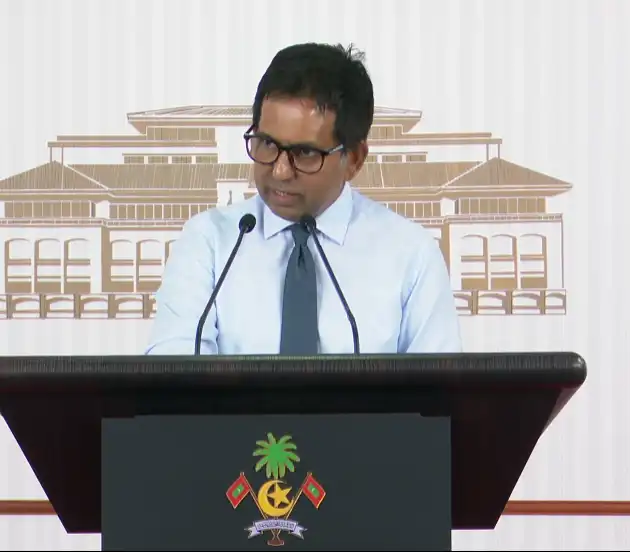
Minister Mohamed Saeed at a press conference held at the President's Office. | president office
Minister of Economic Development and Trade Mohamed Saeed has stated that it is "natural" for the Bank of Maldives (BML) to require additional US dollars and emphasized that such requirements must be facilitated.
Responding to a question at a press conference held at the President's Office on Thursday, Minister Saeed cited Bank of Maldives (BML) figures to detail the total amount of funds released by the bank for business telegraphic transfers (TTs).
Minister Saeed stated that some businesses are generating as many as six different Telegraphic Transfers (TTs). However, he noted that dollars for these transactions can only be released based on the availability of funds at the Bank of Maldives (BML), adding that policy adjustments may be forthcoming.
Regarding the volume of foreign currency released for business Telegraphic Transfers (TTs), Bank of Maldives (BML) reports that the total amount issued for TTs in 2023 reached $175 million. In comparison, by the end of April this year, $136 million has already been released for TTs. While $175 million was issued throughout the entirety of last year, $136 million has been utilized just within the first few months of this year. Looking at the monthly averages, approximately $15 million was released for TTs each month in 2023. However, based on data up to April 2024, the monthly average has surged to $34 million. According to BML, while small businesses averaged $15 million in monthly TTs last year, that figure has risen to $34 million per month this year. This indicates that the demand and subsequent release of foreign currency for TTs has more than doubled compared to the previous period.Minister of Economic Development and Trade Mohamed Saeed
Minister Saeed stated that as businesses expand, the demand for US dollars continues to rise. He noted that it is natural for the Bank of Maldives (BML) to face challenges in dollar inflows or require additional liquidity to meet this growing demand.
Minister Saeed stated that if the Bank of Maldives requires additional foreign currency, efforts must be made to secure the necessary dollar liquidity for the institution.
Looking at the details of Telegraphic Transfer (TT) dollar sales for 2024, January alone saw $35 million across 10,838 transactions. In February, $34 million was processed through 10,550 transactions, followed by $37 million via 10,600 transactions in March. For April so far—excuse me—$30 million has been recorded through 8,955 TT movements. Regarding dollar sales for debit and credit cards, Bank of Maldives (BML) reports that $390 million was spent in 2023, with $160 million recorded so far in 2024. While the monthly average in 2023 stood at $33 million, it has risen to $40 million per month this year. This indicates a significant increase in transactions compared to previous periods, driven by growth in business activity.Minister of Economic Development and Trade Mohamed Saeed
Minister Saeed made these remarks amid growing public outcry following Bank of Maldives' recent decision to significantly reduce the dollar limits on local currency cards.
Effective May 2, 2026, Bank of Maldives (BML) has revised its foreign currency limits, suspending the use of foreign exchange on cards for customers while they are within the Maldives. Additionally, the bank has introduced a monthly cap of 30 transactions for online foreign currency purchases.
President Dr. Mohamed Muizzu assumed office with a pledge to eliminate the dollar black market and bring the exchange rate down to the official rate of MVR 15.45. However, under the current administration, dollar shortages have worsened and the black market has expanded further, with the exchange rate now surging past MVR 20.