Detainees at Dhoonidhoo are being handcuffed and shackled, then forced to lie on mats under the midday sun: HRCM
5 މެއި 2026 | އަންގާރަ 07:22A report by the National Preventive Mechanism (NPM) states that while detainees at Dhoonidhoo Custodial Clinic are handcuffed and isolated during instances of non-compliance to ensure the safety of both officers and inmates, the designated isolation areas are inadequate for this purpose. The report further highlights a failure to maintain logs of basic services provided to detainees and reveals that some individuals have had their privileges suspended for periods of up to 14 days.

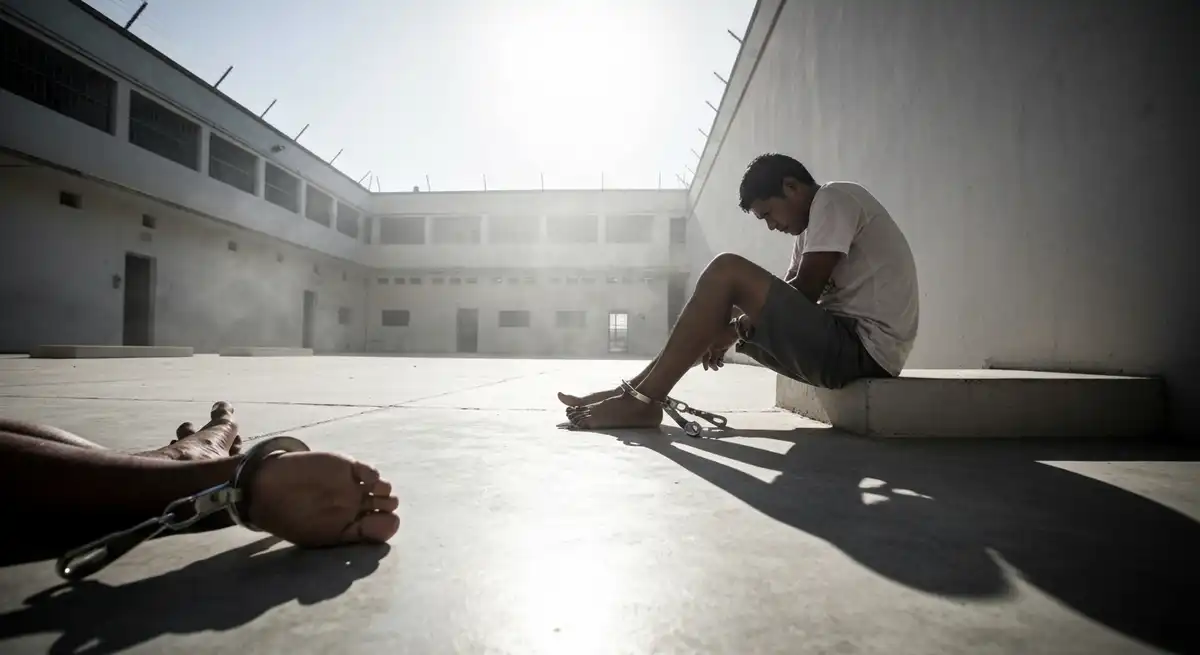
An image showing detainees at the Dhoonidhoo detention facility with their hands and feet restrained by clip-cuffs, forced to sit on a mat under the midday sun. | RaajjeMV
The Human Rights Commission of the Maldives (HRCM) has detailed numerous acts of inhumane treatment in its 2025 annual report, including allegations that detainees at Dhoonidhoo are being restrained with clip handcuffs and forced to lie on mats under the midday sun.
The report states that detainees at the Dhoonidhoo Custodial Facility informed the National Preventive Mechanism (NPM) that those who disobey orders from prison officers are handcuffed and held in an area outside their cells, isolated from other detainees. Prison staff also confirmed to the NPM that, in certain instances, unruly detainees are handcuffed and placed in isolation for a specific duration to maintain general order within the facility.
According to the report, several incident logs indicate that during routine searches, detainees who used profane language and disobeyed orders were handcuffed and placed in isolation. The report further notes that under Section 34(b) of the regulations governing custodial jails, officers are authorized to use handcuffs as a disciplinary measure. This authority applies when a detainee, having been temporarily removed from their cell, continues to show defiance or acts in a manner that poses a threat of injury or danger to themselves or the prison officers. Under such circumstances, officers may exercise their discretion to restrain the individual to halt their disruptive behavior.
The report states that under this article, officers are authorized to use handcuffs, leg irons, mouth gags, straitjackets, or any other suitable restraints to restrict a detainee's movements. This authority is granted only if the detainee exhibits disobedience or acts in a manner that poses a threat of injury or danger to themselves or the correctional officers.
The report emphasizes that handcuffing and isolating detainees should not be used as a punitive measure against disobedient inmates to maintain prison order. Instead, these actions must be strictly temporary measures implemented solely to ensure the safety and security of both officers and detainees.
The report states that the area where detainees are kept handcuffed is a custodial exercise yard, noting that it is not a suitable location for isolation. It highlights that the area becomes excessively hot during midday and that detainees are sometimes kept there for extended periods on mats, with their hands and feet restrained by zip-tie handcuffs.
Although officers reported that detainees are granted opportunities for prayer and restroom breaks during such periods, it was noted that these instances were not recorded in the system logs. Furthermore, a review of the documentation at Dhoonidhoo revealed that the privileges of the detainees held at the facility had been suspended for a duration of 14 days.