State's argument that basic structure of the Constitution is not explicitly defined is a legally baseless and hollow claim: Ali Hussain
14 އެޕްރީލު 2026 | އަންގާރަ 10:38In a Supreme Court challenge seeking to nullify the constitutional amendment that triggers the loss of parliamentary seats for floor-crossing, attorney Ali Hussain argued that the change violates the basic structure of the Constitution. While the state maintains there are no legal grounds for an interim order to stay the amendment, Hussain contended that the provision undermines the independence of lawmakers and infringes upon public rights, asserting that such a fundamental shift cannot be applied retroactively.

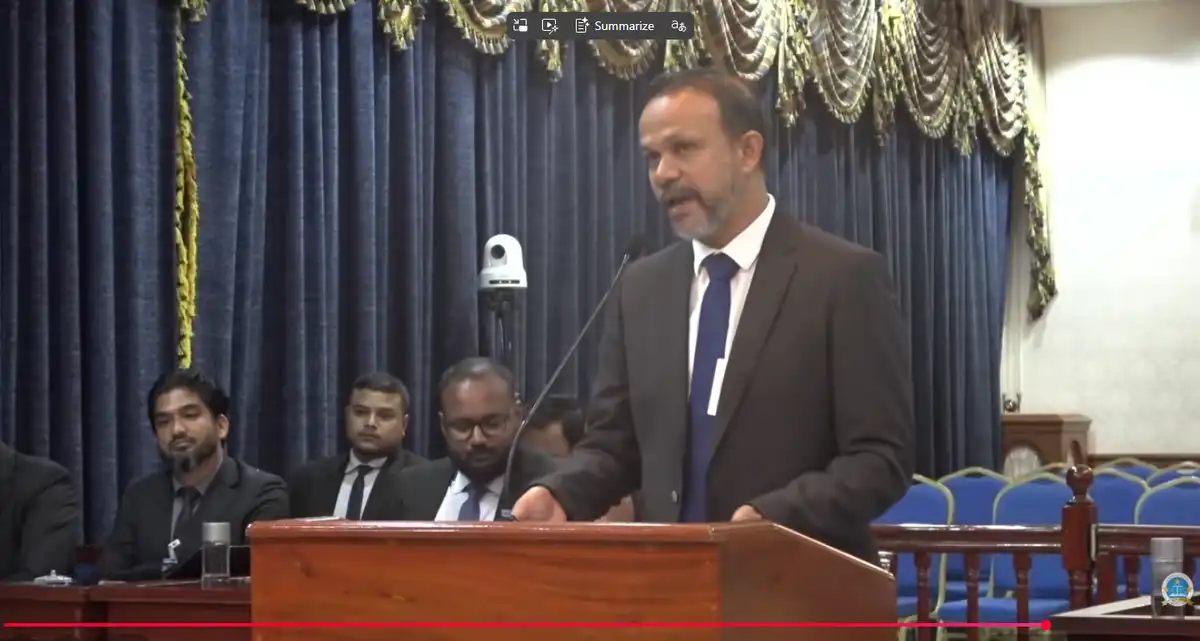
Attorney-at-Law Ali Hussain. | RaajjeMV | Raajje MV
Legal expert Ali Hussain has stated that the government's argument—claiming the Constitution lacks a explicitly defined "basic structure"—is legally baseless and holds no merit.
He made these remarks while discussing the questions raised by the bench during the Supreme Court hearing on the petition seeking to nullify the constitutional amendment that defines the circumstances under which Members of Parliament lose their seats.
When the petitioner filed the case, they also sought two temporary injunctions. One of these requests seeks an interim order to halt all proceedings related to the removal of any Member of Parliament from office until the court reaches a final verdict on the matter.
The second injunction requested was an order to halt any investigations or proceedings related to the dismissal of Supreme Court justices. At the time, this request was submitted amid intensifying rumors that a bill had been introduced to reduce the number of Supreme Court bench seats and remove several sitting judges.
However, before a decision could be reached regarding the temporary injunction, the presiding bench was completely reconstituted. Furthermore, the judges sitting at the time were removed from their positions under various pretexts.
Responding to the request for an injunction, the state attorney argued that the petitioner had failed to establish the legal grounds necessary for the issuance of these two orders.
The state attorney stated that three conditions must be met for the issuance of an interim order. These include the presence of a constitutional dispute, the risk of the case becoming moot before a final judgment is reached, and the necessity of the order to protect the public interest.
The state maintains that neither of the two proposals submitted by the claimant fulfills the necessary requirements.
Following this, the court proceeded to clarify several points. In response to questions from Justice Shujune, the petitioner, Ali Hussain, stated that under the current amendment, a member loses their seat even if they voluntarily resign from their political party. He argued that this contravenes the basic structure of the Constitution. He further noted that in a presidential system, the independence of members of parliament is one of the most fundamental characteristics of the Constitution.
Ali Hussain stated that the state's argument—claiming the basic structure of the Constitution is not explicitly defined—is legally baseless and holds no merit.
The argument that the "basic structure of the constitution" does not exist simply because it is not categorically explicitly stated in the text is, in my view, legally baseless and holds no merit.Attorney Ali Hussain
Furthermore, Ali Hussain highlighted that applying this law to current members of Parliament would constitute retroactive enforcement. He noted that this amendment would infringe upon the rights of the people by imposing conditions that did not exist at the time of the election.