It is unacceptable to use "regulations" to override matters explicitly mandated by law: Ali Hussain
24 މާރިޗު 2026 | އަންގާރަ 10:47The government's decision to amend regulations to allow housing project beneficiaries to transfer small landholdings to family members instead of surrendering them to the state has drawn significant legal criticism. Legal expert Ali Hussain noted that provisions explicitly defined in the Land Act cannot be overridden by administrative "policies" unrecognized by the Constitution.


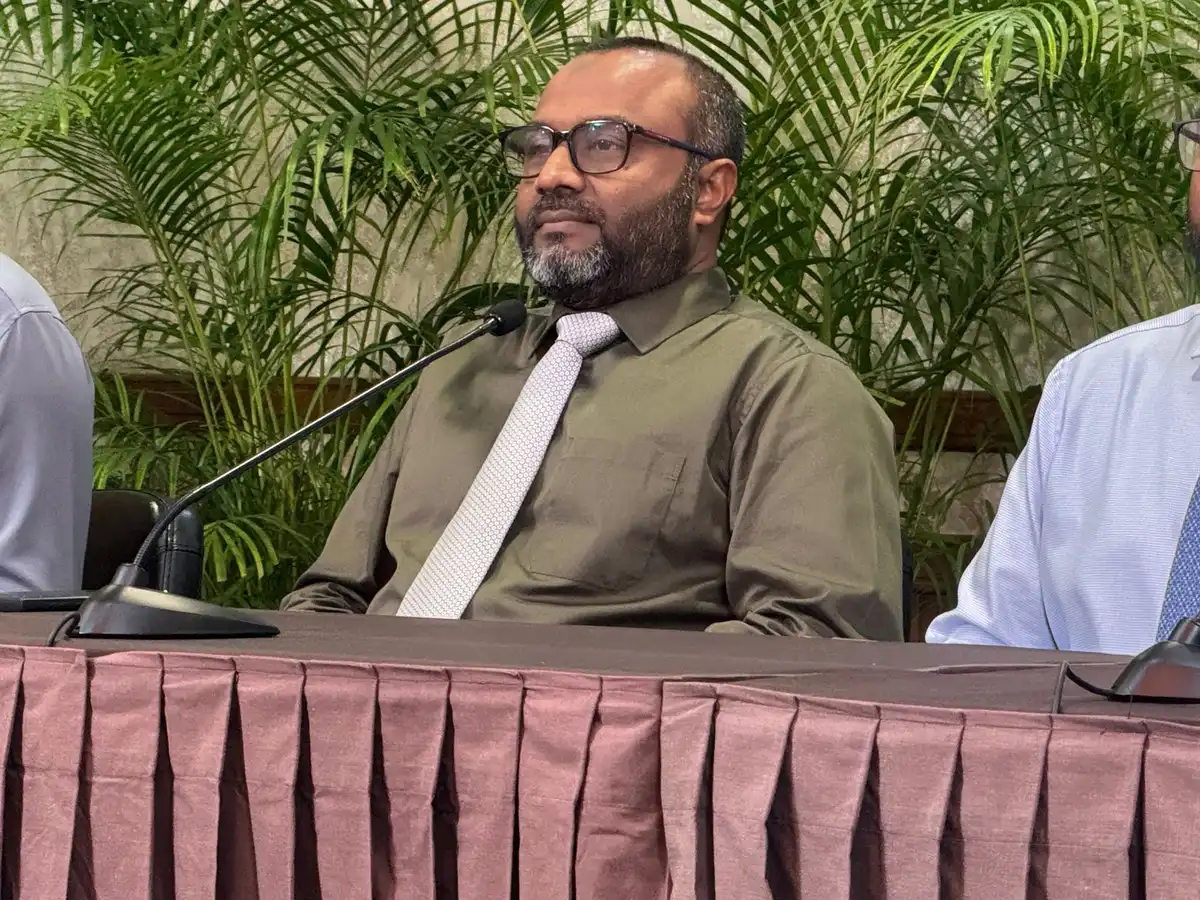
Legal counsel Ali Hussain speaks to RaajjeMV outside the Judicial Service Commission (JSC) — February 27, 2025. | RaajjeMV | RaajjeMV
Legal expert Ali Hussain has stated that it is unacceptable to use so-called "guidelines"—which are recognized by neither the law nor the Constitution—to alter matters specifically mandated by law.
Ali Hussain made these remarks following President Dr. Mohamed Muizzu's announcement regarding a policy change in the government's "Family Housing Program." The President stated that the administration has decided to amend a regulation that previously required applicants for flats and land to surrender any existing small plots of land exceeding 400 square feet to the state.
Speaking at a press conference held at the President's Office on Monday, President Muizzu stated that under current regulations, individuals who are allocated a plot of land or a flat are required to surrender any existing land holdings to the state if the plot is smaller than 400 square feet. However, he announced that this policy will be amended.
The regulations are being amended to allow individuals to transfer their land plots to a spouse, child, or sibling of their choice. There will no longer be a requirement to surrender the land to the government. Instead, the plot can be transferred directly to one of these family members. This provision will also apply to those who were required to relinquish their land under the previous administration's "Binveriya" housing scheme.President Dr. Mohamed Muizzu
In this regard, legal counsel Ali Hussain stated that it is unacceptable to alter matters explicitly defined by law through the application of so-called "principles" that are recognized neither by the law nor the Constitution.
Ali Hussain stated that the Constitution does not recognize the concept of "guidelines" (Usool), noting that such a term is nonexistent within the constitutional framework. He explained that after the Constitution was first ratified, the Attorney General's Office at the time introduced the practice of drafting guidelines, which subsequently became a common occurrence. Ali Hussain further emphasized that the Constitution only recognizes the Constitution itself, formal laws, and regulations. Therefore, he maintained that the legal framework established by the Constitution does not acknowledge the validity of mere guidelines.
This cannot be achieved simply by amending regulations. The Land Act explicitly stipulates that land cannot be assigned or transferred to another party unless it aligns with established legal principles. The Act categorizes specific individuals to whom land may be granted, whether as a gift or through other means. No one outside of these defined categories can be granted land. To facilitate such a transfer, the Land Act itself must be amended. The authorities cannot allocate land to others merely by changing administrative procedures.Attorney-at-Law Ali Hussain
The legal framework in the Maldives operates on a top-down hierarchy. This structure begins with the Constitution, followed by Acts of Parliament, regulations, policies, circulars, and finally, official correspondence. However, this administration is operating in total disregard of established laws and regulations.
Any policy that conflicts with an Act or the Constitution is inherently void. This government has carried out numerous such actions. Specifically, the cancellation of registrations for the 4,000 housing units, as well as land plots in Phase 3 and Giraavaru, was executed by merely creating a new policy. This is not a legally permissible way to conduct such affairs.