Upon returning to Male’ after advocating for reef conservation in Germany, President Muizzu promotes the operations of two dredgers currently working without any regard for the protection of the reefs
13 ފެބުރުއަރީ 2026 | ހުކުރު 17:51Environmental experts and the public are expressing grave concern over irreversible ecological damage caused by large-scale land reclamation projects in Kaafu Atoll. The lack of adequate protective measures during the reclamation of Ras Male' and Giraavarufalhu has led to extensive sedimentation on coral reefs, severely impacting renowned dive sites and threatening the local fishing industry.
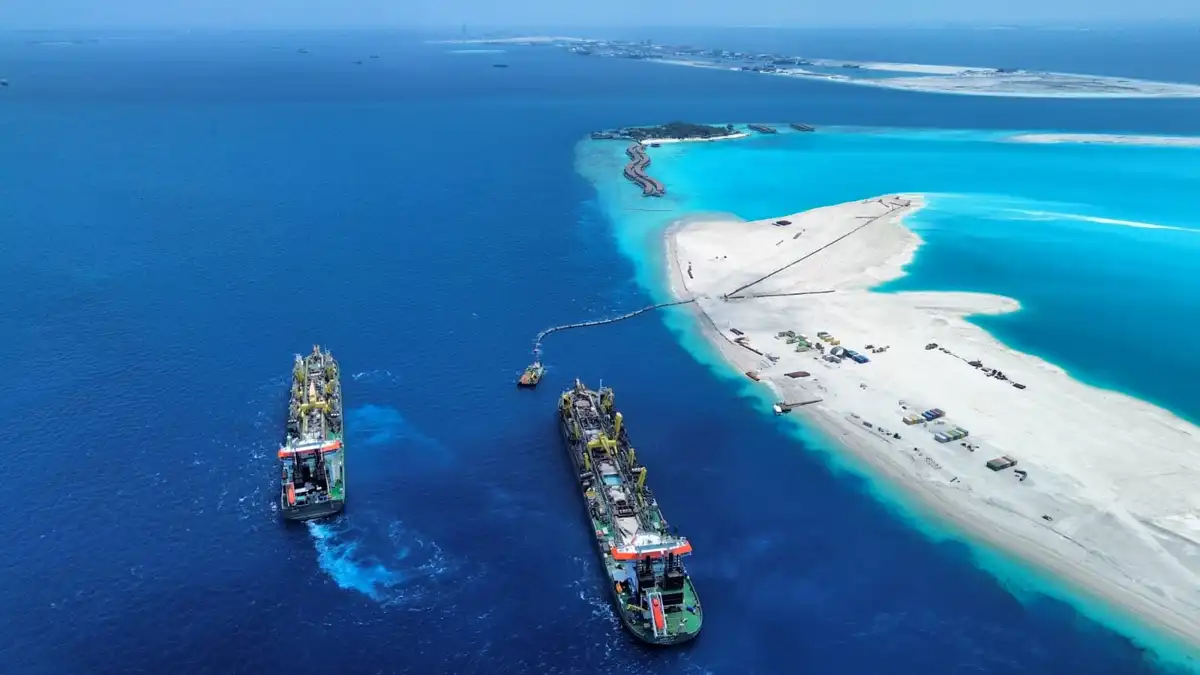
Land reclamation efforts at Giraavarufalhu are currently underway, with two dredgers operating simultaneously to expedite the project. | X | X
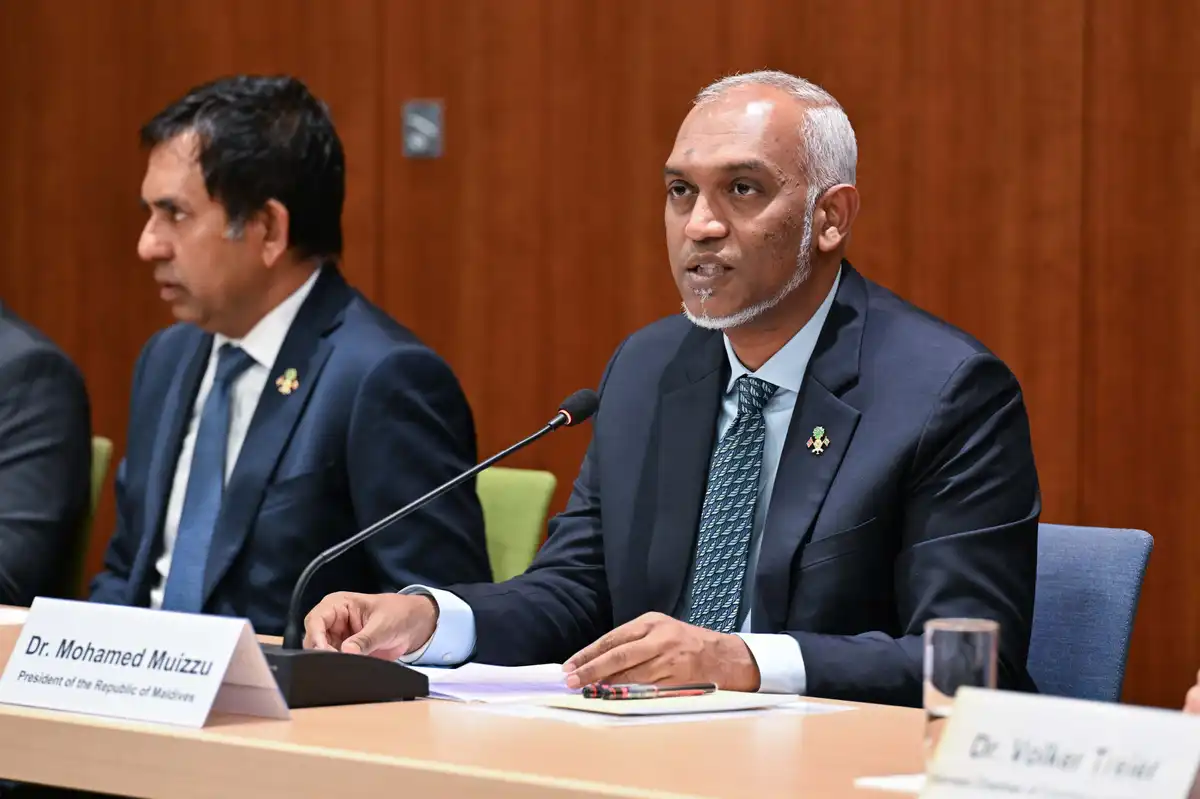
Upon returning from a trip to Germany where he highlighted the critical importance of protecting the Maldives' coral reefs, President Muizzu has promoted the use of two dredgers that are currently operating with a complete disregard for reef conservation.
On Friday evening, President Mohamed Muizzu announced that land reclamation at Giravarufalhu is underway using two dredgers, sharing photographs of the ongoing operations.
Muizzu's post has drawn heavy criticism from several quarters.
A commenter on X stated, "By reclaiming land with two dredgers, you are destroying the reefs across the entire Male' Atoll." They further noted, "You visit various places and speak eloquently about the environment, yet your actions are the exact opposite."
During his visit to Humboldt University last week as part of his official trip to Germany, President Muizzu described coral reefs, mangroves, and other natural resources as the most cost-effective and efficient defenses against climate change. Furthermore, President Muizzu emphasized that climate adaptation efforts and national development must progress hand in hand.
Meanwhile, Maldives Airports Company Limited (MACL) has announced that 84 percent of the land reclamation for the Ras Male' Site A project has been completed, even as the process continues to spread sediment across the entire Male' Atoll.
Maldives Airports Company Limited (MACL) has announced that 116 hectares of the 137.5 hectares designated for reclamation at Rasmalé Site A have been completed. This represents 84 percent of the total land area planned for the site. While the world’s largest dredger continues the reclamation of Fushidhiggaru Falhu, divers, environmental experts, and fishermen have raised concerns, alleging that the operation is proceeding without the necessary environmental safeguards.
Physical reclamation work on Ras Male' Site A commenced on December 1, 2025. The dredging operations for this project are being carried out by Jan De Nul Group using the Trailing Suction Hopper Dredger (TSHD) "Cristobal Colon".
Rasmalé, also branded as the "Maldives Eco City," is a massive land reclamation project currently underway at Fushidhiggaru Falhu, located in close proximity to the capital, Malé. Despite its designation as an eco-city, the project is being executed with an apparent disregard for environmental preservation. Concerned stakeholders have described the extensive damage being inflicted upon the local coral reefs as an "environmental crime."
While the government continues to implement this project, it has yet to disclose any information regarding the project's costs or the associated environmental concerns.
The government states that the primary objective of this opaque project—which involves reclaiming 1,150 hectares of land, an area nearly three times the size of Hulhumale’ Phase 1 and 2 combined—is to establish 65,000 housing units and provide a permanent solution to the housing crisis.
The Housing Development Corporation (HDC) has stated that this is the largest land reclamation project ever undertaken in the history of the Maldives.
Land reclamation is being carried out by extracting sand from various locations within the atolls and pumping it through pipelines into lagoons to create new land. Many observers have pointed out that no visible measures are being taken to contain the resulting silt and sediment during this process. As a result, there is growing public concern over the environmental impact, as sediment spreads far beyond the reclamation sites and onto the reefs, threatening coral ecosystems and delicate marine life.
Despite the widespread circulation of photos and videos on social media and online news outlets documenting the environmental damage and public concern, neither the Ministry of Climate Change, Environment and Energy nor the environmental regulatory authority—both under the full control of the government—have issued a statement. In contrast, it is noted that the Environmental Protection Agency has previously taken stringent measures in response to similar incidents of significant environmental degradation.
Diving service providers report that several renowned dive sites in Kaafu Atoll have become unusable due to ongoing land reclamation projects. Reports indicate that spreading silt and sediment have settled on these sites, deteriorating conditions to the point where diving is no longer viable. This has led to a decline in diver numbers, resulting in significant financial losses for diving centers. Some divers have noted that they have already ceased operations at several of these locations.
In addition to Ras Male' and Hulhumale', the government is simultaneously executing several large-scale land reclamation projects across various locations in Malé Atoll. Despite the scale of these operations, no measures have been implemented to control sedimentation. Furthermore, during the reclamation of Hulhumale' Phase 3, allegations surfaced regarding the disposal of waste into the sea as part of the filling process. The relevant government authorities have failed to take any action regarding these issues, despite a precedent of imposing substantial fines for the disposal of waste into the ocean in previous instances.
While the reclamation of Ras Male' is underway using the 'Cristobal Colon', one of the world's largest dredgers, two additional vessels have also been utilized for the reclamation of Hulhumale'.
Speaking on condition of anonymity, an environmental expert stated that the European dredging companies involved must be held accountable for the extensive damage caused to the reefs of Male' Atoll.
"They would never be able to cause such extensive damage in their own country. They are exploiting the fact that the government has halted enforcement actions here," he said.
Observations from divers and satellite imagery reveal that the sediment plume has extended well beyond the boundaries of Hulhumale'. Reports indicate that the house reef of Kurumba Maldives, located near the airport, has sustained significant damage, while the renowned 'Banana Reef' is also being adversely affected.
Fishermen have also voiced their grievances, stating that government negligence is causing significant damage to the fishing industry in addition to the tourism sector. According to the fishermen, the accumulation of silt has also led to a decline in bait fishing within the atoll's inner waters.
Satellite imagery from Sentinel-2 reveals that a massive plume of sediment spread across a vast area of Kaafu Atoll last January, leaving the surrounding waters heavily turbid.