Officials of Muizzu administration being granted opportunity to engage in corruption without fear of consequences: Transparency Maldives
10 ފެބުރުއަރީ 2026 | އަންގާރަ 20:26The Maldives has been ranked 91st globally with a score of 39 points in Transparency International’s 2025 Corruption Perceptions Index.

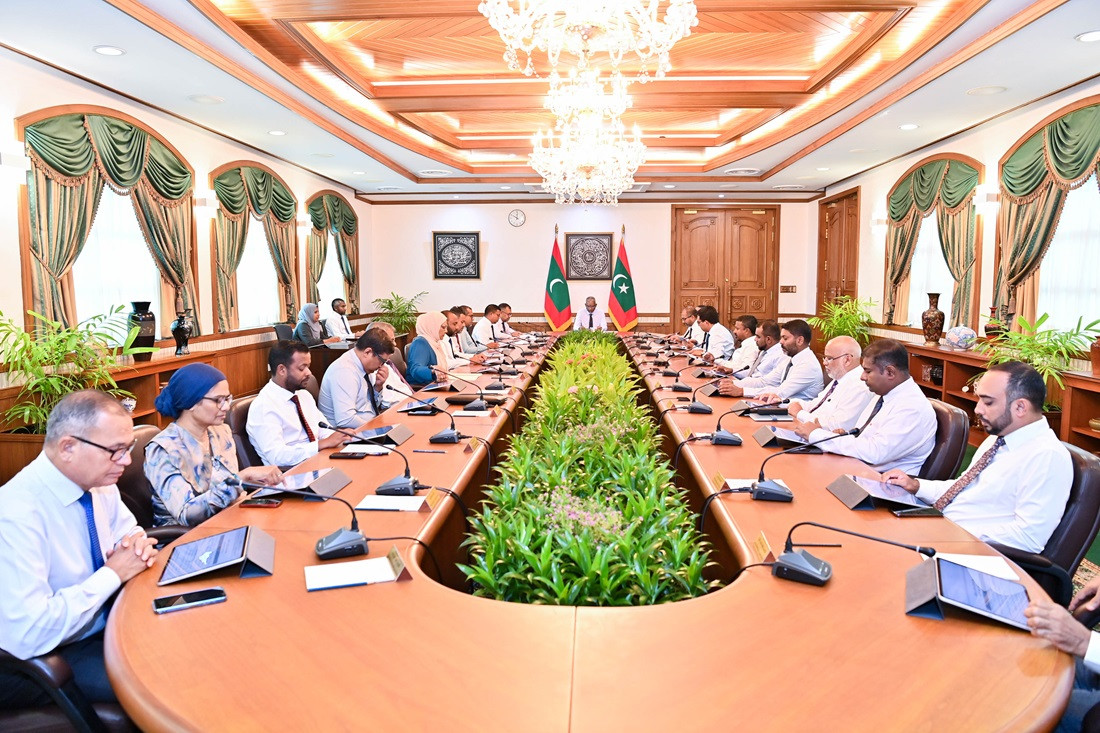
From a meeting of President Muizzu’s Cabinet of Ministers | President's Office | president office
Transparency Maldives has stated that the lack of transparency within President Dr. Mohamed Muizzu’s administration, coupled with politically motivated decision-making, has paved the way for unchecked misconduct. The organization further noted that these factors allow state officials to act with total impunity, free from the fear of legal consequences or accountability.
The Maldives scored 39 points in the 2025 Corruption Perceptions Index (CPI) released by Transparency International on Tuesday.
In a statement, Transparency Maldives highlighted that persistent challenges in enforcing anti-corruption measures and ensuring accountability are undermining the country’s democratic governance. The organization noted that weak oversight, a lack of transparency, and politically motivated decision-making have created an environment where illicit activities flourish, allowing state officials to act with impunity.
Transparency Maldives stated in its report that people remain hesitant to report corruption and abuses of power due to the lack of a robust legal framework. This is further exacerbated by low conviction rates for perpetrators and the failure to fully implement legal protections for whistleblowers.
The organization has called on the government to adopt Transparency International’s recommendations to take decisive action against corruption and rebuild public trust, urging the administration to prioritize specific key measures.
Transparency Maldives calls on the government to address key issues
- Ensuring the independence and impartiality of key state institutions, including independent bodies, the judiciary, and local governance structures, while eliminating political influence in appointments to prioritize merit and professional competence.
- Upholding the principles of decentralization as enshrined in the Constitution to empower local councils and strengthen democratic governance.
- To ensure citizens can participate meaningfully within the governance system and to provide opportunities for holding state institutions accountable, it is essential to protect civic space, press freedom, the right to information, and other fundamental freedoms.
- Strengthen the transparency and accountability of all state institutions and state-owned enterprises to prevent the misappropriation of resources, eliminate the culture of impunity, and mitigate the risks of corruption.
- Strengthening anti-corruption frameworks by implementing robust monitoring systems, ensuring the disclosure of financial statements, and effectively enforcing legal structures for the recovery of illicitly obtained assets and funds, while providing comprehensive protection for whistleblowers who report acts of corruption.
- To ensure increased public participation and inclusivity in the legislative process, policy formulation, and developmental stages, while guaranteeing that governance remains responsive, participatory, and aligned with decentralized principles.
- To reduce opportunities for corruption and safeguard state resources, national governance frameworks must be aligned with international standards, such as the United Nations Convention against Corruption (UNCAC) and the Open Government Partnership (OGP).
The CPI is an annual index that measures the perceived levels of public sector corruption in 182 countries and territories worldwide, based on a composite of surveys and expert assessments.
The index scores countries on a scale of 0 to 100, where 0 represents the highest level of perceived corruption and 100 indicates the lowest. With a score of 39, the Maldives is ranked 91st out of 182 countries in the 2025 Corruption Perceptions Index (CPI).