Grand Chagos illusion and baffling logic of Maldivian sovereignty
4 އޯގަސްޓު 2026 | އަންގާރަ 08:21Although President Muizzu asserts that the Chagos Archipelago is Maldivian territory, his support for the islands remaining under British administration reveals a clear policy contradiction. Furthermore, as the administration’s term progresses beyond its midpoint without any tangible actions or practical results challenging international court rulings on the matter, it is becoming increasingly evident that these statements are being made solely for political gain.
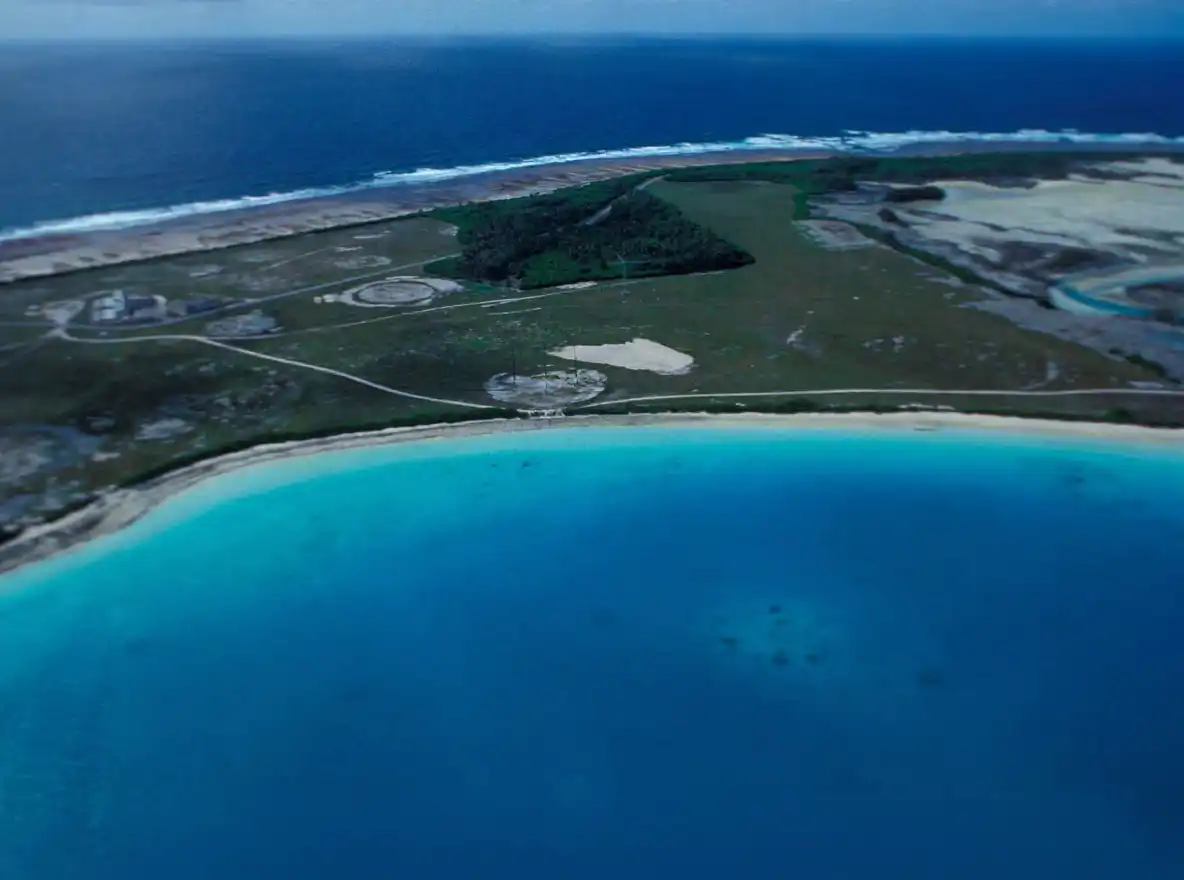
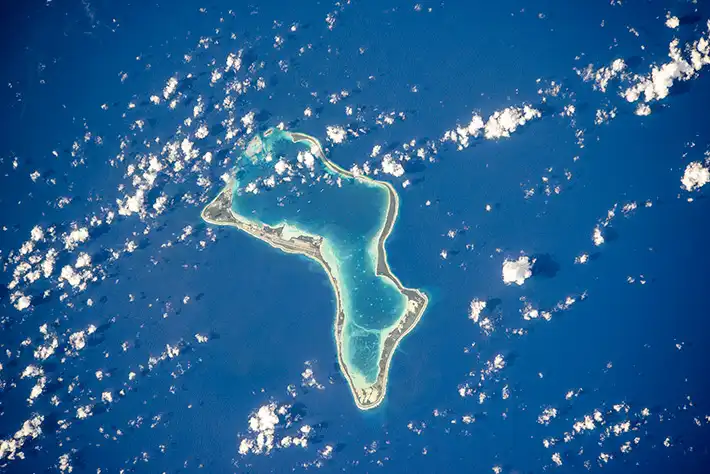
Aerial view of roads and buildings on Diego Garcia Islands in the Indian ocean. | getty images
The executive leadership in Malé City loves to boast about ancient borders, however the official narrative regarding the southern archipelagos seems hopelessly lost at sea.
President Dr. Mohamed Muizzu has repeatedly insisted that the Chagos Archipelago, historically recognized as Peros Banhos, belongs strictly to the citizens of the Maldives.
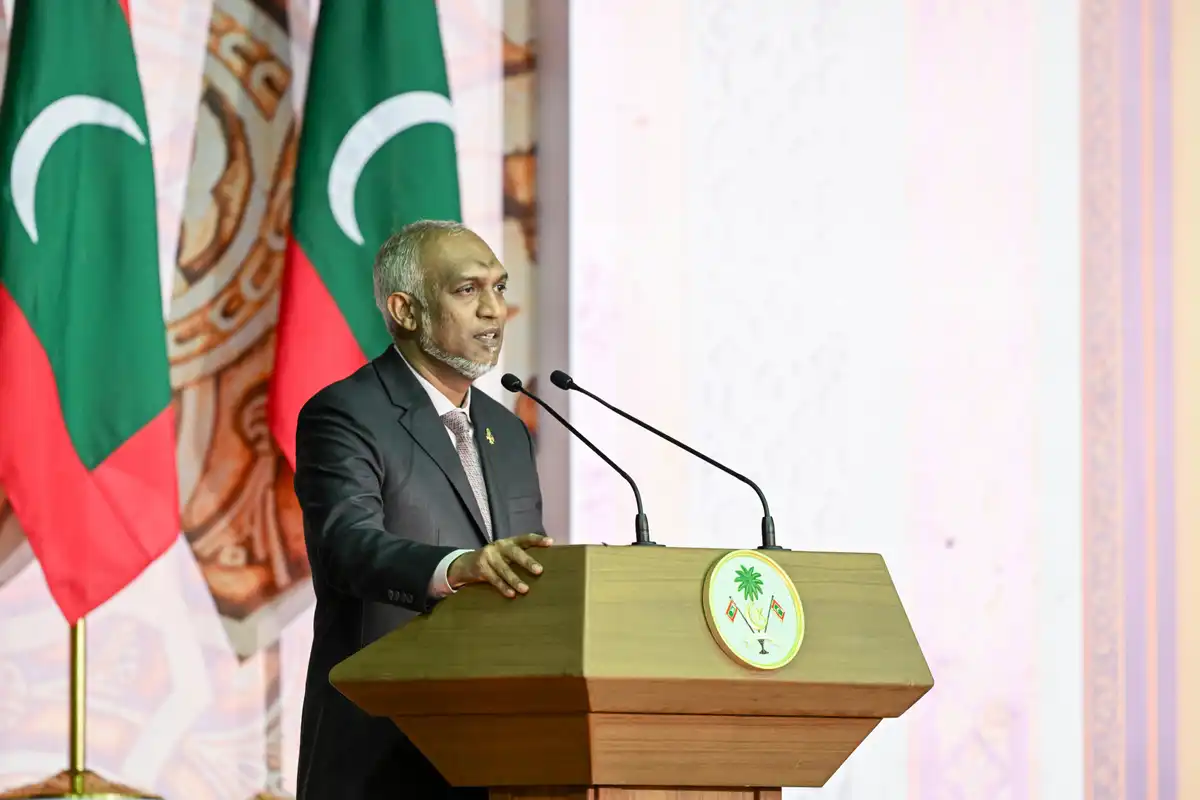
Since taking office, he has broadcast this exact narrative across every possible venue, from the formal inauguration of the legislative sitting at the People's Majlis and a fiery speech during the Independence Day celebrations to the third segment of the state broadcaster’s Nation Chat program.
During that broadcast, he proclaimed with total conviction that historical reality places the territory squarely within ancient Maldivian boundaries.
However, in the very same breath, he suggested that the ongoing British occupation of these islands remains entirely tolerable, provided the land is not transferred to any foreign power other than the Maldives itself.
Double standards on imperial soil
This contradictory stance raises glaring questions about the administration's true commitment to territorial integrity.
If every inch of land and ocean rightfully belongs to the Maldivian people, there is zero justification for permitting a foreign monarchy to maintain control over a single grain of sand or a drop of surrounding water.
Such tolerance might make sense had a formal accord historically ceded the territory to Great Britain, but that is simply not what happened. Imperial Great Britain acquired the islands through the Treaty of Paris, taking control when France surrendered its colonial possessions, including Mauritius.
When Mauritius later gained sovereignty, the British detached the Chagos group to establish the British Indian Ocean Territory.
Why the current administration implicitly accepts a colonial deal between France and Great Britain remains a mystery, especially when the logical course would be demanding complete liberation and immediate return of the land.
Where was the patriotism during the court battles
The historical hypocrisy becomes even more glaring when looking at recent legal history.
The International Court of Justice explicitly declared in 2019 that Great Britain must surrender the archipelago to Mauritius, a directive reinforced in 2021 by the International Tribunal for the Law of the Sea. Back when these landmark cases were being argued on the global stage, the Maldives remained silent, despite functioning governments being in power. While the current president now wraps himself in intense nationalistic rhetoric, one must ask where his vocal outrage was when those international lawsuits were actually underway.
Did he ever press the previous government on why they failed to intervene in court, or did he only stumble upon the famed historical documents of King Hassan IX after moving into the president's office?
Whatever the reasons for past inaction, accepting prolonged British control simply out of deference to global superpowers completely undermines any claim of genuine sovereignty.
Paper objections and casual phone calls
Beyond the grandstanding about sixteenth-century maps and royal letters, the administration’s pledge to reclaim the lost maritime territory has produced zero tangible outcomes.
Despite public promises of tireless work, the actions taken so far resemble mere bureaucratic theater. The government claims to have dispatched written protest letters to British authorities in late 2024 and early 2026 to oppose handing sovereignty to Mauritius.
However, sending letters to London ignores the fact that the transfer stems from international judicial mandates rather than a simple British preference.
Similarly, attempting to tackle a major geopolitical crisis through a single telephone discussion with British Deputy Prime Minister David Lammy in late 2025 highlights a staggering lack of seriousness. Reaching out to Mauritius and the International Union for Conservation of Nature regarding potential economic damage to Maldivian tourism and fishing yields equally pointless results, considering Mauritius has cut official ties and the conservation group lacks any legal power to alter international borders.
Military bases and foreign rejections
The administration's policy contradictions reach a peak with the Diego Garcia military facility. The president indicated that if the archipelago were returned to the Maldives, the United States military would be permitted to maintain its station on Diego Garcia.
This willingness to accommodate foreign troops directly clashes with his solemn presidential address on February fifth, in which he vowed never to yield a single speck of national territory.
Observers are left wondering whether this is merely a setup for a future nationalist protest campaign against American forces, or simply an unprincipled compromise.
Regardless of these political maneuvers, both world powers have already shut the door on Malé City's ambitions.
British officials firmly maintain that the status of the archipelago is strictly a two-party affair between themselves and Mauritius, while American President Donald Trump reportedly made it clear that any entity attempting to disrupt military operations or lease terms would face immediate military retaliation.