Former Finance Minister Ameer calls on government to maintain transparency and provide the public with comprehensive details regarding its strategy for refinancing sovereign sukuk
12 ފެބުރުއަރީ 2026 | ބުރާސްފަތި 15:33Former Finance Minister Ameer stated that ensuring transparency in refinancing state debt is not optional, but a fundamental necessity to maintain public and investor confidence.
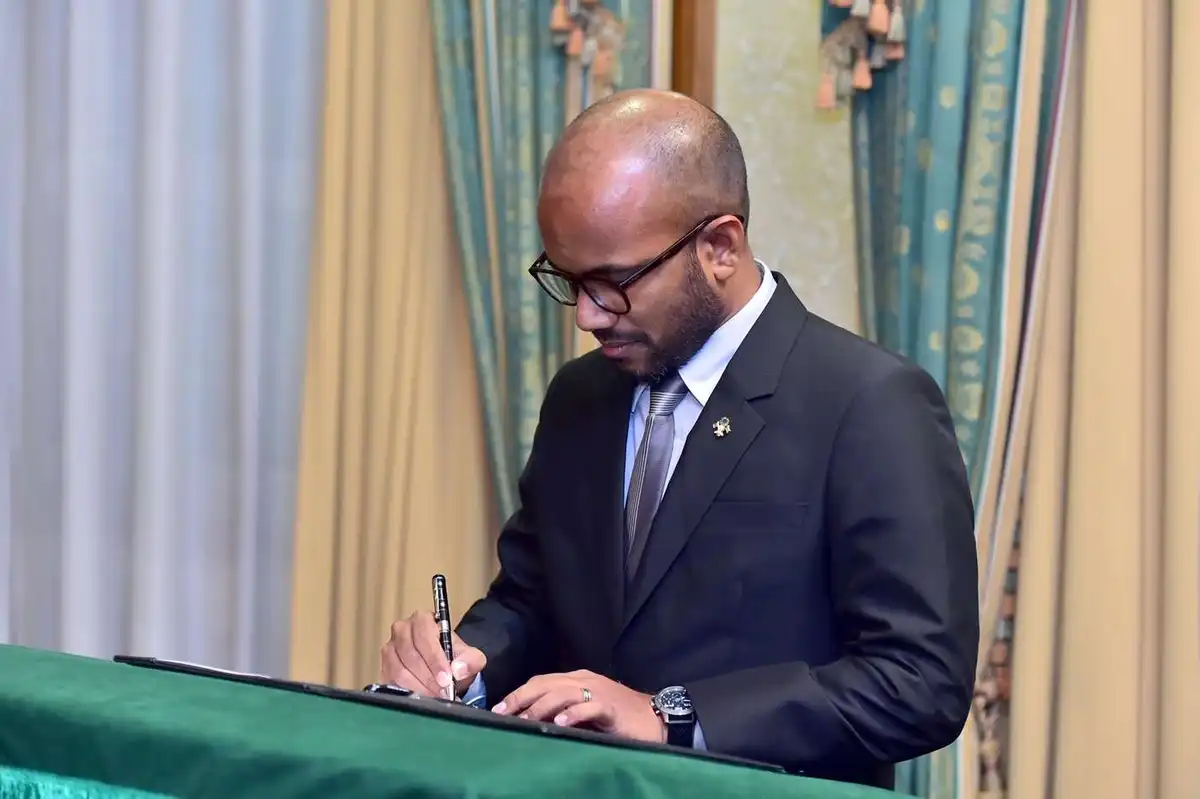
Former Minister of Finance Ibrahim Ameer during the ministerial swearing-in ceremony. | President's Office | President's Office
Former Finance Minister Ibrahim Ameer has called on the government to maintain transparency and provide the public with comprehensive details regarding its strategy for refinancing the sovereign sukuk.
Ameer emphasized that the public and investors must be fully informed of the financial framework, interest rates and repayment periods involved. He further noted that if the project is to be executed through a specific company, there must be full disclosure regarding all potential risks associated with such an arrangement.
He said that ensuring transparency in the refinancing of public debt is not an optional measure; it is an absolute necessity to maintain institutional trust.
In a post on social media platform X on Thursday, Ameer stated that according to recent reports, the government is in the final stages of securing a $300 million loan from Cargill at a 14 percent interest rate. This financing is intended to refinance a $500 million sukuk set to mature this coming April.
President Muizzu informed Parliament that new borrowings would not exceed a 9 percent interest rate and that the sukuk would be refinanced in a manner that reduces the debt burden and ensures fiscal stability. However, Ameer noted that due to the Maldives' downgraded credit rating, the country can currently only access debt on the international market at a rate of 14 percent. Consequently, Ameer stated that it is highly unlikely to secure this financing below 9 percent through conventional means.
Predicting how the situation might unfold, Ameer suggested that the government may opt not to borrow directly at the 14 percent interest rate. Instead, a state-owned enterprise—most likely the Bank of Maldives (BML)—could secure the loan from Cargill at 14 percent and subsequently on-lend the funds to the government at a lower rate, such as 9 percent.
Ameer stated that under this framework, the actual cost to the entire financial system remains at 14 percent, and that the lower rate is merely a superficial illusion. He warned that this poses a significant risk to the balance sheets of State-Owned Enterprises (SOEs) and banks. Furthermore, Ameer noted that the exposure of the banking system to sovereign debt would escalate to extreme levels, leading to an increase in the financial liabilities and debt burdens of these companies.
Ameer noted that this does not constitute debt relief, highlighting that instead of reducing the cost of debt, the overall burden has increased. Furthermore, he stated that the risks posed to the entire financial system have also intensified.
Ameer stated that if the original rate at which the funds were available was 14 percent, then that 14 percent must be accepted as the actual rate.
Ameer stated that executing this through a company does not alleviate the debt burden; instead, it merely transfers the risk to the balance sheet of an institution like the Bank of Maldives (BML). He noted that this raises serious questions regarding BML’s financial health, liquidity, and institutional independence. Furthermore, Ameer emphasized that a commercial bank should not have to bear the risks associated with refinancing sovereign debt.