Ultimate career illusion for Maldivian graduates
14 ޖުލައި 2026 | އަންގާރަ 14:58The Maldivian Education Minister’s recent advice on career guidance has been criticized as detached from a reality dominated by political patronage. Critics argue that academic specialization is devalued by a system where job security depends on party loyalty rather than merit, leaving graduates sidelined by political appointees.

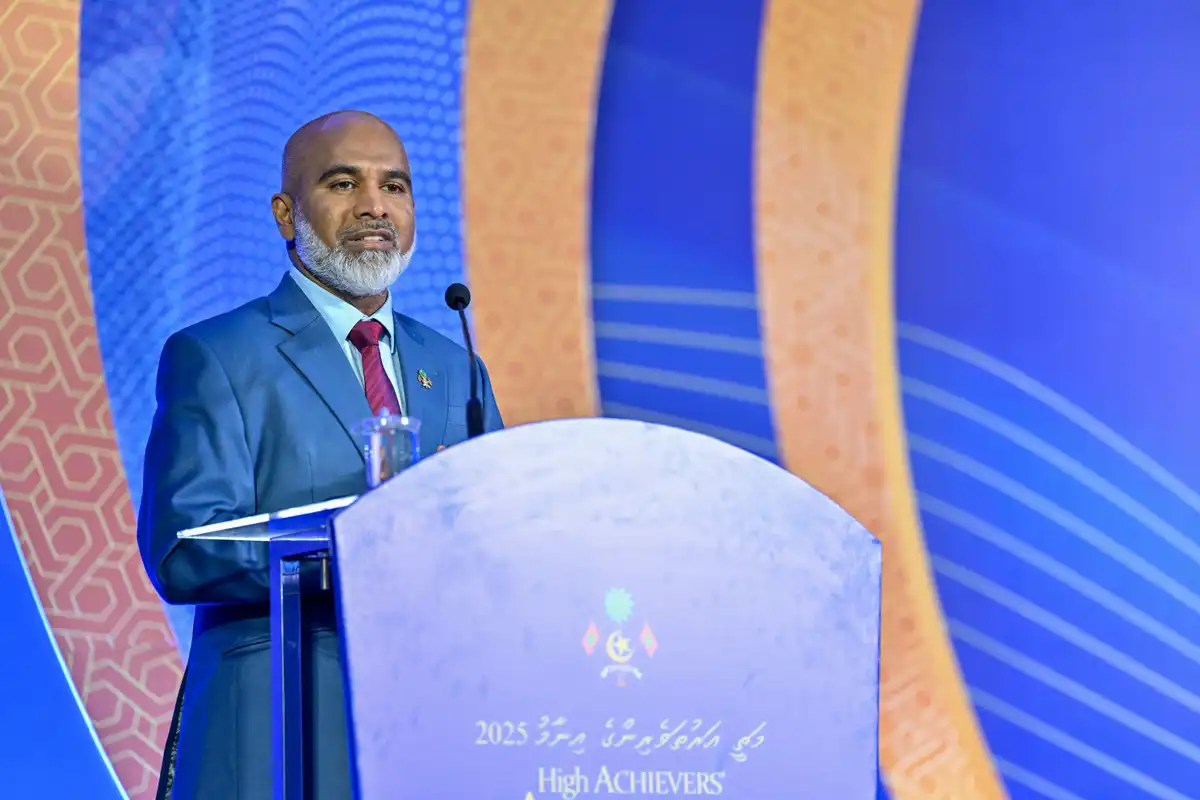
Minister of Education, Higher Education and Skills Development Dr. Ismail Shafeeu delivers his remarks at the Top Achievers' Award ceremony. | President's Office
Listening to the words spun by the Minister of Education, Higher Education and Skills Development, Dr. Ismail Shafeeu at the recent High Achievers’ Award Ceremony felt like watching a performance detached from reality.
Standing before a room full of bright minds, the Minister pushed the usual textbook narrative, telling the students they need to hunt down career guidance and scan the job market before diving headfirst into the workforce after graduation.
But instead of feeling inspired, his speech left a bitter taste and sparked a completely different, much darker train of thought about how the real world works here.
Political puppetry of employment
Let us talk about how people actually get hired or fired in this country, and look at the true, grim state of Maldivian employment practices.
What is the actual point of career guidance when landing a job typically requires a well-placed phone call to a lawmaker or an influential politician?
What good is professional guidance in a system where job security does not even exist, and the entire workforce gets reshuffled every single time a new administration takes over every five years?
A waste of higher education
Minister Shafeeu also made it a point to highlight the need for students to gather degrees across different fields, pushing them to branch out academically.
But one has to wonder what they are actually diversifying for. When State-Owned Enterprises (SOEs) such as Fenaka, STELCO, HDC, and RDC are blatantly used as parking lots for political favorites and rewards for party loyalty, specialized education loses all its worth.
A staggering number of Maldivian graduates are left walking the streets aimlessly today, completely blocked from finding jobs in the exact industries they spent years mastering at the highest academic levels.
Disgraceful math of government priorities
The Minister went on to point out that a meager fourteen percent or so of students are entering education and healthcare, which happen to be the two absolute pillars of national development, and he openly worried about these low numbers.
To that, the only fitting response to the Minister is that he should be incredibly thankful that even fourteen percent are still willing to choose those paths at all.
The paycheck of a political appointee, whose main responsibility is frequently just singing the praises of the current administration, completely eclipses the wages given to hard-working professionals in schools and clinics. While certain individuals pocket upwards of MVR 50,000 monthly for doing absolutely no real work, the people grinding day and night in classrooms and hospital wards are left pulling in a measly MVR 20,000.
Family ties and professional executioners
In the current Maldivian landscape, career guidance is nothing more than a pointless exercise.
The reality is a society where a person is handed a job or thrown out of one solely based on their political views. Anyone faces the very real threat of being fired simply because their mother, father, or another relative happens to align with an opposition party.
Even if a worker stays entirely out of politics themselves, the simple political preferences of their family members hang over their professional survival like a permanent guillotine.
The podium of pure irony
It is deeply ironic for the Education Minister of a nation run this way to stand at a podium and deliver that kind of lecture.
Rather than preaching to youth about career advice, labor markets, and academic variety, it would be much more valuable if politicians like the minister started showing some actual sincerity and moral character.
Instead of serving up empty, scripted rhetoric, they ought to try focusing on delivering genuine honesty to the citizens they are supposed to serve.