Political interests and influence will take precedence over public interest due to fear of losing seats under new constitutional amendment: Shujune
30 އެޕްރީލު 2026 | ބުރާސްފަތި 07:57While the Supreme Court ruled by a majority that the constitutional amendment mandating the forfeiture of parliamentary seats is valid, Justice Aisha Shujune Muhammad issued a dissenting opinion. Justice Shujune argued that the amendment undermines the sovereignty of the people and increases the likelihood of members succumbing to political influence rather than advocating for the rights of their constituents.

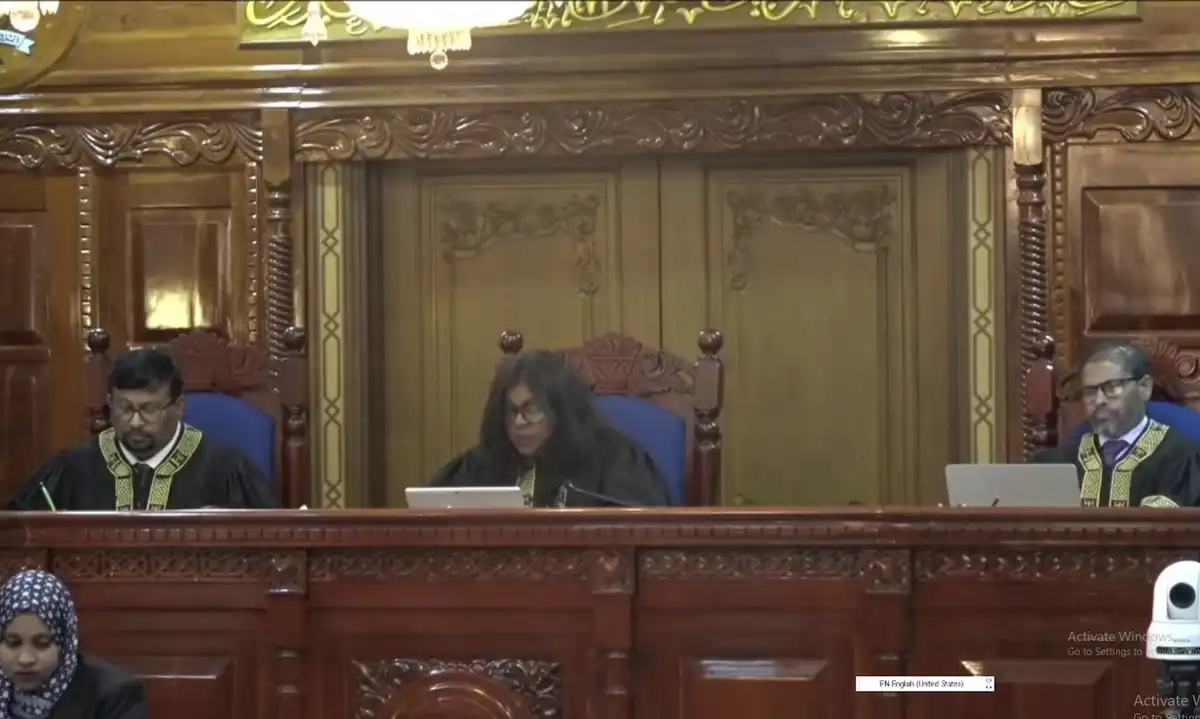
A hearing in progress at the Supreme Court. | Raajje MV
Supreme Court Justice Aisha Shujune Muhammad has stated that the constitutional amendment defining the circumstances under which Members of Parliament lose their seats will compel lawmakers to prioritize political interests and influence over their duty to advocate for the public.
In a ruling issued on Wednesday, the Supreme Court's majority opinion held that the constitutional amendment regarding the loss of parliamentary seats cannot be declared void. The court further clarified that this amendment remains applicable to the 20th People's Majlis.
Regarding the verdict in this case, Justice Shujune was the sole dissenting voice.
Shujune stated that she believes this amendment compromises the principles of state sovereignty and the continuity of power as stipulated in Article 4 of the Constitution. She explained that the amendment allows a third party to intervene and terminate the relationship between the people and their elected representatives through mechanisms outside the legal and constitutional framework.
Furthermore, Shujune noted that this amendment obstructs the individual autonomy of members regarding their right to join or resign from political parties.
Shujune further noted that this amendment paves the way for prioritizing political interests over the welfare of the nation and its citizens, as representatives may now act primarily out of fear of losing their seats.
The loss of the opportunity to work in the best interests and welfare of the Maldivian people, coupled with the fear of losing one's parliamentary seat, discourages members from speaking out on behalf of their constituents. This increases the likelihood of prioritizing political interests and influence over national interests and the well-being of the public.Supreme Court Justice Aisha Shujune Muhammad
The state contends that the specific law governing the removal of a Member of Parliament from their political party—one of the conditions under which a member would lose their seat—does not currently exist. However, Justice Shujune stated that she could not support the state's argument. She further clarified that the provision in question refers to the Political Parties Act.
Justice Shujune stated that even if an amendment is passed by Parliament in accordance with established procedures, she believes the Supreme Court has the authority to intervene if that amendment contradicts the fundamental principles of the Constitution. She further noted that such oversight is permissible under the constitutional principle of checks and balances.
Regarding the scope of rights and freedoms, my assessment of the recent constitutional amendment reveals that certain rights enshrined in Chapter Two of the Constitution have been altered through a process that bypassed the mandatory procedures stipulated in Article 262(b). Even when considering the procedural aspect alone, I do not believe this amendment was enacted in accordance with the framework prescribed by the Constitution.Supreme Court Justice Aisha Shujune Muhammad
Shujune stated that this amendment would impact the rights enshrined in the chapter on fundamental rights and freedoms, as well as international treaties to which the Maldives is a signatory, such as the ICCPR, albeit in a restrictive manner. She further highlighted that certain provisions, such as Article 27 of the Constitution, represent rights that cannot be restricted even during a state of emergency.
Shujune believes that Article 73 (e) of the Constitution must be declared null and void.