Courts are only remaining venue to challenge issues within referendum resolution; rather than engaging in political obstruction, hope is for case to be registered promptly and for hearings to commence: Mauroof
13 މާރިޗު 2026 | ހުކުރު 15:04The main opposition Maldivian Democratic Party (MDP) has stated that the Civil Court has rejected their lawsuit challenging the legal validity of the President's decree to synchronize presidential and parliamentary elections on three separate occasions. MDP’s Legal Director Ahmed Mauroof confirmed that the party has now refiled the case after addressing the court's previous procedural concerns, seeking both an annulment of the decree and a temporary injunction to halt its implementation.


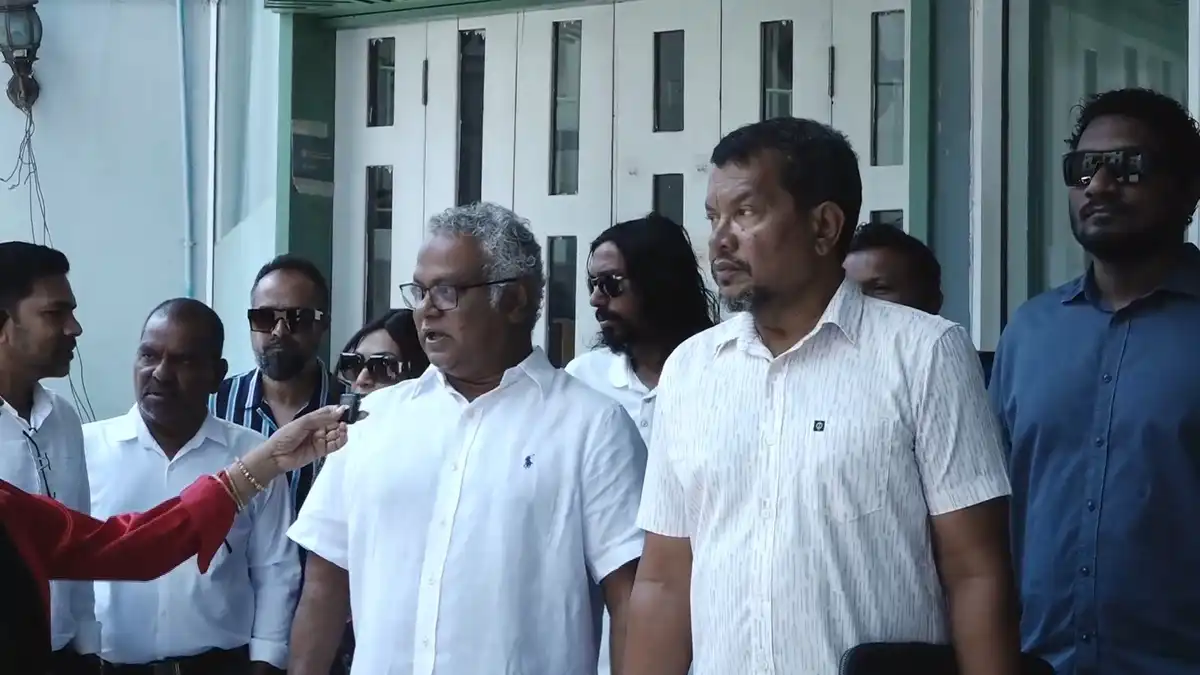
The MDP press conference held on Friday regarding the referendum vote. | RaajjeMV | RaajjeMV
Ahmed Mauroof, the Legal Director of the MDP, has stated that despite the courts being the sole venue to challenge President Dr. Mohamed Muizzu’s decree on the referendum to synchronize presidential and parliamentary elections—due to its failure to meet constitutional and legal requirements—the judiciary has repeatedly obstructed the process, rejecting the case three times by raising successive procedural hurdles.
Speaking at an MDP press conference on Friday regarding the upcoming referendum, Mauroof stated that the party has filed a lawsuit in the Civil Court challenging President Muizzu’s decree on synchronizing presidential and parliamentary elections. He noted that the legal action was taken because the decree fails to meet the requirements stipulated in the Constitution and existing laws.
Mauroof stated that the court is the only venue where such grievances can be addressed. He explained that this type of lawsuit seeks a judicial review of actions or decisions taken by the executive branch. Consequently, Mauroof noted that the MDP first filed the case in Civil Court on February 25.
The court recently notified us to rectify certain issues in the form we submitted. We made those corrections and resubmitted the form the same day; however, on March 1, we were instructed once again to make further amendments. Among the initial requirements was the submission of official party documentation, as this is a case filed by the MDP. This included a copy of the MDP’s registration and the resolution designating the individual authorized to sign on behalf of the party for court filings. Although we had already provided these official documents, the court requested clearer copies. Following this instruction, we submitted legible copies of the aforementioned documents that same day. These are the exact same documents and files we have used in recent cases filed by the party, as well as cases where the party was the defendant, in the High Court, Supreme Court, and Civil Court.Ahmed Mauroof, Legal Director of the MDP
Mauroof stated that after resubmitting the documents following the initial revisions, the court issued further instructions for amendments on the 5th of this month. According to Mauroof, the court requested the submission of a witness statement to substantiate the events surrounding the case.
Our entire case is built on the argument that the decree issued by the President fails to meet the legal requirements and conditions stipulated by law. Specifically, the decree does not outline the detailed arguments in favor of the issue being proposed for a public referendum. In our submission to the court, we are asserting that a specific legal requirement was not met. Therefore, the burden of proof does not lie with the claimant to demonstrate that an action failed to occur.Ahmed Mauroof, Legal Director of the MDP
Mauroof stated that based on legal precedents regarding challenges to the validity of such decrees, as well as existing laws, the burden of proof lies with the respondent. He clarified that the respondent in this case is the State, and it is their responsibility to prove that the decree meets all legal requirements in response to the lawsuit filed by the MDP. However, Mauroof noted that the Civil Court’s actions in this instance have completely deviated from the established procedures followed in previous cases.
Mauroof noted that the process would have been significantly more efficient if the Civil Court had identified all necessary amendments at once, rather than issuing them piecemeal. He highlighted that the court has rejected the party's submission three times in this manner.
Mauroof stated that the party has consistently resubmitted the forms after rectifying the highlighted issues. In line with this, he confirmed that a revised application was submitted last Wednesday, fully addressing all previous concerns and complying with the specific requirements set out by the court.
Mauroof stated that the party's primary objective is to have the case registered and proceedings commenced as soon as possible. He further noted that, in addition to seeking a ruling to annul the resolution, the lawsuit includes a request for an interim injunction.