
New amendment clears path to lease islands, land, and lagoons for resort development, to SOEs
6 ޑިސެމްބަރު 2025 | ހޮނިހިރު 12:26The amendments establish that state-owned companies with at least 45 percent government shareholding can lease islands and lagoons for resort development with Cabinet approval

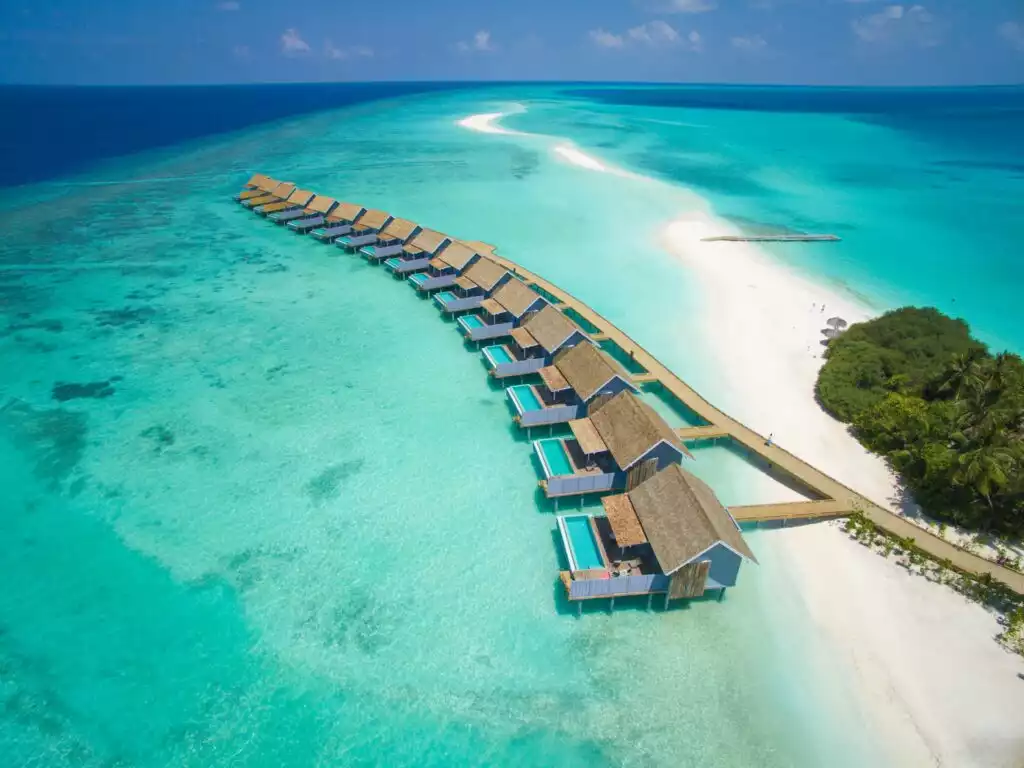
A resort island in the Maldives
President Dr. Mohamed Muizzu has ratified amendments to the Tourism Act that allow state-owned enterprises to lease islands, land, or lagoons for the development of tourist resorts or integrated tourist resorts, widening state-backed corporate access to some of the country’s most valuable natural assets.
According to the government, the bill was submitted to establish a system through which state-owned companies can obtain leases for developing tourist resorts and tourism training resorts.
It also seeks to define the principles under which such properties may be leased and operated, though the scope of these provisions raises clear questions about expanded state involvement in resort development.
The government further stated that the amendments aim to formally incorporate into law the regulations governing extensions to development periods for leased resort properties, as well as the guidelines for determining lagoon areas designated for tourism purposes. These additions consolidate existing discretionary practices under a legal framework that now explicitly accommodates them.
The bill states that any island, land, or lagoon may be leased to a state-owned company for the development of a tourist resort or integrated tourism resort, provided the Cabinet grants approval. It requires that any company receiving such a lease demonstrate both financial and technical capability to carry out resort development, a condition that appears intended to legitimize the allocation process while still concentrating access within state-dominated entities.
Under the amendments, an island, piece of land, or lagoon can only be leased to a state-owned company through an agreement with the government and in accordance with the provisions outlined in the bill.
The company assuming the lease must pay the acquisition fee to the government, formalizing the financial terms of the transfer. The ministry may also impose conditions requiring contributions to the Tourism Trust Fund as part of the company’s Corporate Social Responsibility obligations, or mandate funding for a development project designated by the ministry.
The legislation restricts eligibility for such leases to companies in which the government holds a minimum of 45 percent share, further entrenching state control over access to land and lagoon resources for resort development.
The bill also introduces regulations concerning tour operators and foreign tour operators. It mandates that only entities holding a Tour Operator License may provide services related to planning and operating tourism-related travel within the Maldives.
Foreign tour operators registered outside the Maldives must obtain a Foreign Tour Operator License to conduct their activities.
The ministry is granted discretion to defer rental payments owed during the redevelopment period of a tourist resort or land, along with any outstanding rent and fines accumulated up to the date of closure, according to regulatory provisions. This mechanism allows substantial financial leniency at the ministry’s judgment.
The amendments further impose penalties on parties providing any tourist service requiring a license without first obtaining the required license. Violators may be fined up to MVR 1,000,000, with the amount determined by the type of service provided and the duration of the unlicensed activity.
With the president’s ratification and publication of the bill in the Government Gazette, the amended law has now come into effect.