“Belgian company reclaiming Ras Malé with utter disregard for environmental protection”
2 ޑިސެމްބަރު 2025 | އަންގާރަ 12:35Muizzu administration has significantly weakened environmental regulations by eliminating key EIA requirements including stakeholder consultations and coral relocation measures

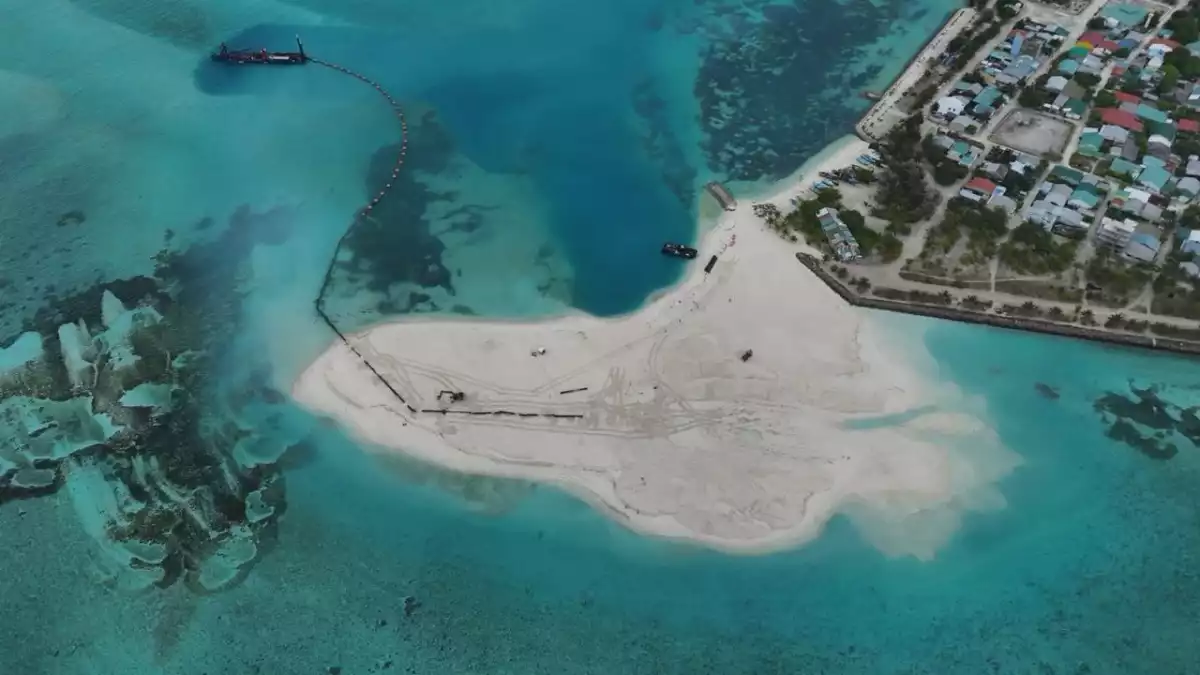
One of the two world's largest Trailer Suction Hopper Dredgers "Cristóbal Colón" of Jan De Nul started reclamation works at Ras Male on 1 December 2025.
An environmental expert has stated that the Belgian company ‘Jan De Nul’ is carrying out land reclamation at Ras Malé with no consideration whatsoever for environmental protection.
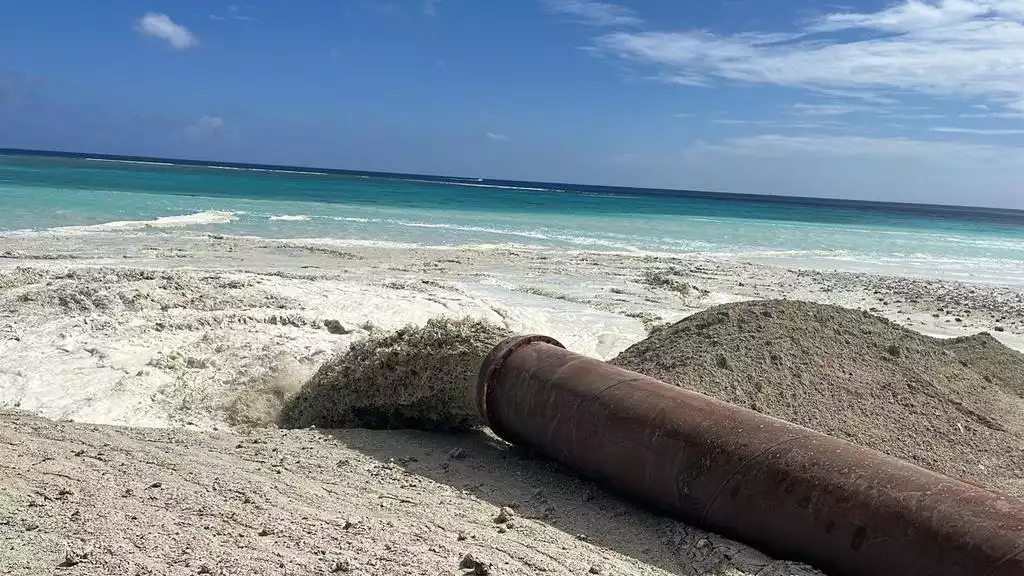
Speaking on the condition of anonymity, the expert revealed that during the dredging operations in the Ras Malé area, where the company’s large dredger deposits sand, no measures have been taken to control the dispersion of silt onto the reef. He noted that the company is proceeding as it wishes, with absolutely no environmental safeguards in place.
He further explained that the inevitable outcome of this approach will be irreparable and extensive damage to the surrounding reefs and their ecosystems.
The incumbent administration of President Dr. Mohamed Muizzu has significantly relaxed the stringent regulations previously observed for preparing Environmental Impact Assessment (EIA) reports and has abolished the robust evaluation criteria formerly used for these reports.
Despite the Constitution mandating environmental protection as a state obligation, the incumbent administration is widely regarded as the least environmentally conscious government in recent Maldivian history.
It is noteworthy that in the past, environmentally impactful projects such as land reclamation were undertaken in the Maldives with numerous measures implemented to mitigate potential damage.
According to the environmental expert, with the changes introduced by the Muizzu administration to the regulations governing EIA reports, the process has been reduced to a report in name only.
He highlighted that the preparation of these reports previously adhered to internationally accepted standards, but several critical stages in the report preparation process are no longer mandatory.
Previously, the Terms of Reference for a report would only be prepared after a scoping meeting involving all relevant stakeholders; now, that stage has been eliminated entirely, with authorities simply agreeing to whatever the report preparer submits.
The requirement for consultation with relevant stakeholders during report preparation has also been abolished. He added that while the then-Environmental Protection Agency (EPA) previously mandated the relocation of live corals to protected areas before commencing reclamation in lagoons and reefs, such measures are now bypassed and sand dumping begins without any such activity. He expressed concern that no coral rescue efforts were undertaken when the Ras Malé reclamation began, nor are any being conducted now.
Even if coral protection is included in the Environmental Mitigation Report, he pointed out that it is no longer monitored or acted upon.
He also emphasized that in the past, no reclamation work was undertaken without installing bund walls, whereas the Muizzu administration is currently carrying out land reclamation in various parts of the Maldives, including Ras Malé, without such measures.
Taking to social media platform ‘X’ on December 1, Muizzu announced that ‘Jan De Nul’ had brought its largest dredger to the Maldives, tripling the pace of Ras Malé reclamation. While he described Ras Malé as the largest project undertaken in the Maldives for climate change adaptation, environmental experts believe the project will be recorded as an irresponsible venture, highly damaging to the environment and carried out with complete disregard for environmental protection. In his post, Muizzu stated that the dredger ‘Cristóbal Colón’, one of the world’s two largest trailing suction hopper dredgers, was mobilized to Ras Malé on November 30, and the first load of sand was deposited on December 1. He described this as a historic event, but a photo attached to his post clearly shows that no measures have been taken to control silt dispersion.
Environmental experts are concerned that despite the project potentially generating millions of U.S. Dollars in profit for the Belgian company, no funds have been allocated for environmental protection. They noted that such measures were absent even when the project first began.
Despite approximately 100 hectares of land being reclaimed under this project, not even an environmental monitoring report has been made public.
The expert stated that the company would not be allowed to operate in Europe without implementing silt control measures and is taking advantage of the government’s weakened regulations to minimize costs and maximize profits.
He highlighted that while such projects typically require the regular submission of monitoring reports to track progress, this government pays no attention to any of these requirements.
He further stated that if it is a government project, no matters need to be scrutinized and officials are now powerless to address any complaints lodged.
Information indicates that when the large dredger began operations, approximately 100 hectares, or 10 percent of the designated reclamation area for Ras Malé, had already been reclaimed. The reclamation work for Hulhumalé Phase III also commenced last week with the arrival of a large dredger, and Muizzu has stated that this work will be completed by the end of December.
The government has not disclosed how these companies were selected for the projects or the amount of taxpayer money being spent on them.